Showing posts with label saatchi. Show all posts

01 April 2015

The Saatchi Gallery again surprised and delighted me


A bit of fortune at work gave me some free time at the end of the afternoon and as I was heading to Battersea for theatre in the evening I was looking for somewhere to spend some time along the way. It did not take long to think of the Saatchi Gallery in South Kensington as I had been there a few times and had always enjoyed it.

The gallery is a short hop from South Kensington tube station but I was on something of a walk fad at the time (and still am as I write this) so I chose to catch the Victoria Line down from Kings Cross to Victoria and to walk the rest.


The Saatchi Gallery impresses me most with its scale, there are a few very large rooms and these mostly have large objects of art in, the sort of works that would not fit into any sort of normal house.

There is also usually the element of shock (a good thing with art) and this time was no different with Gallery 1 filled with bright blue plastic bags.


The title of the main exhibition was "Pangaea II: New Art From Africa and Latin America" which, not surprisingly, was a follow-up to Pangaea that I had seen last year. As then, the only connection between the works was the nationality of the artists. This meant that every room was very different. I prefer it that way as there is more of a surprise on entering each room and more variety means more stimulation.


I was pleasantly surprised to see the large ants back from the first incarnation of Pangaea though this time they had been relegated from Gallery 1 (possibly the largest room) to definitely the smallest on an upper floor.


Pangaea II filled most of the gallery but there were a couple of other little exhibitions on too. One took a different national theme, "Soviet Union: New Art from Russia". I've said nice things about Russian art several times before and this is an opportunity to do so again.

My self-imposed rules for this blog means that I have only allowed myself one picture of the many exhibits and I've chosen this one of the several copies of the famous Worker and Kolkhoz Woman monument from 1937. Whatever you think about the ideology there is no denying the power of the piece.


Another exhibition was of photographic collages that mixed pictures of everyday objects with science fiction elements. Both sets of images had a very fifties feel to them which added a touch of nostalgia to the strangeness.

I was only in the Saatchi Gallery for just over half an hour, because I had a theatre date, and it was a very rich and fulfilling half an hour. Good art has the ability to do that and the Saatchi Gallery is home to good art.

29 May 2014

Lifting my spirits at the Saatchi Gallery

It had not been a good day in the office but at least it finished early which meant that I could go somewhere to cheer myself up. And it did not take long to think of the Saatchi Gallery.

This was conveniently situated almost on Sloane Square station which I had to pass though any way so it was a very minor detour to pop-in there.


The mood was set in the first gallery which was full of giant ants. You can get some idea of the scale when you realise that the walls that they are climbing on are tall, as you would expect in a gallery. Each ant was about 1m long.

I immediately thought of the Blondie song Attack Of The Giant Ants from their excellent eponymous first album and I was feeling better already.


The Saatchi has huge light galleries which are ideal for showing off large colourful eye-catching pieces. That is exactly what they usually have in there and is exactly what I was hoping to see.

Of course small pieces of art can be very good too, for example I love the book illustrations by William Blake in Tate Britain, but there is something special about putting a large bright picture on a very large white wall. The simple act of walking in to the room can be breathtaking.


The exhibitions that I saw were called Pangaea: New Art From Africa and Latin America, and Abstract America Today, which means nothing other that the artists shared a geography and a time.

I was quite happy with that and was not trying to find any sort of unifying theme across the works. I just wanted them to surprise and delight me. Which they did.


It was not all about colour and I am quite a fan of greys and blacks too.

The "milk" piece at the far end was striking from a distance and from close-up and I settled for just the long range view to show it in context and also to give a better idea of the scale of it.

It was one of many works that I would gladly have had in my house if only I a spare room like that to put it in.


One of the galleries at Saatchi is double-height and that usually has something even larger that the other pieces in it. This time the walls were draped with what looked like used bags stitched together.

Again this piece worked at a distance because of its visual impact and also close-up because of its texture.


I really liked these pieces and I also wanted to show how they were presented. There was a lot of space around the works, even when they were by the same artist, and that made it easier to appreciate each one. It was almost as if each piece was alone in the gallery.


Another blast of colour simply because I liked it.


One small room, on the top floor I think, was quite different. It had a display of "normal sized" paintings by Richard Maurovic. I liked their industrial subjects, simple yet striking colouring and the way that the pictures wrapped around the edges of the canvas.

There are under twenty gallery rooms at Saatchi and most of these had just a few sparsely hung pieces. I was in something of a rush, I was on my way home after all, so went round with decent haste. Even then it took me almost an hour to get around.

I went to Saatchi on the spur of the moment for a quick lift and it did that and more. Good modern art galleries are some of my very favourite places and Saatchi is definitely one of those.

22 November 2013

Body Language and British Art Today at the Saatchi Gallery

Now that I am not working away from home for most of the week I am finding time to make quick trips to galleries. This time I was on my way to see West Side Story in Wimbledon and rather than take the easy route (train from Kingston to Wimbledon) I opted to take the tube from Richmond to Sloan Square and from there to Wimbledon, taking a couple of hours out in the middle to visit the Saatchi Gallery.

The Saatchi Gallery is relentlessly modern and that means that every work instils a reaction, asks questions and demands an opinion. It is never bland.

There were two exhibitions on. The first, Body Language, had works that featured people, a simple enough concept that allowed for a wide diversity of themes and methods.


I went to Gallery 3 first (an error I quickly corrected) as this was behind the reception desk and this picture, The Feast by Eddie Martinez, insisted that I go and see it. The picture filled the far wall in a visually striking way.

There was much more to it than the sheer scale and I stood back from it to admire the composition and the unusual line of heads then went up close to look at the things on the table.


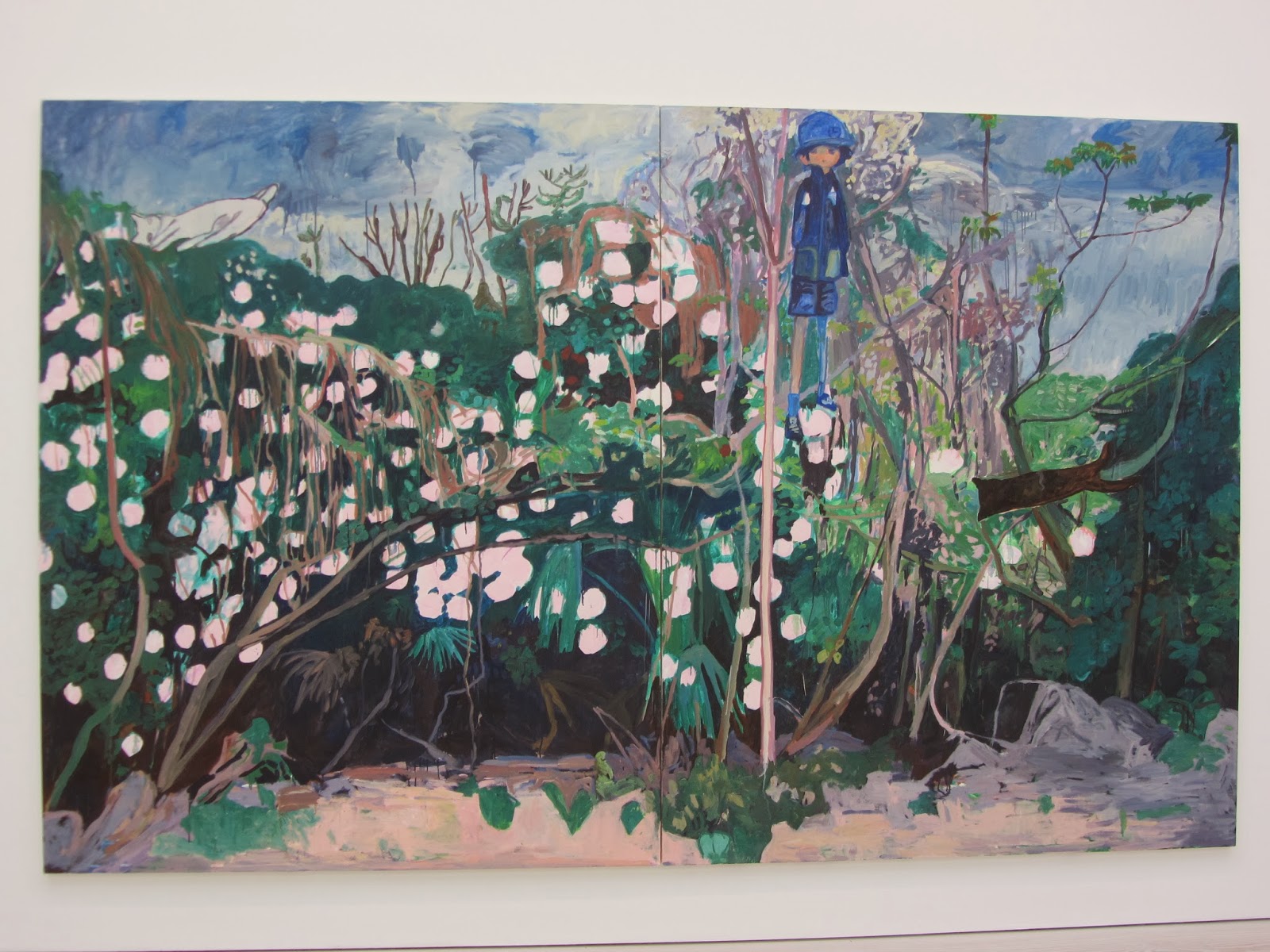
Back on track in Gallery 2 I was impressed by several works by Makiko Kudo. They all had brash natural scenes and in them a person who looked a little out of place.

These pictures captured the mood of childhood brilliantly. I am that boy, proud to have climbed the tree.

If I could have sneaked out of the Saatchi with one painting under my coat it would have been this one. I would have needed a rather large coat though.


The graveyard room was one of the more unusual. The headstones scattered around the gallery (by Marianne Vitale) were all made from reclaimed wood while the pictures on the walls (by Denis Tarasov) were of tombstones decorated with (I presume) pictures of their inhabitants.

I was not sure whether putting a large picture of yourself on your tomb was some cultural idiom that I had missed or whether the artist had photoshopped them on afterwards. And I did not want to know, they were weird and interesting and so deserved to be true.


This is just a small selection of the many portraits by Chantal Joffe. The use of simple compositions and bright colours gave them a vibrancy and warmth.

The other exhibition that was on was New Order: British Art Today. This wider scope made for a more diverse collection of works.


Just to show that I do not "get" all modern art, this is a set of constructions by Sara Barker which did nothing for me at all.


Amanda Doran's Tattooed Lady was a jolly sight and while I would probably not want it on my living room wall I was very happy to spend a few minutes looking at it in the gallery.


I loved the blackboards by Alejandro Guijarro.

These were full-sized photographs from various universities that specialised in Quantum Mechanics and the boards had names like Cambridge and Berkeley.

I cannot vouch for the maths but it looked pretty real to me.

I also liked the way that one of them, Oxford, had been wiped clean leaving just a patina of chalk dust evenly spread across the board. Memories of school.

The Saatchi Gallery has lots of space and knows how to use it. The blackboards were generously spaced to allow them to be seen individually rather than as one large piece.

The perspex form on the red box in the corner was by Natasha Peel and was something else that I did not understand. I had more luck with Nicolas Deshayes' Soho Fats, the sheets of white polystyrene on the left edge of the photo. The sheets were weathered in some way to make interesting patterns that were reminiscent of sand dunes.


Steven Allan's We're All In This Together was a real highlight of the show for me.

The subject matter, dancing bananas, was imaginative and the use of just two bold colours gave it impact.

The shot of the gallery (with the picture on the left) shows both the size of the picture and how well the gallery was laid out.

And it needs a gallery like this to show off most of the works that I liked. They were either large or very large and needed the space to be seen individually and to step back from them far enough to appreciate their form. While I might have fancied the idea of having some of the works at home there are few people who have homes big enough for works like these.

What started off as a speculative visit to the Saatchi Gallery to add excitement to a tube ride became a very enjoyable immersion in to modern art. There were a few works that I did not like but even these did not offend and the vast majority of pieces I could either appreciate or love.

Who said Modern Art is rubbish?

09 April 2012

New Art from Germany at the Saatchi Gallery

I was going in to Town for some theatre in the evening and thought I'd make a day of it by visiting the Saatchi Gallery first.

This was my first visit there (my bad) and so it was the gallery that I was interested in seeing rather than any specific exhibition that was on at the time.

The gallery is within spitting distance of Sloan Square in a large old building that has had its innards ripped out and replaced with a few large rooms uniformly decorated with white walls and bleached wooded floors - exactly how you expect a modern gallery to be.

It's a private gallery but it is still free, which makes it even easier to give modern art a try.

The New Art from Germany (Gesamtkunstwerk) occupies the whole gallery which consists of 14 galleries spread over 3 floors in a 5-5-4 formation.

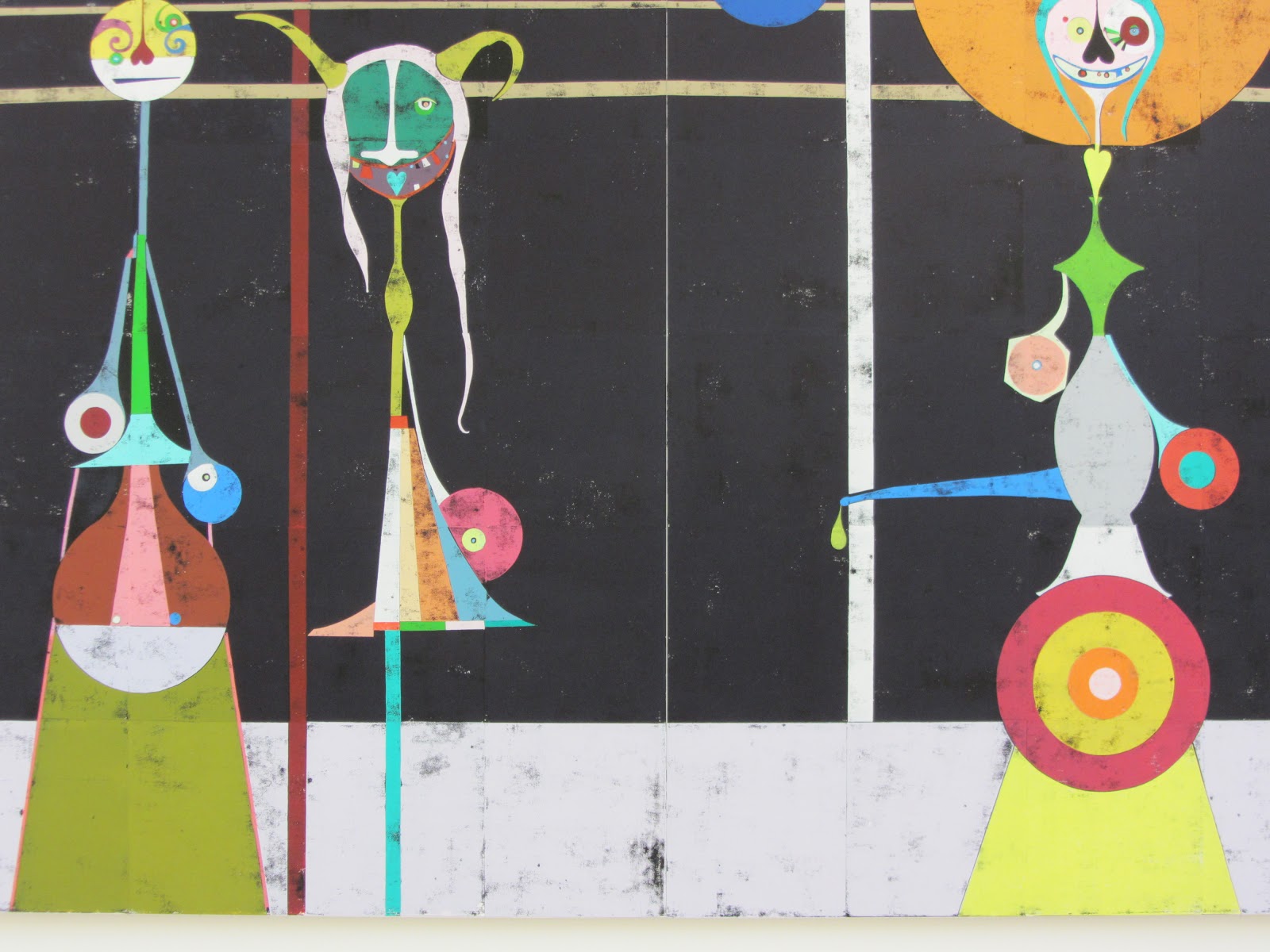
Gallery 1 opens the show with works by Markus Selg and makes an immediate impression.


This picture is called Traum der Sarazenin (Dream of the Saracen) yet it is the echoes of Britannia that made me dwell on this for so long. And at over 2m x 3m it fills one wall.

Each of the galleries is different and each door crossed brings new surprises.

A wide range of materials are used even for the traditional pictures.

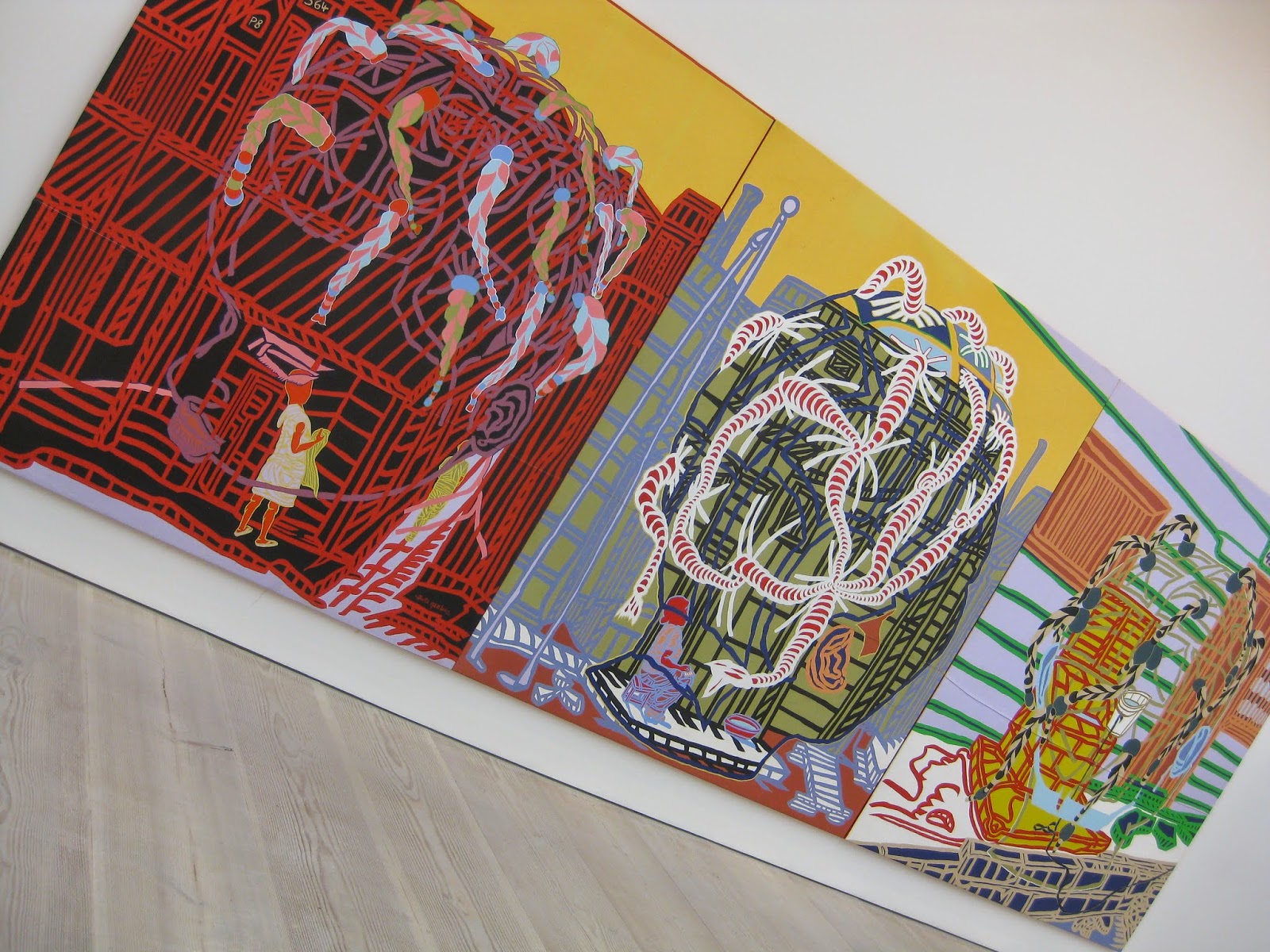
This is a small section of a works by Gert and Uwe Tobias that is woodcut on paper on canvas.

The full picture is 2m by 12m and is rather jolly.

The size and method of construction mean that you need to stand some distance back to see everything and then to get up close to appreciate the parts that make the whole.

The same is true of the next picture.


From a distance you see the larger image of the trees and the river and when you get up close you see all the little elements that make this a series of pictures on a common background.

It is such a busy picture that you can look at for ages spotting new things all of the time.

The colours grabbed me at first with this painting and I could appreciate it as a piece of abstract art before noticing some of the detail hidden in it.

It is probably about something else but it evokes in me a couple having a quiet drink in a bright and busy city, say Tokyo.

The colours and noise of the city are outside but where they sit is calm.

Another picture that evokes quiet is this one of an urban garden.

Here there is no movement and only a few red flowers break the gentle greens and yellows.


Again approaching the picture is rewarding as there is a lot more detail than an initial look suggests. Up close you can see, for example, more flowers with each leaf and petal picked-out.

There is a lot more to the exhibition than pictures, and here is just one example to prove the point.

I chose this one simply because it is colourful and fun, like so much in the exhibition.

The motley assortment of desk lamps is drawing attention to the cartoon in the centre that shows a couple on a desert island hiding from a passing boat.

Elsewhere there was some odder things, like the installation chosen for the exhibition poster above, a large vibrating mirror and cloth stuck in expanded polystyrene.

While these installations used more exotic materials and could, therefore, be considered less mainstream they were equally interesting.

One of the more useful things I did while there was to sign off for their mailing list so that I keep informed about their exhibitions and events. I'll be going to the Saatchi again.

14 February 2011

SFX Weekender: Beyond the US - The wider world of comics

The final session I saw at SFX Weekender looked beyond superhero comics at how the medium can be much more than that and took examples from beyond the UK and USA to show that.

Bryan Talbot was on the panel again (no problem with that) where we was joined by Pat Mills (not pictured) and two others who's names I did not catch as I had rushed upstairs to but Heart of Empire for Bryan to sign (which he did!).

All of the panellists told stories of how comics flourish in other countries which was both encouraging as it showed that the is some really good stuff out there but also dispiriting in that it can be hard to find even if you start looking for it in a comic shop.

Indeed comic shops came in for a fair deal of criticism for sticking unintelligently to the USA format and not learning about and promoting other material.

There are some exceptions and nice things were said about Page 45 in Nottingham, OK Comics in Leeds and Gosh in London.

We were also given some tips on where to start our own comics adventures and I'll be trying out Persepolis, Blacksad, Maus, Phonogram, Laika and Mouse Guard before too long.

Interestingly most of these are anthropomorphic (ok, so Laika was a real dog) but it was not just Bryan that was recommending them.

Another interesting panel discussion and this time one with real value as were given tantalising glimpses of the rich world of comics and shown the first steps to take to get there.

13 February 2011

SFX Weekender: Tie-in and shared universe fiction

The session on tie-in and shared universe fiction might not have been the sort of thing that I went to SFX Weekended for but it sounded interesting enough and it meant that I could keep my hard-won front-row seat for this and the following session too.

There were a couple of names I knew on the panel; I've read several of Dan Abnett's stories in 2000AD and in various Marvel Comics (e.g. Guardians of the Galaxy) and I'd seen Ben Arronovitch on the Dr Who panel earlier that day.

There were a few times that day when panellists were repeated, but that's a good thing when the panellists contribute knowledgeably and appropriately. There was no repeating of favourite stories here.

The conversation flowed immediately and we were treated to many insights in to the life of a writer working within the boundaries set by other people.

And perhaps the most interesting aspect of this was the way that a pre-defined world and characters takes some of the hard work away from authors, leaving space to play with the story.

The differences between canonical stories and spin-offs filled a large part of the session. During this Stephen Baxter produced an old Stingray book that I recognised as I have a copy in the attic!

We also learnt that Dan Abnett had been commissioned to write a Primeval story that the producers wanted to tell but which would have been too expensive to do on TV.

There are various reasons why copyright owners want to extend their franchise in to print media ranging from the obvious one of making more money from the brand to finding a way to keep fans engaged when the main product is not available.

The obvious example here is Dr Who that was kept going for several years in books and audio. Similarly the Warhammer books let game players in to the world of space Marines and Tyranids from places other than Games Workshop.

From the author's perspective there is the need to play within the rules and that's a question of getting the tone right (would the character behave like that?) as well as the continuity. And the continuity problem is getting bigger all the time as the back-catalogue grows. Imagine how much a new Dr Who or X-Men writer has to read and watch.

Ben Aaronvitch also made the interesting point that writing within a shared universe means a writer has other people they can talk to about their story, e.g. to discuss exactly how a character would behave in a given situation.

So what I initially treated as a fill-in session proved to be much more than that and I learnt a lot and gained even more respect for authors.

11 February 2011

SFX Weekender: Bryan Talbot on the anthropomorphic tradition

Having got a back seat for the previous session I was well placed to leap for a front-row seat when the sessions changed and Bryan Talbot returned for his solo set.

This was the third time in little over a year that I seen Bryan give his talk on "Grandville and the Anthropomorphic Tradition" and it still informs and entertains.

The story does change a little each time, when I asked Bryan about the presentation beforehand he said that this version had more pictures of funny animals, and so it did.

It also had all the old pictures too which gives me the excuse to pick the Kamandi one this time.

As always, Bryan spoke quickly, clearly, intelligently, knowledgeably, charmingly and enthrallingly on a subject he is clearly very interested in. There is so much content in the talk that it easily bears a second and a third listening.

I got the impression that SFX saw this session as something of a filler, something ready on the shelf that they could reuse, but that mattered not to me as I was just delighted to be able to see the talk again and from the front-row too.

The only disappointment at that time was that I was unable to get Bryan to sign Heart of Empire due to my complete failure to buy a copy. That story has a happy ending later.

09 February 2011

SFX Weekender: Dual Britannia

In the second year at secondary school (that's year 8 in new money) there was a period when the boys ran from one class to the next to get the envied desk in the back corner by the window. Winning that was a badge of honour but it also put you in last place in for the next race facing the prospect of a desk at the front next to the teacher.

And so it was that my front row seat for the first two sessions of the day turned in to a pretty poor one when I had to move downstairs to the Screening Zone for the next session.

Never mind.

In Dual Britannia authors who had presented alternative Englands (particularly Londons) discussed the attractions, approaches and issues in doing so.

This was a fascinating talk for me, particularly as the only author who's work I knew was Bryan Talbot.

Over the next half hour or so several ideas emerged, some of which were slightly at odds with each other due to the authors' different perspectives.

London has familiar landmarks, e.g. Big Ben or Crystal Palace, that can be morphed in to new realities to mix reality with fantasy.

London has real places that suggest fantasy. A good example of this was Neil Gainman's Neverwhere which reinterpreted places like Earl's Court, Old Bailey and Knightsbridge.

There are alternative Londons (fantasy) and obscure Londons (real).

Michael Moorcock is generally though of as the inventor of alternative but similar worlds with his Eternal Champion stories. He invented Steampunk too!

I had reasonable hopes of the Dual Britannia session but these comfortably exceeded due to the wide range of knowledgeable contributions from the diverse panel. This was exactly the sort of thing I went to SFX Weekender to see.

07 February 2011

SFX Weekender: Dr Who panel

Having secured a front-row seat for the first session of the day I stayed there for the second on the popular theme of Dr Who.

On the excellent panel were four writers who have told stories about the good Doctor on TV and in books over a number of years. And this time we had a moderator too to push things along and to keep some sort of structure to the debate.

What followed was a very insightful look at the life of a writer that raked through a large range of subjects including, writing for children and adults, TV and books, then and now, humour and horror, series and episodes, Sarah Jane Adventures, politics, gay role models and lots more besides that I probably should have made a note of at the time.

I especially enjoyed Toby Whithouse's accounts of writing for the modern Doctor where the demands of the audience mean that the pace has to be relentless to keep the kids involved and the plot clever enough to keep their parents involved too.

Toby wrote one of my favourite episode, School Reunion, and he told us how Russell T Davies said that it was too slow at one point and the way to fix that was to kill another child.

And that story hints at the one minor problem that I has with the session. I recognised the story School Reunion because it was set in a school but the Who fans threw episode titles around like confetti and none of the others meant anything to me at all.

Throughout the session, what came through strongly was each writer's passion for writing and for taking that mission seriously through research and planning.

Equally evident was their enthusiasm and the session was lively and totally engaging. I'd not call myself a Whovian (though I never miss the program) but I was totally enthralled by the discussion and was surprised and disappointed when it lost out to time and had to end.

SFX Weekender: 2000AD panel

The fist session on the Saturday of SFX Weekender was on 2000AD and i was not going to miss that!

Driving down from London in the grey morning flecked with intermittent rain still got me there before most of the weekend residents and so I was easily able to get a front row seat for the 2000AD session that started they day at a leisurely 10am.

On stage we had Al Ewing (author of Zombo and Judge Dredd), Leigh Gallagher (artist on Defoe) and Keith Richardson (head of the graphics novel line).

There was no facilitator for this session and that hurt as the session got of to a slow start while the panel worked out what they wanted to talk about.

But these are all creative types and so do not need much prompting to get talking and a few questions from the audience helped too.

And so we learned some things about the new Dredd movie, what it's like to draw him and to write stories for him, the Nikolai Dante saga will end next year, one day soon you'll be able to buy Zombo underpants and, best of all, there's an iPad app on the way.

A bit disjointed and unstructured it may have been but, despite the early out for them and us, the panel entertained and informed easily and before you knew it signals were being passed and it was time for session to end.

I doubt if the session did much to win new fans to 2000AD but those of us who already were fans had a good time.

06 February 2011

Clint Langley is a real star

I had a fun day at the SFX Weekender and in telling that tale I'll start and the end, which was the best bit, thanks to Clint Langley.

I'm a big fan of Clint's artwork for 2000AD and have written about it a few times here over the last couple of years and so I was delighted to see that we was part of the 2000AD delegation.

Sadly I was kept busy in sessions until late in the afternoon and missed Clint's official signing session but I was able to catch him when he returned to the stall not long before it closed. I then expressed my admiration for his art in much the same gushing manner that teenage girls use for the latest boy band, but with slightly less screaming.

Clint was very approachable and signed my copy of ABC Warriors enthusiastically, as author Pat Mills had done earlier, and with the same gold pen.

But the unexpected icing on the already rich cake was the sketch of Slaine that Clint drew for me. It was worth going to SFX just for that.