Showing posts with label riverside. Show all posts

21 January 2020

Persona at Riverside suffered from the seating

Riverside Studios in Hammersmith was one of my favourite theatres before it was closed a few years ago for a substantial rebuild so I was delighted when the reopening was finally announced and I booked tickets for the first new show there. That was a retelling of the Ingmar Bergman film Persona (unknown to me) and I put out £30 for seat F9, a little warily as I had no idea what the new studio was like.

The evening started very well with a meal and a coffee in the new cafe/bar area called Studio 8. The space was open, welcoming and attractive while the food, a curry!, was excellent and superb value at about £10 including some extras.

The new Studio 3 felt just like the old studios with the emphasis on function rather than form. That was never a problem before and should not have been this time, but it was. The raking between the rows was too shallow and with the stage not raised my view was severely limited.

The shallow depth of the stage, so unlike the old Studio 3, made things worse as the players could not move back further were they could be seen better. In one scene, where they sat on the ground picking mushrooms, I could see nothing at all.

Obviously the poor view severely detracted from my enjoyment of the play which was a shame as it was an interesting story imaginatively told.

Two of the main devices to tell the story I could see. Understandably as this was a play of a film, use was made of projections and while I could not see the whole screen I could see enough between the heads to get the mood, e.g. of a gentle shoreline. Also I presume inspired by the film, there was a soundtrack played on a device labelled 'Earth Harp" which was a harp of sorts in that it had long wires that were strung out above the audience. The harp base was raised and in a corner of the stage so I could see and hear it perfectly.

The story was introduced as a staging of a redreaming of the a dream by Ingmar Bergman that he had turned into a film. That sense of unreality and uncertainty pervaded the story which while superficially simple, a nurse looks after a patient, had many complexities within it. The story progressed slowly and artfully and I enjoyed the journey without having any idea where we were headed. Destinations were reached but these were just other steps on the enthralling journey.

Persona was a delightful play delivered with skill and imagination. It is just a shame that the theatre let it down.

22 July 2014

Simon Callow was superb in Juvenalia at Riverside Studios

Obviously Simon Callow was the main attraction in going to see this.

The Riverside Studios has a habit of putting on good one-man-shows (they are usually men) and I had previously seen Steven Berkoff and Edward Fox there.

I had heard during the day on Twitter that the show had sold out which added some unwanted tension to the difficult journey there. An incident miles away hours earlier meant that very few tube trains were heading west out of Paddington and I got to the Riverside just before 7pm. Plenty of time for a beer but no time to eat.

The queue started forming around then and I joined it pint in hand. I was beaten to my favourite seat by a family that first pushed their way in and then claimed about a dozen seats so instead of sitting in the second row just to the right of the aisle I sat in the second row just to the left of the aisle. The seat was perfect.

Juvenalia was a collection of commentaries written about Roman life towards the end of the first century AD.

Juvenal, the author, was a Grumpy Old Man of his day, and a pretty foul-mouthed one at that. His profanities included both the subjects that he chose to write about, subjects like old men having erotic relationships with young men, and the strong language that he used to describe them.

I am not sure that this is what the parents in the large family wanted their young teenagers to hear but for those of us old enough to be used to the rude subjects and robust language it was good old-fashioned ribald humour.

Simon Callow, dressed smartly and formally, carried the part very convincingly. There was not mush in the dialogue to play with, only a single voice in a single tone, so he added texture to the words with expressions and some little movements. His delivery gave the words authority.

The pieces were interesting for what they told us about life in Rome, as Juvenal saw it, and how that could possibly compare to life today but the real interest was in the performer, it was because of Simon Callow not Juvenal that the room was full, and it was a superb performance.

20 June 2014

Brutal and brilliant Hamlet at the Riverside

Something about this production appealed to me from when I first saw the listing but it got caught up among many other things and I was only able to see it in the last week of its run and then I had to escape from work in Reading promptly to see it.

It had been a busy week with a heavy commute and come late nights (and early mornings) and I was a little worried that I might struggle to pay full attention throughout. How wrong I was.

This was a brutal and brilliant version of Hamlet that ripped the guts out of the original, trimmed them a little, moved it to today's Liverpool and added some colloquial language. That may sound like a strange thing to do but it was pure genius and I loved every second of it.

The tone was set from the beginning with Hamlet being strip searched on entry to prison. The language was modern day and even made reference to England's elimination from the World Cup that had happened that day. Reclotherd in prison greys Hamlet then spoke of his mother's quick marriage to her brother-in-law on the recent death of her husband, Hamlet's father. This was told in Shakespeare's and a Scouse accent.

Setting the play in a prison made the violence (there was a lot of it) more natural and also more brutal.

Rosencrantz and Guildenstern were a particularly nasty pair filling the stage with swagger, violence and strong language.

The villain of the piece, Hamlet's uncle Claudius, was equally superb in his suave malevolence. He was every inch the criminal big man from something like Layer Cake.

And Hamlet (Adam Lawrence) was everything that Hamlet has to be, moody, vengeful, loving, violent and despairing. It was a masterful performance.

Everything about the production was wonderful and made the familiar story even darker and more visceral. But this was not Scum because it was still very much Shakespeare.

This is the sort of Shakespeare that school children should be encouraged to see.

17 May 2014

Exploring Nordic Noir at the Riverside

There was no way that I was going to miss this show.

I am not as steeped in Nordic Noir as some people, lacking the organisation to watch long TV series, but I have seen the Stieg Larsson trilogy a few times (I have them all on DVD) and caught the occasional episode of shows like Wallender and The Killing. Besides, I love Noir and have an affection for the Nordics arising from many visits there.

This double-bill promised an example of the genre (The Evil) and then a comedy on the subject (Killing the Danes).

The travel went well and I got there in good time to have a beer before joining the queue for Studio 3 where I was able to claim my preferred seat in the second row immediately to the right of the central aisle.


The Evil turned out to be a monologue by Danish actor Claes Bang, who has played parts in The Bridge and Borgen, based on a novel by Swedish writer Jan Guillou.

This told the story of a young boy immersed in violence, he was beaten regularly by his father and got in to fights at school. To try and control him, he was then sent to a boarding school where the violence was even worse.

This was a powerful story powerfully told by Claes and it had me gripped from beginning to end. So much so that I lost all track of time but it seemed to be the best part of an hour before we broke for the interval.

Claes told the story in the first person, he was the boy in the centre of the violence. He spoke slowly, calmly and darkly. Even when describing heated violence his voice was calm. The beatings were facts to describe not things to get emotional about. And that made it the more menacing.

It was a brutal story told wonderfully and I loved it. I was grateful for the break that followed too. A chance to catch breath and relax a little.

The second half of the show was Killing the Danes in which Vivienne McKee, an English born actress who has lived in Denmark for some years, explored the Danes' fascination with the dark side and how this contrasted with their reputation for being one of the happiest countries in the world.

This was another sole performance except for a brief reappearance by Claes as one of the Wallanders. In this brief sketch he compared his success in catching many murderers, rapists and other criminals with Sarah Lund's achievement in catching just one person a series.

Incidentally, we also had THE Sarah Lund jumper on stage. It was hidden under the white sheet on the left.

The point of the second half was to explore Danish life and for some reason I was chosen to help Vivienne in this. I had to turn own the pork an herring as I am a vegetarian, I happily accepted the Carlsberg (though I would have preferred a Tuborg), I quite liked the salted liquorish which I had not seen before an I pointed out the the bricks were Duplo not Lego but I had no idea what was being put on my head until I saw the photos!


There was much more to the show than that but I was not taking notes so I cannot recall all of the themes. I can recall laughing a lot and seeing the few Danes in the audience joining in too. It was fun.

The two shows worked well together with, rather like a Guinness, the dark and heavy The Evil, combining with the light and frothy Killing the Danes to make a very enjoyable evening.

17 April 2014

Gothic delights with Dorian Gray at Riverside Studios

This was a production that I wanted to see from when it was first announced because anything based on Wilde's Picture of Dorian Gray was going to be interesting and a musical even more so.

The final clincher is that the production company was called Ruby in the Dust, and every Neil Young fan knows where that comes from.

In fact I was so keen to see it that I actually went in the preview week rather in the far more usual last week. Riverside Studio 3 was packed for the event, fuller than I had ever seen it before, and there was a good queue well before the doors opened.

That meant that I go in to the theatre later than usual and my preferred seat (second row, first seat to the right of the aisle) was taken and I had to settle for the front row instead. I've still not worked out why I fight for the front row everywhere else but prefer the second at the Riverside. I suspect that there is no logic to that.

Dorian Gray was mostly a standard theatrical drama with the addition of an occasional narrator and some even more occasional music. I think the description "musical" was somewhat misplaced.

I knew the gist of the story (doesn't everybody?) and I even read the book once but the details were lost in my faded memory and so I was seeing much of the story for the first time. And I liked it that way.

The story was as dark and Gothic as I had hoped.

The production was quirky, which is always a good sign. There was a lot of interaction with the audience and having found myself in the front row I got both a small drink of ginger beer with orange and a friendly touch from the rather attractive Lady Victoria Wotton. What was Lord Henry Wotton thinking when he abandoned her?

More quirkiness came in the dialogue. I expected a lot of Wilde, and a lot of it sounded like it was his words, but Daisy's acting career was used as an excuse to add some Shakespeare too, and not just in the parts where she was acting in a Shakespeare play. Oddly, Dorian Gray (the play, not the man) ended with a Shakespearean phrase that was entirely suitable for its meaning and entirely unexpected because of its authorship.

Dorian Gray (the man, not the play) was not at all quirky and Jack Fox had the appropriate calm self-assured swagger in the first half and transformed in to introverted despair in the second. Also noteworthy was Joe Wredden as Dorian's companion Lord Henry Wotton.

Since seeing the show I have seen some negative reviews for the show which mostly seem to be about the show not doing what the reviewers wanted it to do rather than any discernible faults in the production, and it is because reviews are so subjective that I do not read them. My experience, and that of the packed audience on the evening that I was there, was very different. We had a very enjoyable evening which we recognised with an enthusiastic reaction at the end.

A quirky adaptation of a well-know story is always going to involve a lot of risks and will upset some people but I liked what they did here and, if time allowed, would go to see it again to pick up more of the nuances in the writing.

16 February 2014

Kiss me, Figaro! at Riverside Studios

Last year's production of The Magic Flute (a story around the opera, not the actual opera) by Merry Opera was enough to convince me to see their new show Kiss Me, Figaro! when it came to the Riverside Studios.

How right I was to do so.

Kiss Me, Figaro! uses the clever device of telling the story of a travelling opera company to include songs from their performances, songs from their rehearsals and songs they sung when being themselves. So, for example, we had a beautifully staged except from The Elixir of Love (everything was sung in English), an awkward rehearsal of Your Tiny Hand is Frozen (from La Boheme) and a raucous rendition of Irving Berlin's I'm Putting All My Eggs in One Basket.

Kiss Me, Figaro! calls itself a romcom, and that is fair. The amount of music, mostly but not all from operas, makes it a musical, of sorts. While it may be hard to classify it is easy to enjoy.

The romantic protagonists are the leading soprano (Daisy Brown) and tenor (Joe Morgan). These are also the actors real names which suggests the possibility of there being some truth in the story. They had been together and then he left her for another woman, just as she was having the final fitting for her wedding dress. He also left the company. An accident brings Joe back and having split from the other woman he is keen to get back with Daisy, but she does not want to so pretends that she is interested in the baritone George, played by James Harrison. Meanwhile one of the other singers has her eyes on Joe.

There are some other things going on with the cast and the company, including the comedic high-point just after the interval when they experiment (briefly) with a new thematic style which involved them singing Three Little Maids from School are We, from The Mikado, in outrageous costumes. That scene alone is worth going to see the show for.

There is just so much to like, and nothing to hate, about the production.

The large cast, eleven I think, all sang beautifully. I am used to shows like this having a few good voices and a few weaker ones but I think that this is the best overall singing that I have heard.

The two leads were magnificent and I'll also single out (possibly unfairly) James Harrison and that is partially because I saw him play the completely different role of a member of the Stasi in Tosca last year and he was very good in that too.

The acting was excellent too and everybody was always busy doing something. I'll highlight soprano Jenny Stafford, Daisy's understudy in the company, here for the faces she pulled behind Daisy's back and the way that she reacted to Joe's return by opening her blouse more at the top and leaning back seductively. This was echoed later in the performance from The Elixir of Love where Daisy was brilliantly over the top in trying to attract Nemorino's attention when he has stopped chasing her briefly because he thinks that the elixir will win her affection tomorrow.

The selection of songs was wonderful and, given the scenario, entirely appropriate. I even liked the mash-up of Pearl Fishers and the Flower Duet from Lakme which they sang at a gala.

Kiss me, Figaro! was highly accomplished in all areas and immensely entertaining in a way that would appeal to any lover of opera, musicals or theatre. It was a joy from start to finish.

22 January 2014

Othello at Riverside Studios

There seems to have been a lot of Othello in London recently, always with a big name in the title role, but none of those tempted me while this production did.

I was probably persuaded by the "Film Noir" description but, as is always the way with these things, by the time I got to the theatre I had forgotten what the particular motivator was for seeing this production.

The main nod to Film Noir was in the setting with Othello moved to the 1950s. That time-shift and a song given as a prelude were the only concessions to modernity and this was the original script complete with all the familiar language, rhythms and references.

Despite the recent flurry of Othellos this was my first time apart, possibly, for some long-forgotten films or TV adaptations that I may have caught all or part of. I was aware of the gist of the plot but all the detail was refreshingly new to me.

Othello is a tense drama with much intrigue, passion and violence so it is well-suited to a theatre like the Riverside where the action happens almost in stabbing distance.

The play revolved around (in order of guilt) Desdemona the completely innocent victim, Othello the victim who is guilty of unfounded jealously and Iago the schemer who steers the drama towards its messy end for his own ends.

There were several other players along the way, some of whom became collateral damage.

The cast was uniformly excellent, including all the supporting characters.

Obviously most of the attention fell on the three protagonists and, for me, Peter Lloyd's Iago stood out, which was only right as he did drive all the action. Othello was beautifully played by Stefan Adegbola and he successfully made the transition from a proud and powerful general to a vengeful husband but he fell to Iago's spell and that made Iago the star.

The mechanics of the play, the set, costumes and transitions, were all neatly done, always doing enough to help the story along and never too much to distract from it.

It was an utterly fabulous performance on all fronts. I chose the right Othello to go and see.

05 January 2014

The Little Mermaid at Riverside Studios

The Little Mermaid was another delightful play hosted by Riverside Studios.

It told the famous (though not to me) story at two arms' lengths. Framing the play was a conversation between an elderly Hans Christian Andersen and a strange young girl, she might just have been a faerie.

He tells her the story of the mermaid mixed in with the story of himself as he wrote it as a young man yet to make an impression on the world but with the support of a rich patron who believed that he would.

The mermaid's main attraction, her beautiful singing voice, was brought to the fore through music and songs, though I would not go quite as far as to call it a musical. Others might.

The three intertwined stories were skilfully told by a small cast who each played several roles and also provided all the music for the songs. The character changes were nicely done with just minor changes to costumes and in one the mermaid's prince transformed in to Andersen just by walking across the stage and putting a tie on.

That stage had two halves. On the right was a study where Andersen wrote his stories and on the left (pictured) was the mermaid's realm. The space became other places, like a ballroom with no physical changes needed as the cast conjured up the scene by themselves.

I enjoyed both stories and they shared a certain strangeness and a troublesome love-life that failed to come good at the end.

The story that Hans Christian Andersen wrote ended as it had to and he himself, in the other story, explained why that was.

I enjoyed even more the way that the stories were put together and were presented. There was much for the theatre enthusiast to enjoy in the construction and execution that added to the pleasure of the slightly-dark tales. It was an accomplished production without being fussy, and that is just how I like them.

The only ever-so-small negative on the evening was the title of the work. Calling it The Little Mermaid and putting it on over the Christmas Holiday obviously fooled some people who could not be bothered to read beyond the headline. If they had done so then they would not have brought small children to the event and if I had not done so I would also have assumed that it was for children and I would have missed a treat.

Blind Tiger, the production team, have as their motto "Be brave and get bitten" which is exactly the attitude that I take to theatre. I am glad that I was brave and took a risk on going to see The Little Mermaid and I like the way that it bit me.

08 November 2013

Chelsea Hotel at the Riverside

My approach of booking theatre on the merest whim worked out well yet again with Chelsea Hotel.

This time I thought that I was going to a play and I got an energetic modern dance instead. And that's good.

There were drama elements to Chelsea Hotel but these are told with just a few words and these are spoken in to camera and presented to us on a large screen in the centre of the stage.

The middle of the stage was left bare for us to see the screen and for the dancing. One one side of the stage was a kitchen table with chairs and on the other a wrought iron bed. Hiding behind the bed (most of the time) were three musicians playing guitars, keyboards and drums.

The cast was just four dancers, two men and two women.

The music made the first impact. It was loud and in a rock vein. The brash rhythmic sounds set the tone for the action.

The dancing was a vigorous as the music. There was lots of whole body movement, tumbling and driving across the stage, and physical interplays that mimicked sex and violence. It was all very energetic and athletic, and it was beautiful too.

Chelsea Hotel certainly had a consistent look and feel to it but within that the mood changed with the scenes and the emotions ranged from tender love to violent passion.

My favourite scene was probably the Lesbian Downton Abbey one during which my front row seat brought me into direct contact with one of the dancers. Other front-rowers were touched or approached in other scenes.

A nice touch was the wandering minstrels. The use of wireless technology enabled those playing guitar (they all played more than one instrument) to wander out from behind the bed to show us that they were real people. The drummer also escaped for one particularly rhythmic number and he played his small electronic drum at head height while standing. It all added to the drama.

The combination of the pulsating music, physical action and the close proximity to the action made it an exciting and exhilarating performance. The choreography and overall design was well thought out and constructed. The performers, musicians and dancers, all played their parts well. Blogger's privilege allows me to highlight Jessica Haener whose dancing captivated me the most.

Chelsea Hotel was an excellent show. It was very original but did not rely on its originality alone to make it special.

26 October 2013

Sex Cells at the Riverside

The blurb for Sex Cells ended with, "A must-see for all mothers, want-to-be mothers and anyone who's ever had a mother.", which is a pretty fair description of what the play is about and why you should see it.

The blub also says that it was set in the call centre of a business selling sex toys and that was unusual enough to pique my interest. Besides, I like going to the Riverside.

There was nothing else on that day so I got there in good time to have something to eat and drink first.

That also gave me time to look at the current exhibition in the bar area (it was of posters for surf films) and to look at the plans they have for expanding the studios in to the empty block by the river, creating a new riverside walkway in the process. I hope that it happens.

The reception area had a cake sale related to the play but I had eaten so was able to resist temptation. Until the interval.

Sex Cells was in Studio 3, that's the small one to the right of the entrance which is where I usually find myself as that is where the more fringey of the fringe plays get put on.

I was a little disappointed in the size of the audience but that was because I was quick off the mark to secure my usual seat (second row, next to the aisle on the right) and the steady trickle of people following me in filled the studios to a very healthy extent. Indeed, it was quite possible the largest audience that I had ever seen in there.

The call centre was in the centre of the stage, four desks with phones and catalogues, with the manager's office off to the right and a storage room to the left.

The four main characters, all women, sit at the desks taking calls and chatting to each other in the gaps between them. Their ineffectual boss sits in the office.

The women all have different issues relating to femininity and motherhood.

Tiffany is young and is enjoying life. She gets plenty of sex. Sylvie is approaching forty, is desperate for a baby and has been trying IVF. Janice has young children and they dominate her life with the demands of schools and piano lessons. Lilly is older than the rest, is in a lifeless marriage and has no contact with her son.

In the course of the evening we learn more about their hopes and fears and all of their lives change a little. A course of IVF fails, a man dies, a child gets in to a good school, a relationship ends and the manager continually misunderstands the conversation he joins.

Their lives waxed and waned over the course of a few months (the passage of time was subtly indicated by the addition of stars to the employee of the month chart on the wall behind them) and these broad changes were punctuated with sparks of humour helped by the place they worked.

The changing lives of these four women gave us many insights to what motherhood is from the desperate need to be a mother to the fear that children grow up to be unpleasant people, with lots of other emotions between these.

The play ended on an almost happy note though it is not major and it is not permanent, it was just that the various stories reached a slight upswing at the same time. And that was a convenient place to end a story that had kept me enthralled and engaged for the evening.

I liked Sex Cells a lot, probably because I had a mother.

17 September 2013

The Speed Twins at the Riverside

I go to the theatre rather a lot but it still seemed like the obvious place to go to celebrate my thirtieth wedding anniversary and the Riverside Theatre was the obvious one to go to.

How could I resist a play that introduce itself as, "Three old women meet as strangers in a spectral version of the Gateways, the lesbian nightclub featured in the film The Killing of Sister George."

On the surface this was another of those sitting around in limbo waiting for heaven/hell plays but that just describes the setting not the substance. Also, unlike some other plays, we get to the "we are in Limbo" realisation quickly and it is just a clarification rather than a significant plot twist.

The play is about reassessing decisions in the light of hindsight and with the opportunity, perhaps, to make some of them again.

The Speed Twins are what two young women in love called themselves before decisions separated them.

They are reunited in a Dyke Bar in Limbo. One of them has just died in her seventies but the other appears in her twenties just as she was when a motorcycle accident, and the consequences, ended the Speed Twins' relationship.

A third woman, dressed, oddly,  as Charlie Chaplin played the role of the critical friend to both forcing them to think about what they want while trying to drink the bar dry at the same time.

The age gap was a neat trick and another came towards the end when instead of the usual heaven/hell option the possibility of resurrection came bringing with it more decisions to think about.

There was one big final twist at the end that left the situation open to interpretation though by then a lot of the relationship and lifestyle questions had been addressed.

The Speed Twins was a very satisfying play performed with feeling. The plot was an interesting theme to string the conversations on and it was the way that those conversations looked at lives lived and emotions endured that gave the play its interest and warmth.

18 August 2013

Tête-à-Tête Opera Festival 2013 Day Six was magical

All too quickly it was my sixth and final visit to Tête-à-Tête Opera Festival 2013 and, by my reckoning, these were my fifteenth and sixteen operas in just over two weeks.

The Hidden Valley was the closest thing to a full opera that I saw during the festival. Not only did it tell a complete story but it also ran for about an hour and a half.

It was a fairy story about a river goddess who falls in love with a human against her father's wishes. He turns her in to a series of animals but despite this, years later, the lovers are reunited.

The story teller was a crow, just to reinforce the magical element.

There was a cast of nine with a breadth of voices that gave a richness to the sound. In contrast there were just three musicians (piano, harp, percussion) who provided a light almost staccato background.

Some effort was made with the staging though I never expect much in a festival like this. There were some perfunctory trees on stage but we had to imagine the river, which was fine. It was all neatly done.

The Hidden Valley is the story of Ariene, the river-goddess, and Laura Pooley was superb, especially when mimicking the various animals that she was turned in to including a beetle and a when.

It was all rather magical, as it was meant to be.

Dart's Love had a similar theme (though I had forgotten that), which made it the idea companion piece.

Put simply, the story was river meets man and falls in love, man falls in love with woman, river kills woman, man runs away never to be seen again.

The tale had a strong touch of the ancient myth about it but the music was fresh and modern. The four musicians were placed in the four corners of the river and plucked and blew in short bursts to make a series of sounds rather than a continuous piece. It was still music, rather than sound effect, and added to the atmosphere of the piece.

Dart was played by three women on swings. It was original and effective with their swaying suggesting the movement of the river.

Dart's Love was a lovely short story, it lasted about half an hour, that was enchanting to watch. It was one of my personal highlights of the festival and an excellent note to end on.

I was not in a rush to get home and was loitering in the bar area, as you do, when I was invited to the after party by one of the organisers who recognised me from my frequent visits.

I could not stay long, just long enough to finish my beer, but that was enough for a couple of final operatic flings.

First we had a repeat of one of the Lite Bites that were performed around the festival. These lasted about five minutes and were usually performed in the reception area. The blood on her apron reveals that this was not a happy story.

The final final piece was Nancy's Lament, this being the Nancy of Charles Dicken's Oliver Twist. This was meant to be unusual, and was. The music was provided by a lone guitarist who was then joined by a Dixie Band and a parade that moved through the audience.

It was a shame to have to leave though I left with a happy heart, delighted at what I had seen over the previous two weeks and already anticipating what Tête-à-Tête might do next.

16 August 2013

Tête-à-Tête Opera Festival 2013 Day Five was extreme

My fifth visit to Tête-à-Tête Opera Festival 2013 was limited to two performances due to the timings of the shows. There were three operas that I fancied seeing but, luckily, one of them was moving on to Grimeborn (at the Arcola Theatre) and I bought tickets to see it there instead.

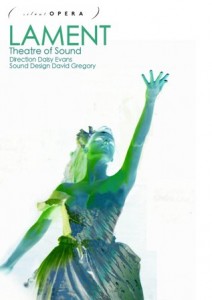
The two shows that I did see, Lament and Crocodile, were about as different as two operas could be, and I liked them both.

Lament tells you from its name that it is not going to be a bundle of laughs and so I went expecting slow mournful music, which is what I got.

What I was not expecting was the heavy use of electronics. The music was clearly a lament and there were the sounds of people chanting but the presentation was in the ambient/trance area and it had police sirens too.

Between them the two musicians had one sparsely used keyboard and three computer screens. I am used to this for bands like dan le sac Vs Scroobius Pip (not my usual thing but I saw them supporting Sparks) but to see an opera delivered digitally was something of a surprise. A good surprise.

In addition to the two musicians there was one singer, Katie Slater, playing the role of Ariadne. She wore a microphone and for most of the time her voice was amplified and modified, e.g. with added echo.

There were a few light effects and Katie walked, sat and lay down but visually this was a minimalist performance performed by a minimal group. And I loved it.

My CD collection has things like Portishead, Sigur Ros and Michael Gordon so electronic music and classical music done electronically were not new to me. It was just that this was the first time I had seen it done as a live show billed as an opera.

Lament had the haunted sound that I expected and wanted, and the presentation built on that mood to produce something quite lovely.

The ending was nice too with the performers walking off in the dark while the computers finished doing their thing and then the lights came on and we all clapped an empty stage.

The Crocodile, based on Dostoyevsky short story of the same name, could not have been more different.

It was bright and bouncy, had a large cast supported by a large group of musicians, and it finished with a party that had balloons and silly-string.

The crux of the story was simple, some Russians had got hold of a crocodile that they thought will propel them up in the world of Russian High society, only for it to eat one of them.

Some deep ideas are then explored around what this means, and I should read the story to find out what direction that takes, but the mood of the opera is resolutely funny.

The band set the tone for this playing a series of light jazzy tunes.

There was a life-sized crocodile too, luckily it was a puppet and it was kept well under control by its handler. Clearly the crocodile was a metaphor for something else pertinent to Russian life in the last 19th Century but here it was mostly played for laughs.

The amusing side of the story was emphasised by the costumes with a stereotypical mad professor, a German with goggles, a woman with an electric blue wig and another woman wearing enough make-up to start a shop.

The whole thing was enjoyably silly and smile inducing, much a children's party. There were some laughs too but the Crocodile was not farcically funny in the way that The Secretary Turned CEO was, nor was it trying to be.

Of course there was also plenty of singing and most of the cast had a reasonable amount to do and they all did it reasonably well. There were only a couple of significant singing roles and these were nicely done.

The Crocodile was frivolous and fun and made a packed house very happy.

10 August 2013

Tête-à-Tête Opera Festival 2013 Day Four sparkled

Riverside Studios in Hammersmith is about an hour away by bus (65 and 33/419) which makes it quite convenient to go there but it is not close enough to pop-in for just one of the short shows in Tête-à-Tête Opera Festival 2013 so I am only going when there is a full programme to attract me. This means going six times in three weeks to see sixteen shows, and that means missing quite a few more.

What enticed me to the Riverside on this Saturday evening was the varied bill and that was firmly and brilliantly delivered.

The Secretary Turned CEO was, to be honest, added to the schedule to make a full evening of it but it turned out to be one of the very best shows in the festival. A genuine hit.

It claimed to be based on "La serva padrona, Pergolesi’s seminal comic intermezzo of 1733" but it must have gone through some serious reworking to be set in current times in a toilet paper manufacturer's office.

The classic feel was there though in both the form of the opera and the sound of the music. It had many comic elements, verging on farce at times, as well as a simple girl-gets-boy plot.

I loved Alberto Prandini as the Italian intern, and Johnny Depp lookalike, far more interested in playing with his iPhone than actually working. What made that even better was discovering afterwards that he really was taking photos during the performance and was tweeting them. Genius.

The comedy carried the show but the main plot and the singing were good too with sterling performances from both the bumbling CEO (Dionysios Kyropoulos) and his calculating secretary (Charlie Drummond).

MICROmegas was my main reason for going to the festival that evening. Again the claim in the promotion, "Think Hitchhiker’s Guide meets Doctor Who meets Rosencrantz and Guildenstern…" was enough to convince me. It helped that it was based on Voltaire's short story of the same name.

What we saw was the first part of what may become a full opera. That means that we did not get the full story but I don't think that mattered very much as the story was a "banquet of the bizarre" and probably would not have made much more sense if there had been more of it.

Luckily we had an introduction from word-smith David Spittle who explained the three scenes we were to be presented with. Essentially they were all introductions; first we met the giant Micromegas from a planet circulating Sirius, then a group of Artic explorers and finally a dwarf (as far as Micromegas is concerned, he's still a giant compared to humans) from Saturn. Only at the end of the opera do the giant and the dwarf meet and agree to go on an adventure together.

Devoid of a meaningful plot we were left with the characters and their songs. And that was plenty enough. The music and singing were good enough without being spectacular (i.e. strange) and there were lots of little things to pay attention to, like the dwarf's fixation with ties.

It was also good to hear so many musicians, there were about a dozen of them on stage, including a harp, and that helped to produce a rich and full sound.

It did not feel like a work in progress, or even that much like a partial piece, and I can only believe that it will be even better when it is completed.

Guilt caught my eye because it was about Hildegard of Bingen and used some of her words to tell her story.

My expectations were of something medieval  and what I got was something sharply modern. So modern that I had a looked at the music score afterwards to see just how they managed to write down the instructions to, for example, bow at different parts of the strings and at different angles.

The music, from two violinists standing in opposite corners of the stage, was immensely strange and compelling because of that.

What happened on stage was not much less strange either. The cast was just two, who I presumed to be Hildegard and her Mother Superior. The action started with Mother Superior flogging Hildegard and ended with Mother Superior flogging herself. I am not quite sure what happened in the middle.

Guilt was a tableaux rather than an opera (that is just a description, not a criticism) and its triumph was its shocking strangeness. I like being shocked by strange things.

09 August 2013

Tête-à-Tête Opera Festival 2013 Day Three was the best yet

My brave decision to go to as many operas as reasonably possible in Tête-à-Tête Opera Festival 2013 is proving to be wise and my third evening there was even better than the good first two.

Fossils and Monsters was a mixed bag of mixed bags with two different musical scenes and two different singing scenes. If that sounds unusual, well it was.

The first scene was musical with two clarinets hidden behind a black wall making vaguely medieval sounds. If anything, it reminded me of Michael Nyman. As an overture it was pleasant enough but rather long with three movements when one would have done.

For the first singing scene brought Alison Wells to tell us about Mary Anning who was famous, apparently, for her work with the fossils she collected at Lyme Regis. This was sung nicely without accompaniment and with great expression.

The second musical scene was more fractured with the two clarinets exchange squawks and squeaks. The two musicians, Ian Mitchell and Catriona Scott, slowly edged on and off the stage to prove that they were real and to give us something other than a black wall to look at. Again this was OK but a little longer than I would have preferred.

For the final scene Alison Wells returned to tell us about Mary Shelley, this time accompanied by some electronic music. There was even more passion this time as she mourned the death of her husband Percy Bysshe Shelley.

The Garden was JG Ballard set to music, and that is high praise.

To emphasise the dystopia we were led to a small community centre in the nearby council estate, a short walk made the more dramatic by the presence of a large number of policemen chasing somebody.

The community centre became the living room and kitchen of a couple. He is struggling at work to get on to an important sub-committee and she is suffering from a mental illness for which she takes pills.

The world outside, we gradually learn, is facing the real crisis of overpopulation and the loss of productive lane while inside we learn, or suspect, that they lost a child once.

In to this double chaos a plant emerges, growing through the lino from the concrete floor. This is a third thing for the couple to cope with and it is a mix of hope and threat.

Eventually the true extent of the dystopia becomes apparent to them and us.

Everything about the production was excellent, stimulating and intense. Pauline Knowles and Alan McHugh sang and acted marvellously which made it easy to engage with them and their plight. Emerging in to the real world afterwards felt as strange as entering in to theirs had earlier.

Vivienne shared some of the structure of Fossils and Monsters with a lone female voice, Clare McCaldin, telling us the story of TS Eliot's first wife, Vivienne Haigh-Wood.

Rather like the play Vanessa and Virginia (Wolfe) this was a life of ups and downs told with great care and expresion.

Early on we had the happy days of the Vivienne dancing to the popular tunes of the day, along the way we heard about her affair with "Bertie" Russell and her story ended in an asylum.

The subject matter and the structure of the performance were intelligently handled and would have made this a good show on their own. What lifted it to the exceptional was the performance by Clare McCaldin who sang and acted with such grace, beauty, humour and despair.

If I had to pick a best show of the festival so far, which is never a fair thing to do because of the diversity, then it would have to be Vivienne.

03 August 2013

Tête-à-Tête Opera Festival 2013 Day Two was an excellent mixed bill

My decision to go to Tête-à-Tête Opera Festival 2013 six times is proving to be a good plan and my Day Two offered another mixed bill of operatic entertainment.

Two Clowns: Pagliacci and Gorgonio opened the evening with two different pieces. In the first a pianist wrestles with his page turner to great comic effect, assisted by one of them looking like a cross between Marty Feldman and Andy Zaltzman.

To give just one example of their merry japes, when setting up to play the page turner find that the stool is too far from the piano so he tries to pull the piano towards him.

The second part replaced comedy with strangeness. An opera singer had lost his voice and he told us that story through a recorded voice synthesizer. Accompanying the story was a pianist and a soprano to make it something approaching an opera. Whatever it was it was intelligent and fun.

Black Sand was a fully-formed piece that describes itself as a horror opera. That was what attracted me to it and it lived up to its billing.

It is America 1952, and Nathanael is madly in love with Olympia but is being tormented by the Sandman. Terrified he decides his only defence is to sleep forever.

Nathanael is haunted, Olympia is sympathetic but does not understand and the Sandman has the easy charm and the looks of Rock Hudson.

The story was concise, coherent and compelling; all good tributes. The music and the singing were splendid too. Dark Star was a dense and dark treat, like Death By Chocolate only with a somewhat less happy ending.

There was so much packed in to the forty minutes or so that, like Soon the day before, Dark Star easily warrants another viewing, even if it means traipsing over to Dalston to do so.

Mme Butterfly: The One Man Opera was amazing.

The one man was the son of the original Mme Butterfly who had grown in to a young man and had travelled to America to meet his father, Pinkerton. As he sat waiting patiently for several days for an audience with the great man he told us about his past as a mixed-race child in Japan, what drew him to America.

As with much at the festival, Mme Butterfly is hard to categorise. It is largely a monologue that is acted out with great flourish and attention to detail. For example. I loved Ignacio Jarquin's use of Japanese gestures and the way he flicked his baggy trousers out of the way when kneeling.

A few musician kept him company, most prominent were a flute and a xylophone, and they produced snatches of sound that carried the distinctive Japanese twang. There was some singing from Ignacio Jarquin too, a few songs to puncture the narrative.

Mme Butterfly was a good tale excellently told. A lot of work went in to all aspects of the production, and it showed.

02 August 2013

Tête-à-Tête Opera Festival 2013 Day One opened on a high

I discovered the Tête-à-Tête Opera Festival in 2011 when I went to one evening's performances. I was so impressed that last year I went to four. This year I have booked for six!

The heavy schedule of concerts, six evening is just over two weeks, means that I'll have to be brief on my write-ups. I am sure nobody minds that.

Gala opened the show positively.

The festival makes a point of including half-formed and unfinished ideas and ideas that do what they want to do quickly and do not have the urge or the need to expand to anything grander or fuller. Gala is one of these collection of ideas that fuses a simple story with puppetry and a mechanical Salvador Dali in a box.

Gala is a lady, with a surly maid, who is looking for a man and she finds one, Jesus Christ Superstar who is only after her money. It is all very weird but wonderful too, especially Becca Marriott's singing as Gala.

I liked it a lot.

Soon was one of those pieces that could be expanded further, though I loved it in its short form. The idea is simple and brilliant. It is set on a train and explores the lives of some of the passengers.

We meet many people with just a cast of four singers all of whom were good. Leading the way was Kate Symonds-Joy mezzo-soprano who, as the narrator, had the largest role. It was a pleasure to be able to congratulate her personally at the bar afterwards.

The stories were inconclusive fragments, as real life is, but the whole came together wonderfully. I loved the music too.

The End of Civilisation As We Know It was very strange and very good.

It started before we went in to the studio, though we did not know that at the time. Waiting in the reception area we could hear exaggerated operatic singing, this continued as we went in and it became clear that she was singing directly to us and she told us to stand up and hug the person next to us.

The screen at the back of the stage then came to life and we saw the singer, in a mask, with a man who we quickly leaned was plucked from the audience.

What followed was an interview where the woman, Lore Lixenberg, sang the questions in high-operatic style and the man responded well with some good lines.

Somehow Leon Michener managed to accompany this unscripted half-song on the piano. This must have been hard work as at the end he lay down on the floor while, in their hidden room, the interviewer and interviewee closed their eyes are rested.

It took us a while to realise that it had ended, there was no curtain call, and we crept out confused and happy.

My Day One of Tête-à-Tête Opera Festival 2013 was all that I had hoped it would be, and more. It was much weirder than any opera has any right to be (and that is a very good thing), the three pieces were very different, and the music and singing were lovely.

19 July 2013

Nirbhaya at Riverside Studios (mixed)

I chose to see Nirbhaya just because it was on at the Riverside on a Friday night and that is a nice routine to get in to. And it was hot enough to justify an ice cream on the terrace beforehand.

This was the first performance of Nirbhaya as part of a short pre-Edinburgh run where the official premier  will be given.

Obviously I knew that it was about the violent sexual assault on a bus in Delhi last year and so was not going to be a light evening. What I had no idea of was what form it would take, and having seen it, I am still not sure.

The main thread of the play was the story of the young woman who became known as Nirbhaya. This was told as a direct narrative with the actors speaking directly to the audience. I felt that this was mostly unnecessary as either we knew the story or it was played out before us.

Supplementing the main story we heard the tales of several other Indian women who had suffered abuse in some way and got no sympathy for doing so, usually the opposite. Again it was not clear why this was necessary or why we had to hear quite so many stories, two or three would have been sufficient to make the point.

We also saw something of the society that spawned the incident, e.g. the constant groping on Delhi buses, and of the aftermath of the incident when it became a national and then an international story.

There was anger in the play but I felt that it was unfocused and a little obvious. It may be that this unfocused rage was deliberate and was an attempt to describe the impact of the incident but the result was that we got the expected outrage but no insight.

I also felt that it fell into the common trap of focusing on the women as victims. A recent TED Talk explained that transitioning from "Jack beats Mary" to "Mary is beaten by Jack" to "Mary is beaten" to "Mary is a battered woman" takes Jack out of the picture and that is where the problem lies.

The final flaw in the play came at the end, or rather the succession of false endings that made the closing section of The Return of the King seem hurried.

Nirbhaya has lots of good points and it was an enthralling hour and a half that while it would be hard to call it entertaining in the usual sense because of the subject matter, it was certainly captivating. Among the ninety minutes there is a reasonable sixty minute play waiting to get out.

12 July 2013

The Shelter at the Riverside (fine drama)

I love the Riverside Studios in Hammersmith for its range of performances, its convenience and for the food and drink options. It is on my way home when working Up North so taking in a show on a Friday evening is generally a good idea. It certainly was this week.

The Shelter was staged by LAMDA (London Academy of Music and Dramatic Art) and was technically free though I gladly donated the usual ticket price in the collection at the end.

Sadly I cannot find any production photos of it anywhere, certainly not on the LAMDA or Riverside websites or Facebook pages, so all I have is this shot of the stage taken from my customary seat in the front row before the performance.

The Shelter is set during the Blitz and the shelter in question is at the Savoy Hotel and is for the exclusive use of the rich patrons while their working class neighbours have to chance it in much flimsier shelters.

At that time the Underground was not open to the public as the Ruling Class (led by Churchill) feared what would happen if the working class were allowed to group there.

A small group of protesters storm the Savoy to use their shelter, and that's the story of the play.

We learn a lot about class attitudes at that time and pivotal in this is the hotel porter who though working class is strongly aligned to the hotel and what it represents. Around him we have his daughter, who is one of the protesters, the firebrand rebel leader, a younger member of staff who is not so wedded to the ways of the rich, a hotel manager who wants to protect the values of Luxury, Comfort and Service, an elderly resident of the hotel, and an officer from the Home Office who wants to ensure that the revolt does not grow.

This was an aspect of the war that I knew nothing about and I found the tale gripping and well told.

The production was accomplished with a small army of LAMDA students acting as hotel staff and moving the pieces of the set around to create the many different scenes.

The Shelter was a fine play and typical of the good things on offer at the Riverside. That's why I keep going there.

21 June 2013

Knee Deep at the Riverside (circus with heart)

Knee Deep is not the sort of show that would normally attract me as it sounded like a circus act and I do not do circuses (normally). This one though came with some good reviews, it was on at possibly my favourite venue, the Riverside Studios besides the river at Hammersmith, and I had a free Friday evening when I would be passing anyway.

Riverside Studio 2 was set up in the square, not unlike a boxing ring without the ropes, and despite a slow start I was able to secure one of the last front row seats. The down side of that was that I had one of the Riverside staff just in front of me guiding people to their seats and so I was unable to take any photographs of the stage and have had to make-do with official photos gleaned from the web.

Knee Deep are a circus act and the two pictures that I have chosen are typical of what they do. The stunts, tricks and routines that they performed were all technically excellent, who would have guessed that one small woman could lift three bigger men?, and they were presented with great grace, tenderness and heart.

The music that came with it growled and bounced in to unfamiliar territory; Portishead's Third was the closest comparison that I could think of. There was a blast of recognisable music from fellow Australian Nick Cave at the end but that was just to see us out.


Knee Deep was a beautiful experience that while firmly rooted in the circus successfully rose above the merely technical proficient by adding a lot of heart.