Showing posts with label oslo. Show all posts

07 August 2011

Another day in Oslo

The packaged part of the holiday ended with a train ride from Trondheim back to Oslo for one final day to include a coach tour of some of the main attractions.

The arranged tour only took an afternoon with left a couple of mornings free to do some free-form exploring. And that's the kind of exploring that I like the best.

I was back in the Thon Hotel Opera, ideally situated in the small area between the central railway station and the ultra-modern opera house.

This a sign told me is part of the Opera Quarter where a building frenzy is turning some redundant docks in to something rather different.

substantial changes are being made to the roads there too and so the first part of the expedition was a little challenging but it was worth it just to cross a bridge as crazy as this one.

The triangular beam above the bridge looks very purposeful and structural but I have no idea what it does. Apart from looking great.

Negotiating a few more roads and a few railway lines took me to the hill to the immediate West of the harbour.

Here a series of footpaths through the trees took me quickly up to the top and then slowly down the other side.

Along the way I passed several camping sites, a farm and several sports fields. All this seemed incongruous so close to the centre of the city.

The North side of the hill was a charming older part of Oslo with a familiar European architectural style.

This is one example where familiarity does not breed contempt, instead it gives a reassurance that this is a normal city, where normal people live and normal things happen. Sadly this proved to be untrue only a few days later.

The coach tour did what I wanted it to do and that was to take me to the main attractions that I could not walk.

Our first stop was the Norsk Folkemusem. I don't think that I need to translate that for you.

As with other ethnographic museums that I've been to from Sussex to Latvia, this is a collection of buildings from different ages and places reassembled in one place and time.

This lack of context makes it harder to pull the picture together but taken individually each buildings each have a story to tell and it's a story worth hearing.

This is a stave church. That means that it is made of wood, which is obvious, and that it has leanings towards the pagan religions, which is less obvious.

Elsewhere in the museum are traditional farmers' cottages with earth roofs, communal halls and other examples of how people used to live in what is essentially a harsh environment.

Next on the list was the Viking Museum.

Given that Norway is heavily associated with Vikings you might have expected a little bit more from a Viking Museum in Norway; something on the scale of the Maritime Museum in Liverpool. It isn't.

What it lacks in volume it makes up for in age.

There is one almost intact full-size Viking ship that you can get close to but cannot quite touch and a gallery that you can look down on it from.

Around it are a few fragments of other ships, some smaller cousins and nautical relics from that time.

The point in going to the museum is to see that one well preserved old ship and to see how it was cleverly constructed.

The next stop was completely different.

Holmenkollbakken on the North-West side of Oslo has been the centre for ski jumping 1982 but the latest incarnation is from 2010 and was built for the Nordic World Ski Championships in 2011.

The jump looks strange without its thick coating of snow but the beauty of the construction is obvious.

The jump is there to propel people down the steep slope and through the air but in their absence the structure draws your eye upwards instead.

Our final stop was Frogner Park which is simply insane. It is reminds you of the follies that the madder English gentry built but it is weirder than that.

Vigeland Sculpture Park covers 80 acres and features 212 bronze and granite sculptures all designed by Gustav Vigeland. They are all nudes and are all in non-traditional poses.

Water compliments the statues in several places and this tableau is fairly typical of the park.

I did try a few times to take pictures the show the sweep of the park as it rises up one hill then falls down the other side accompanied by water but this is a very popular place and everywhere I looked there were far more people than statues which rather spoilt the view.

The tour ended back where it started, at City Hall. The guide informed us that the austere brick building was full of art and so I decided to go there the next morning, my final day in Norway.

I was expecting a few classical paintings in a darkened room, not this.


The entrance hall sets the scene. Large paintings fill the room as they also do on the floor above.

The composition is as busy as Bruegel and, I presume, tells stories from the history of Norway and Oslo. Certainly there are lots of Norwegian flags in the pictures but there is also a topless woman on a bear which is a story unknown to me.

The pictures were an unexpected discovery and set the seal nicely both on the two visits to Oslo but also to the eleven days in Norway. Next stop Malmo.

10 July 2011

A day in Oslo

The only time that I had been to Oslo before was around fifteen years ago, and that was a short business trip where I managed to see virtually nothing of the city, so it was good to have a full day to explore at leisure.

My hotel was next to the central train station so the exploration started from there.

I headed West along a main pedestrianised road that was processional in nature with wide pavements shaded by avenues of trees.

Along the way I passed the somewhat underwhelming parliament building and the slightly grander National Theatre.

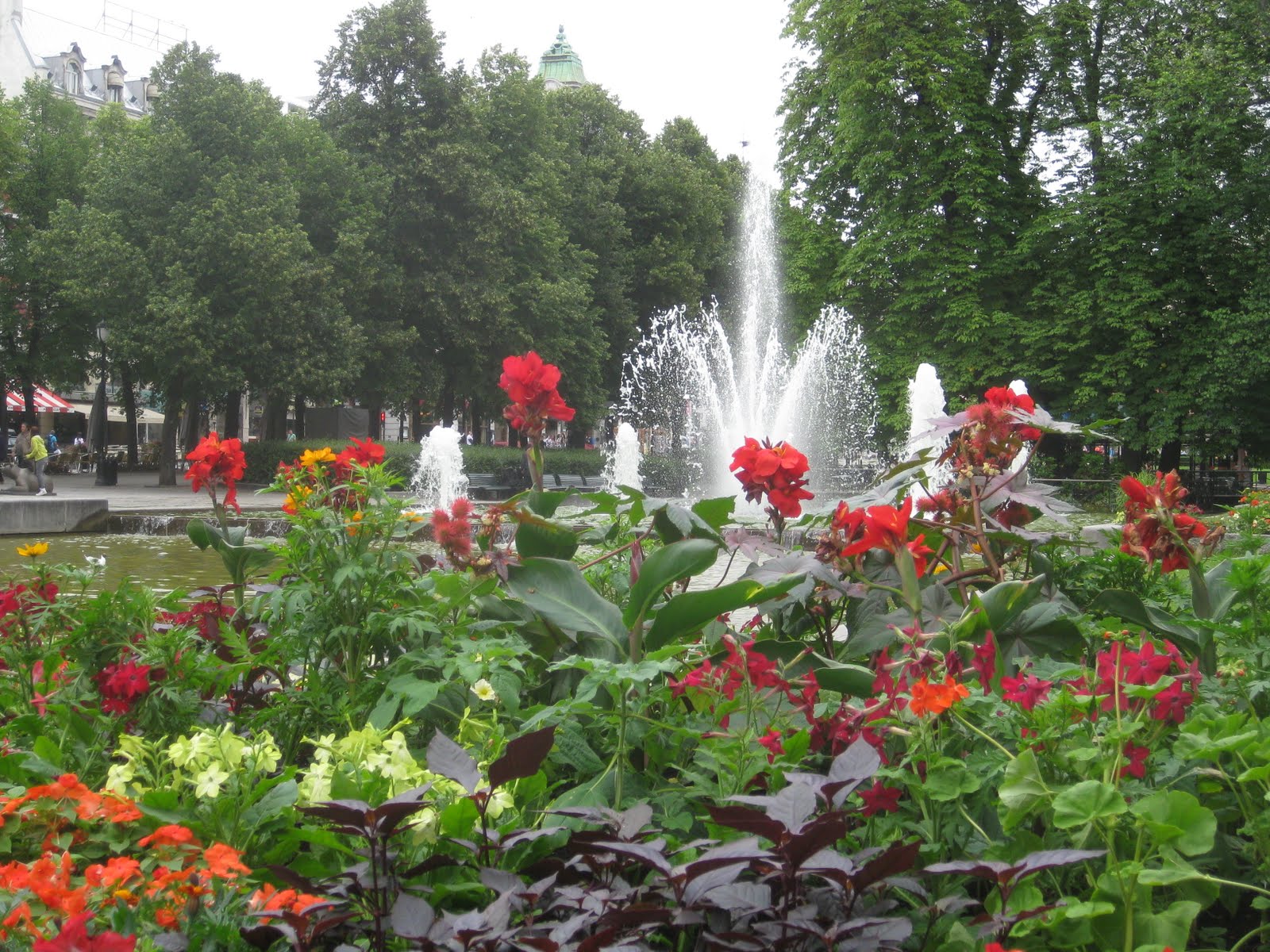
The most attractive feature was the succession of gardens each with several water features, plenty of flowers and copious seats on which to rest and enjoy it all.

At the end of the road is the Royal Palace.

It sits on the top of a slight incline which gives it commanding views back across the city.

I believe that the place is still in use but, as with other Scandinavian and North European monarchies, security is not as overt as it is in England and it is possible to climb through the short garden and then walk across the large parade ground right up to it.

The parade ground make the front view of the palace a little harsh but step to one side and in to one of the gardens and the view becomes much more appealing, helped a little by the statue of Maud.

Turning South from the Palace takes you to a new and vibrant part of the city.

As is the case with other waterfront developments world-wide there are stunning new buildings with lots of open space between them filled with imaginative (or crazy) works of art.

There are also lots of cafes crammed with people appreciating the setting and the ambiance.

Here, on the far left, we have a footbridge connecting two parts of the development and in the centre the large waterfall has a crocodile like feature behind it and a man on stilts in front.

This all adds up to fun and the ideal place to have a coffee or an ice cream.

Just to the East of the new quarter is the large fifties style block of brick that is the Radhus (Town Hall) that makes you think for a moment that you've slipped the other side of the Iron Curtain.

I actually like the building a lot but I like the park in front of it, that separates it from the sea, even more.

Flowers grace the section nearest the building and beyond these is a large paved area with three fountains and two statues.

This is clearly another place that people like to congregate on sunny days, as the group of paddling girls demonstrates.

Turning south again takes you to the old castle.

The small size of the castle may be one reason why Noway has spent most of its history as part of Denmark or Sweden!

Today it provides a contrast to the rest of the city, old stones resting on a grassy hill and watching over a harbour that has long since outgrown its ability to protect.

We too can rest and watch over the old part of harbour as an endless stream of small boats eases in and out.

But we cannot rest for ever and the time comes to slip West over the headland where we find one of Oslo's greatest treasures.

The Opera House is stunning.

It slopes up from West to East and then turns and slopes the other way. And what makes it extra special is that you can clamber all over these slopes.

This picture is taken at the turning point with the lower level sweeping down to the harbour and the upper level climbing up to become a popular vantage point.

A closer look will reveal that the slopes are not uniform and there are smaller slopes within the larger one and patterns within the white stone. These are solely for the pleasure of the clamberers and confirm that the outside of the building is as important as the inside.

I've seen first-hand some of the world's greatest opera houses and while Sydney, Glyndebourne and Helsinki all have their considerable charms, Oslo Opera House is my new favourite.