Showing posts with label norway. Show all posts

05 December 2013

Ørnulf Opdahl: New Paintings at Kings Place Gallery

I had never heard of Ørnulf Opdahl before and so would not have gone too far out of my way to see an exhibition of his paintings. Luckily I did not have to as the exhibition came to Kings Place Gallery which is in the same building as my office.

The main exhibition space was on Level -1 and walking carefully down the long staircase towards the large open area the paintings started to appear and made an immediate and striking impact due to their size and colour.

Getting closer, and the abstract mix of greys became a landscape with a thin row of lights from a settlement struggling for survival between the menacing sea and the brooding sky.

A couple of years ago I travelled along the coast of Norway, from Bergen to Trondheim, and Opdahl's Norway was a Norway that I recognised. And loved.


The pictures were mostly, but not exclusively, of the coast as viewed from the sea or an opposite shore and, despite being very darkly coloured, conveyed the sense of peace that Norway has outside of the towns and cities. The coastline is largely uninhabited with just the occasional shack to show that Man has ever been there.

With no Man to spoil the view, Nature is allowed to show-off what She can do and does this with towering cliffs, thick clouds and deep water.

I would gladly have any of these pictures at home. Sadly the larger ones were priced at up to £20k so that was not going to happen. Enough of the pictures had orange dots to show that other people felt the same way but had deeper pockets.


This was a pleasingly large exhibition too filling the two gallery areas on Level -1 and also stretching down to Level -2. A corporate lunch was about to start there but I managed to see the pictures down there and escape back upstairs before the guests arrived.

The smaller gallery on Level -1 had some smaller pictures (all sold I believe) and also some limited edition prints. They were £1k or less so somebody in a red and white outfit could get me one in the next few days. If not, I'll never believe in Santa Claus again.

Looking at the pictures again as I write this post I am impressed by their grandeur and I want to see them in their full-size glory again. I'll have to find another excuse to go in to the office.


05 May 2012

Contemporary Norwegian Architecture at RIBA

My visit to RIBA was cunningly timed to take in two of their exhibitions at the same time.

The main draw was A Place to Call Home but the prospect of combining that with an exhibition of contemporary Norwegian architecture was always going to appeal having spent some time there last summer enjoying buildings of all ages and especially the very modern opera house in Oslo.

With the possible exception of the front room on the first floor, RIBA lacks exhibition space so they make do with what they can and fill other spaces with models and drawings. There is always something to see on the pretty staircases between the first and fourth floors.

With A Place to Call Home claiming the main space and the Library, the Norway expedition had to find somewhere else.

One of the spaces it claimed was the middle of the restaurant.where it was housed on a collection of light blue boxes.

On these boxes were a series of models, some diagrams and a few words. Between the boxes were some large photographs.

The schemes on display here were all to do with improving the main tourist route through the country.

The country consists of a lot of solid rock carved in to exaggerated shapes by millennia of fast moving water and slow moving ice.This is scenery to admire and so places have been built to admire it from.

Some of these are plain scary with flimsy platforms suspended over drops that take you half an hour or more to drive down round equally scary hairpin bends.

Others were more sedate places for visitors to eat, rest and recover while still being able to appreciate the majesty of the rocks.

Obviously glass featured heavily, not only does it keep the views, it also looks fantastic when made to adopt unusual shapes.

A little surprising was the amount of open space that some of these places had. This is a country where the main road north-south is not clear of snow until May.


The exhibition continued on the second floor is what is really just a wide corridor around the central atrium. Here there were walls to put displays on as well as more tables with more models.

There was a slight change of mood to with some more familiar buildings such as a Centre Parcs like hotel with a number of buildings arranged so that none of them could see each other.

There were also examples of new buildings made with traditional materials, i.e. wood and stone, and designed to sit comfortable with their surroundings.

And there were more viewing platforms too, including this one that I have been on.

As you can see, the barrier is high with a rolled top that keeps you away from the very edge and while the water is white with fury the drop is not that far so the vertigo does not kick in.

It was a small exhibition squeezed in to a couple of unnatural spaces but the content won through and it was a great success.

The lesson from A Place to Call Home was we used to know how to build housing but we have given that ability away to the "free market". The lesson from Contemporary Norwegian Architecture is that other countries do it better. But then anybody who has been to mainland Europe recently knows that.

07 August 2011

Another day in Oslo

The packaged part of the holiday ended with a train ride from Trondheim back to Oslo for one final day to include a coach tour of some of the main attractions.

The arranged tour only took an afternoon with left a couple of mornings free to do some free-form exploring. And that's the kind of exploring that I like the best.

I was back in the Thon Hotel Opera, ideally situated in the small area between the central railway station and the ultra-modern opera house.

This a sign told me is part of the Opera Quarter where a building frenzy is turning some redundant docks in to something rather different.

substantial changes are being made to the roads there too and so the first part of the expedition was a little challenging but it was worth it just to cross a bridge as crazy as this one.

The triangular beam above the bridge looks very purposeful and structural but I have no idea what it does. Apart from looking great.

Negotiating a few more roads and a few railway lines took me to the hill to the immediate West of the harbour.

Here a series of footpaths through the trees took me quickly up to the top and then slowly down the other side.

Along the way I passed several camping sites, a farm and several sports fields. All this seemed incongruous so close to the centre of the city.

The North side of the hill was a charming older part of Oslo with a familiar European architectural style.

This is one example where familiarity does not breed contempt, instead it gives a reassurance that this is a normal city, where normal people live and normal things happen. Sadly this proved to be untrue only a few days later.

The coach tour did what I wanted it to do and that was to take me to the main attractions that I could not walk.

Our first stop was the Norsk Folkemusem. I don't think that I need to translate that for you.

As with other ethnographic museums that I've been to from Sussex to Latvia, this is a collection of buildings from different ages and places reassembled in one place and time.

This lack of context makes it harder to pull the picture together but taken individually each buildings each have a story to tell and it's a story worth hearing.

This is a stave church. That means that it is made of wood, which is obvious, and that it has leanings towards the pagan religions, which is less obvious.

Elsewhere in the museum are traditional farmers' cottages with earth roofs, communal halls and other examples of how people used to live in what is essentially a harsh environment.

Next on the list was the Viking Museum.

Given that Norway is heavily associated with Vikings you might have expected a little bit more from a Viking Museum in Norway; something on the scale of the Maritime Museum in Liverpool. It isn't.

What it lacks in volume it makes up for in age.

There is one almost intact full-size Viking ship that you can get close to but cannot quite touch and a gallery that you can look down on it from.

Around it are a few fragments of other ships, some smaller cousins and nautical relics from that time.

The point in going to the museum is to see that one well preserved old ship and to see how it was cleverly constructed.

The next stop was completely different.

Holmenkollbakken on the North-West side of Oslo has been the centre for ski jumping 1982 but the latest incarnation is from 2010 and was built for the Nordic World Ski Championships in 2011.

The jump looks strange without its thick coating of snow but the beauty of the construction is obvious.

The jump is there to propel people down the steep slope and through the air but in their absence the structure draws your eye upwards instead.

Our final stop was Frogner Park which is simply insane. It is reminds you of the follies that the madder English gentry built but it is weirder than that.

Vigeland Sculpture Park covers 80 acres and features 212 bronze and granite sculptures all designed by Gustav Vigeland. They are all nudes and are all in non-traditional poses.

Water compliments the statues in several places and this tableau is fairly typical of the park.

I did try a few times to take pictures the show the sweep of the park as it rises up one hill then falls down the other side accompanied by water but this is a very popular place and everywhere I looked there were far more people than statues which rather spoilt the view.

The tour ended back where it started, at City Hall. The guide informed us that the austere brick building was full of art and so I decided to go there the next morning, my final day in Norway.

I was expecting a few classical paintings in a darkened room, not this.


The entrance hall sets the scene. Large paintings fill the room as they also do on the floor above.

The composition is as busy as Bruegel and, I presume, tells stories from the history of Norway and Oslo. Certainly there are lots of Norwegian flags in the pictures but there is also a topless woman on a bear which is a story unknown to me.

The pictures were an unexpected discovery and set the seal nicely both on the two visits to Oslo but also to the eleven days in Norway. Next stop Malmo.

04 August 2011

Trondheim countryside

My final view of Trondheim goes a little way out of the town in to the neighbouring countryside.

This was always my plan, and was the reason that I spent four days there and only one or two days at all the other places that I visited, but to make it happened I needed some decent weather and a means of transport. Luckily I got both.

Apparently Trondheim had several tram routes but now it only has one, imaginatively numbered 1.

This takes you from the city centre out to the South-West following roads for a while before heading off on its own route. It was surprisingly busy and a few people got on and off at most of the frequent stops.

The tram abandons you in Lian, which you can just about see a short distance from the centre of the map heading East and slightly South.

You can also see some footpaths marked out in thick lines of red, blue and green. Other paths are marked with thinner red lines and then lowly dotted black lines.

The plan was simple; take a bold route to Solemsasen and another one back again. This was changed slightly and I headed up the road marked in white safe in the knowledge that I could join the thick red route later.

I even took the precaution of taking a photograph of the map with me. This was displayed prominently in Lian but I was not sure how well the rest of the route would be signposted.

The plan went wrong quite quickly.

I arrived at the end of the track with no evidence of the main red route that it was meant to meet there or of the thin red route that I should have been able to take just before that to join it.

So I headed back to Lian and started again.

This time I was determined to follow the main route all the way, rather than hoping to catch it later.

I was reassured to see the occasional post announcing that I was on an official path.

Sadly it was the wrong path.

This became apparent when I stumbled across the tram line which means that I was following it East toward the city rather than North in to the countryside.

Being on the wrong route did not matter that much as I had no particular reason for choosing the original path and this one was pretty enough.

The new plan was to follow this route to the edge of the map, then to turn North along the red route, West along the Blue and finally a thin red back to Lian.

It almost worked.

Filled with new confidence and purpose I threw myself in to the new plan. The walking was lovely with few signs of other people or of anything that people may have built.


The red route and then the blue route were found with some ease. The map's honesty on the route also applied to the terrain and the area marked with thin blue lines proved to be seriously damp, despite the lack of recent rain.

This is a fairly typical picture of the path. At times it was worse than this and only the sheer joy of facing a ridiculous challenge kept me going. That and seeing two girls heading down the path to Lian without a care as if people really were expected to go that way.

I followed the route they took (I think) but did not see them again, or anybody else for that matter. It was hard to believe that this path got enough passage to justify that title.

The path decided not to take me to Lian but back to the tram line instead.

Having got there I could see that I had taken the dotted black line South rather than the thin red path West.

Officially this was a mistake but clambering down the muddy hillside was such fun that it is hard to be critical of the poor map and signs that allowed me to get so lost so often.

It was a very pleasant walk that combined exercise, exploration and environment. For most of the day I was on an ill-defined muddy path surrounded by trees, bushes and grasses. And that is all that I hoped for when I climbed on the tram.

The same tram arrived as if summoned to the little station that I found myself at and kindly took me back in to the town to reflect on a wonderful day.

02 August 2011

Trondheim town

The waterside of Trondheim may be its most attractive feature but the rest of the town has some considerable merit, history and charm too.

The town is laid out in a grid pattern with the newer roads spaced well apart in lessons learnt from the fires that destroyed their predecessors.

The wide boulevards makes walking the town pleasant and the simple grid structure gives you lots of ways to explore the town with no risk of ever getting lost.

The roads converge on the large central square.

This is a meeting place for people with several cafes on the edge, it is also a market at times and, when it's sunny, a sundial.

Keeping a watchful eye over the square is King Olav Tryggvason who founded Trondheim in 997. It's not the most impressive statue in the world but at 18m tall the pillar grabs your attention from some distance.

The wide street south of there takes you directly to the main landmark in Trondheim, the Nidaros Cathedral. Like many churches this has a long history of destruction and restoration which means that most of it is not actually that old but if all you want to do is lap up the detailed Gothic decorations then its age does not really matter.


The downside of the cathedral is that you have to pay to go inside it. I didn't.

Keeping with history for the moment but stepping a little out of the town we have the remains of the old fort which, like the cathedral, has been restored, costs to go inside and was not visited by me.

The outside was good enough.

The fort tries to protect the town from its vantage point on a small hill just to the east of the town but, like the forts in Oslo and Bergen, it is more symbolic than functional.

And being on a hill it offers views back across the town that are worth making the climb up for.

Having seen the town from the outside it is time to climb back down the hill, cross the water and go back to exploring the town up close and on foot.

Taking random turns in the north-west quadrant we find remnants of the old town.

Here the buildings are of a similar style to those on the waterfront, but without the stilts.

They are huddled closer together than their peers in the newer parts of the town and are separated by quiet cobbled streets.

These are the houses that escaped the old fires and have gained some bravado as a result.

Wide streets are for wimps.

The town is liberally peppered with small open spaces many of which hide skilfully from the casual visitors who keep to the main streets.

Any open space seems to be an excuse for a work of art whether it is a simple statue of a woman carrying a bag, a series of elephant-like stones pouring water on each other, a speeding skater, two deer or a bold slab of curved stone beside a square pond.

This proliferation of statues and other works of art was common across Norway and is one of its many pleasing characteristics.

Trondheim is not a large town and is easily traversed, if not properly explored, in little more than an hour. You encounter a lot of variety as you do so and while the cathedral is easily the biggest attraction there is plenty to discover along the way.


My favourite part is the old quarter so I'll end with another picture from there. I walk through cities in the hope of finding places like this.

30 July 2011

Trondheim waterside

Trondheim was the most northern place that I visited on my holiday.

It was also the place that I spent the most time, four days, so it is the town that I have the most to say something about.

I'll start with the waterside.

Not only is Trondheim on the coast but the old town is all but circled by the river. Only a narrow stretch of land on the western edge joins it to the mainland.

Lots of water means lots of waterside.

This water comes in two sections with distinct characteristics. To the north and east are the old buildings from Trondheim's seafaring past and to the south and west are the sedate suburban streets and open spaces that are more typical of the rest of the city.

So it's the north-east corner of the Trondheim waterside that I'll focus on and it's immediately clear why.


The buildings are colourful but functional. They share a similar style but each is unique. And they hug the still water which rewards them with sympathetic reflections.

The industry has long gone, these are offices now, and the stillness of the water is echoed in the stillness of the buildings and engulfs the neighbourhood. There are very few people in any of these photographs.

The ring of water around the town centre is breached in several places by bridges. The age and social attitude of the city mean that some of these are just for people.

Bridges are always a good place from which to enjoy rivers and Trondheim is no exception.

Here, on the east of the town, the river has been sculpted in to a wide straight avenue that almost convinces you that it is the Grand Canal in Venice until you realise that the architecture is wrong and the river is too quiet.

Either side of the avenues of shacks are busy roads packed with tourists, visitors and locals. A few of these have broken through the barrier of the buildings and can be seen by, or on, the water, enjoying the it just for doing what water does.


A closer look at the buildings shows how they are held high to keep dry and this also suggests how high the water can get at times. Indications that the calm waters can be fierce and threatening when the mood takes them.

The boats and doors on to the water confirm what we already suspected that the water was a major highway.

The physical nature of the coast of Norway means that the easiest way to get around was, until quite recently, by boat and it was only natural to extend the sea routes in to the cities.

Fish and timbers may account for a lot of the goods transported this way but these were Norway's main roads and so everything would once have moved on the water and in each port there were buildings right on the water's edge ready to receive them.


Today's boats may be used more for pleasure than for business but they still enliven the waterside and reassure you that this is not just a picture-postcard, it is also a vibrant city. And that's a great combination.

21 July 2011

From Bergen to Trondheim

After less than a day in Bergen it was time to move on to Trondheim. While the aim of the trip from Oslo to Bergen was travel first and sightseeing second this journey was all about sightseeing with a little bit of travel thrown in for good measure.

That's why we took the rather indirect route of Bergen, north to Alesund, south-east to Geiranger, north by bus along Trollsteigen to Molde then back on the cruise ship for the final leg, mostly east, to Trondheim.

Our vehicle for most of the journey was the cruiser Midnatsol (Midnight Sun).

This was a lot smaller than some of the cruisers that we saw but was still comfortably the biggest boat that I had been on.

Working down from the top, levels 9 and 8 were public areas with lots of seating and a few bars, levels 7 and 6 were cabins, level 5 was the main restaurant where we all fought for a breakfast table, and level 4 was more cabins.

Below that were the crew's quarters, service facilities, some engines and a few sea monsters (probably).

There were several places that you could go outside but level 6 was the best as you could walk all round the boat and because there was nothing there to sit on it was nicely quiet. There were generally around half a dozen hardy souls at the front braving the wind.

The boat set sail at 8pm at night and the rest of the evening was spent leisurely exploring the boat, watching the land slip slowly by and waiting for the sun to realise that it was time for bed, which it did around 11:30pm.


I was woken the next day by the tannoy announcement that we had arrived at Alesund, one of our scheduled stops, and would be there for 45 minutes. I knew that Alesund was pretty because I have a jigsaw of it (somewhere) so I took the opportunity to go ashore and have a look around. Good plan.

From there we went down the pretty Geiranger fjord. Those of us taking the overland excursion had to decamp on to a smaller boat to get ashore where our coach was waiting for us.

All too quickly we were hurtling up the mountain and town below looked small, even if the cruise ships didn't.

We headed north along Trollsteigen (Troll's Ladder) getting higher all the time. Our helpful and knowledgeable guide told us that the road was cleared of snow unusually earlier this year, the middle of May.

We also heard lots of stories of avalanches and hardship. Yet people live there. Not many though.

We had a break at the highest point to take in the sights, the fresh air and the snow.

This was too much temptation for some people and the expected snowball fight broke out on one of the larger patches of snow.

But seriously, a snowball fight in July?!

Moving on we took in some more of the sights, crossing awkward stretches of water by ferry to do so.

One of the more spectacular was a thundering gorge that you could get up close and personal to thanks to a metal walkway that snakes above it. Some of the recent repairs to it suggested that it was perhaps not always as sturdy as it should be, but I was brave.

As we descended the final mountain we had the highest waterfall to entertain us.

We also had eleven tight, terrifying hair-pin bend to negotiate.

The blue speck towards the centre of the picture is a coach gingerly making its way down in front of us. It also give a scale to the picture to show just how far and fast the road descends.

Passing the vehicles made enough to go the other way is difficult but the regular drivers know where the passing points are and how to look ahead to spot the traffic coming towards them.

Coaches are the main problem and while it was a good idea to let our driver know that there was one coming towards him I was less impressed that this was via a mobile phone call that he answered while negotiating one of the bends.

The bus journey ended at Molde.

This town is known for its roses but from the little I saw of it has nothing else going for it. This was the only low point of the holiday.

The tour ended with an evening meal in one of the hotels. The meat eaters got a slap of fish, mashed potato from a tin and frozen veg. They were lucky. After some panic at the mention of "vegetarian" I got just the mash and veg. Ugh.

The Midnatsol picked us up at Molde and took us on to Trondheim.

That mean another night on boat waiting for the sun to set. Eventually it obliged and sipped a little below the horizon for a couple of hours but before it did so it painted a streak of red across the water for us to remember it by.


Another good night's sleep on the peaceful boat then there was just enough time for breakfast before we arrived in Trondheim and the next stage of the holiday.

14 July 2011

Bergen

Constraints with booking the boat for the next leg of the journey meant that I got to spend just one night and under 24 hours in Bergen. But that was enough to get a flavour of the place.

As you would expect, Bergen is centred around the harbour which is still very active but these days caters more for tourists than for fish.

One of the things that draws them in is the charming cottages that hug the harbour-side that is now littered with tables and chairs ready for those tourists to spend some of their money on food and drink.

At one end of the harbour is the old fort.

As with Oslo, this fort seems more for decoration than defence. At least it does the decorating bit quite well.

The setting helps with the old buildings surrounded by bouncy grass and appropriately regimented trees.

The park is not that large but the greenery sits nicely between the closely packed buildings of the harbour-side and the open sea beyond.

Having finished exploring the East side of the harbour it was time to climb the hill behind.


The lower slopes of the hill are packed with houses that despite the discomfort and difficulty of living on the slope make an effort to keep clean, pretty and colourful. The good burgers of Bergen add to this beauty by putting pots of flowers outside their houses.

Before long the houses give up trying to survive on the slope and they give way to the trees.

A network of paths criss-cross the hill-side taking you up and around to several places. Maps and signs help you to choose your way but I had no specific destination in mind so just kept going uphill for the better views.

There is also a funicular railway that goes straight to the top but I preferred the exercise and to keep the large amount of money required in my pocket.

A few other people were walking, jogging and even cycling along the paths but not that many and they soon passed so the walk was quiet and peaceful. One minute in the bustle of the town and the next in the calm of the country.

The point of climbing high is to look down.

The climb offered many views of the town below and while I would usually chose a picture of just roofs (and nearly did so) this time I've selected a panorama to give some idea of the size and shape of Bergen.

Of course there are the lovely roofs in the foreground, behind that are the grounds of the fort and behind that the entrance to the harbour.

The three cruise ships in the harbour seem to defy perspective by dwarfing even the buildings in the foreground. The fort would have been of little use if faced with warships that size.

Coming back down the hill a different way reveals more pretty houses on the lower slopes.


It's finding clutches of houses like this that made the random walk through Bergen so worthwhile.


Returning to the harbour-side it was time to trawl the Bryggen UNESCO World Heritage Centre that lies next to the fort.

Bryggen is a jumble of wooden buildings that grew organically to fill that section of the two with only a few narrow passageways between them.

The original buildings date from the 14th to the 16th century when Bergen was a major trading centre for the Hanseatic League.

Fire has been unkind to them over the years but they have been carefully restored allowing us an honest view of times past.

Trade has changed a little over the years too and now these buildings meet the needs of tourists with the predictable souvenirs, local crafts (jumpers mostly) and cafes. Trolls too.

So far I've only described the old town on the East side of the harbour but there is a new town too that caters more for the locals than the tourists.

The new town looks much like any other town in any other European country with wide pedestrianised streets lined with familiar shops.

In the one walk that I took in this area I found very little worth taking a picture of.

The one place that did stand out and which justified having its photograph taken was the park and lake in the centre of the town.

The fountain was expected (Norway has a great number of fountains) but is welcome none the less adding a touch of excitement and action to an otherwise sedate park.

I thoroughly enjoyed exploring Bergen and if I ever go back I'll spend more time exploring the hill and the new town. But, to be honest, I am unlikely to go back because, pretty though Bergen is, I think that I did all that I want to do there in one day.

12 July 2011

From Oslo to Bergen

The train journey to Oslo and then the day spent sightseeing there were all a prelude to the formal part of the holiday that I had booked as a package.

An advert in the Saturday Guardian for a tour described as Norwegian Fjords and Mountain Highlights seemed just the trick, so I went for it.

This is a round trip starting and finishing at Oslo so I had to organise the London/Oslo bit but the rest was sorted.

There is a fast train from Oslo to Bergen but I was going the pretty way.

Actually this mean starting with a bus due to the extensive works around Oslo closing most of the rail lines.

The bus (or rather buses, there were a lot of us taking this leg of the journey) went as far as Honefoss and then there was a proper train to Myrdal where an old, and very packed (I stood), train took us down the picturesque Flam Railway.

Along the way we stopped by this thundering waterfall where a wide wooden platform let us get up close and wet. That was very welcome on a hot day. As was the opportunity to stretch legs a little.

The rest of the valley was pretty, if not sensational, and the slow journey down hill to Flam passed easily enough, despite the standing.

Waiting for us there was our boat to take us to Bergen.

Sadly it was not the grand cruiser in the background but, instead, it was the smaller more functional boat.

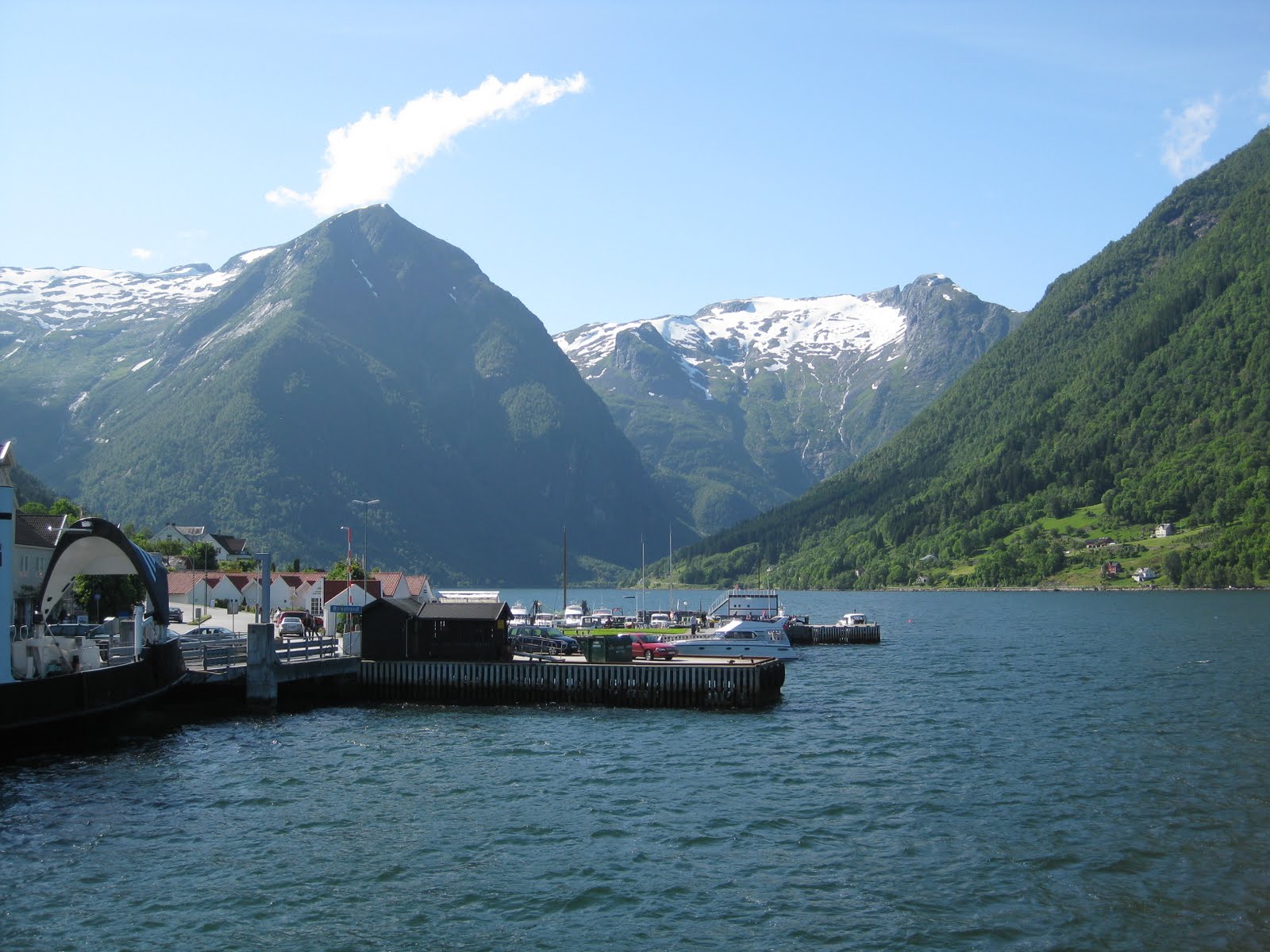
It was also a fast boat which meant that the journey was a mere five hours. There was not much to do on the boat for that time but luckily there was plenty to look at from the boat and the sunny weather encouraged you outside to appreciate it better.

We had trees all the way, whatever the shape of the valley, but when it was shallow we had farms and summer houses and when it was steep we had mostly just rocks.


We stopped at a couple of places along the way but their names meant nothing to me and were quickly forgotten. None of them was particularly large but I was surprised at how much settlement there was along the fjord and even the most desolate regions could boast a hut or two.

The snow was a surprise to me.

I did not think that the Norwegian mountains were not that tall (and I'm still not convinced that they are) but it is a long way North; Oslo and Bergen are on similar latitudes and are both above mainland Scotland.

That combination was enough to keep some snow on the mountain tops on a hot day in July.

I presume that the still melting snow was one of the causes of the many waterfalls I saw along the way.

They almost stopped being interesting, but not quite.

As we got closer to Bergen the mountains slipped in to the distance and the immediate shore was (relatively) flat, rocky, uninhabitable and yet inhabited.

Some people obviously like having rocks for neighbours.

The fjord splits apart and divides the coastal region in to a series of islands (a Viking word) such that the concept of mainland almost becomes meaningless.

The more populated islands were always linked by water and now they are increasingly linked by tarmac and concrete too with sleek and slender bridges cutting through the sky.

And finally Bergen.

The journey started with a bus at 8am, had a couple of trains in the middle and ended with a boat just over twelve hours later.

That made it a fairly long day with a lot of travel but there was just so much to see every step of the way that it definitely felt more like a day of holiday than a day of travel.

In particular, the boat journey was both relaxing (inside) and refreshing (outside).

I saw little of Bergen on that evening as the hotel was on the harbour-side (though on the other side from where the boat came in) as was Pepes Pizza where I went for my evening meal before calling it a day.

The little of Bergen that I did see when walking around the harbour held out promise for the next day.