Showing posts with label politics. Show all posts

06 September 2025

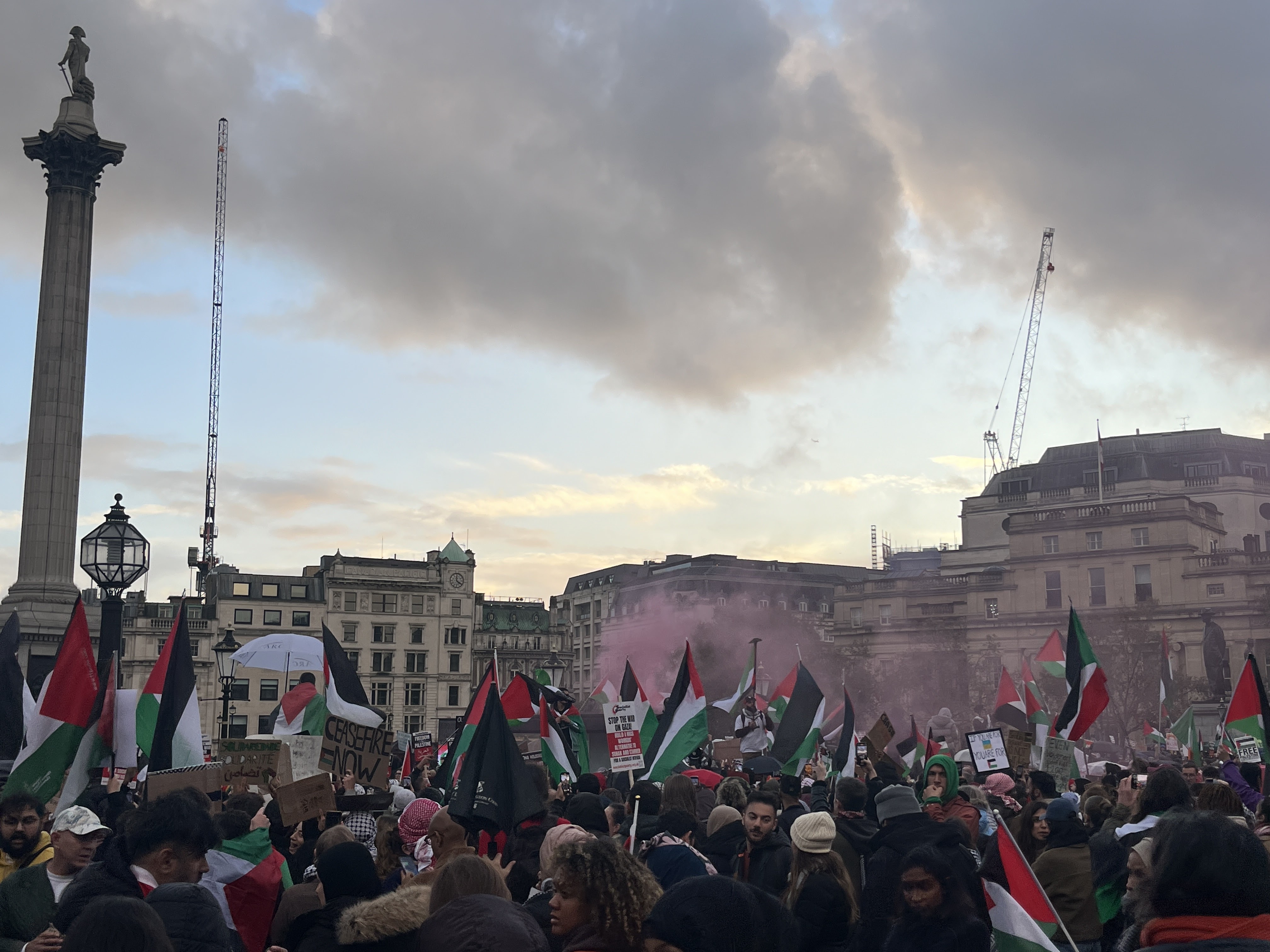
Stop Starving Gaza

While the condemnation of Israel's genocide is growing slowly no serious action has been taken against Israel (they are even still in Eurovision and the football World Cup!) and their deadly violence continues against Palestinians and any perceived supporters in Lebanon, Syria, Iran, Yemen, etc. and so the demonstrations for peace continue in force.

The demonstration this time was also against the ridiculous mass arrests of people sitting peacefully holding placards with the simple message, "I oppose genocide. I support Palestine Action.".

As usual there was a small group of genocide supporters waving Israel flags at one point along the route. I really do not understand why they are allowed to do this (when the far-right march we are not allowed anywhere near them) or why the Israel flag is allowed when it is a clear support for terrorism.

03 July 2025

Marxism 2025

After attending Marxism 2024 I wrote, "Overall it was a lot of fun, if tiring at times, and I am tempted to go again next year.", and I did indeed go the next year.

Thanks to universities shying away from anything remotely looking like support for Palestine the venue had to change to something commercial and so I got to spend a few days in trendy Shoreditch in a venue called Protein Studios.

Shoreditch is not the easiest commute for me and a 10am start counts as early start these days but I managed it using a couple of different routes.

Shoreditch did have the advantage of being full of cafes and restaurants and the one in the same complex, Oat Coffee, was my first port of call each morning.

The format was the same as last year with multiple sessions run in parallel on a variety of national and international topics. That meant quite a lot of moving around the complex and that is when the reduced space really hurt. We also had standard general purpose rooms rather than lecture halls which was not ideal but it just about worked thanks to careful organisation and lots of helpers.

Just to give a flavour of the event, this is the Lenin Room before it got really busy.

This year I found myself doing several theory type sessions which were useful but tiring as there was a lot of content and it was delivered at pace.

A general impression I got was that there were diehard Marxists who though that things like Facebook could be squeezed into a Victorian view of production and others who thought that the original theories needed to be extended or added to.

I am in the second camp, Einstein did not invalidate Newton and Born did not invalidate Einstein.

I also found the idea of a Labour Theory of Value difficult to deal with as in my working life value has always been determined by the end-customer rather that the effort and resources used to produce it.

That said, I was never interested in that minutiae of (any) economic theory but am very happy with the basic Labour v Capital analysis and the need to significantly redress the balance between them so that the wealth is shared a lot more with those that provide labour at the expense of those that provide capital.

A few different views was to be expected, indeed that is the purpose of debates, and that did nothing to diminish the sense of camaraderie that pervaded the event, and that camaraderie was very welcome in a world that had somehow managed to get some much worse (Trump, Gaza, Starmer, Iran, etc.) over the last year. Let's hope there are some good things to talk about next year.

15 February 2025

Walking 16km for several good reasons

The main reason that I was in London this day was for a National Demonstration for Palestine. The route varies each time and on this day we marched from Whitehall to USA Embassy in Nine Elms.

When congregating at Whitehall at 12pm it was obvious that this was going to be another large march and that the enthusiasm for meaningful peace was undimmed by the length of the latest stage of Israel's genocidal aggression or by the temporary lull while hostages help by both sides are exchanged. Trump's plan to turn Gaza into an American beach resort probably encouraged a few more people out.

As always it was a peaceful march and it was lightly policed because of the anticipation of this. We also has the usual Jewish groups out in support and a (very) few Israel flag waving idiots clustered at one point. 

Having completed the march it was time for the second thing on the to-do list and my younger son and I headed to Peter Jones on Sloane Square to buy a mattress. They had a surprisingly large number on display which made making a selection that much harder but we managed to find what he wanted.

The third objective, which is always there when I am walking away from home, was to walk some new roads to add to my City Strides Life Map, hence the wiggly bits at the start end end of the route. That was another success and I added 22 streets.

The fourth objective was simply to do as many steps as possible and in walking 16km I did just that.

The final objective was to take part in a special Pokemon Go event on that afternoon. That was the lowest priority and out of a possible eight raids I managed just two, which was enough for me.

With all five objectives met it as a productive and enjoyable five hours well spent.

10 February 2025

SWLH: Democracy Under Threat?

I go to most of the South West London Humanists (SWLH) discussion meetings but I remain bad at writing them up afterwards, despite always taking notes. 

The exception this time is more an attempt to get back into the habit of posting something that a response to this particular topic; though democracy is something I think and talk about a lot so I was particularly interested in this opportunity to discuss it further.

Oddly, despite my interest in this topic I took no notes during the discussion. I will try to explain why.

The discussion was seeded by a short presentation on the history and status of democracy and we were then asked to consider the threats and opportunities for it. What I felt was missing was any definition of democracy or any argument for why it is necessarily a good thing and without that foundation the conversations were very superficial. 

There was also the false assumption that democracy is ok now but is threatened by people like Trump. Whereas we already have a system where a lot of people do not register to vote, even more do not vote at all, the Government frequently breaks its own laws, media is controlled by a few billionaires with very firm agendas and the judicial system is ineffective because it is swamped.

Yes, we should consider things like maximum terms for elected officials, people's panels and other voting systems but they are all just minor tweaks to a failed system. 

For me, the bottom line is the world is in a nasty state (global warming, poverty, oppression, etc. etc.) and democracy has no answer to any of these and may well have caused most of them. We should judge democracy on the results it achieves for society and not on whether we like the people who get elected or not.

30 November 2024

National March for Palestine (30 Nov 24)


Four weeks after the last National March for Palestine I was back in Central London for yet another one.

This time we assembled in Park Lane before moving along Piccadilly to Eros, down Haymarket to Trafalgar Square then back along Whitehall for the final rally. A fairly short route but the roads were narrow in a couple of places and corners always slow things down and so it took me the best part of two hours to complete the route.

Another reason for the slowness is that I was marching with (or rather behind) a Socialist Workers Party group and they know how to maximise visibility of their banners through walking slowly and leaving a space in front of them, space for the people with the megaphones to lead the chanting from.

The good news was that in the intervening four weeks the the International Criminal Court (ICC) had issued arrest warrants for Israel’s prime minister (Benjamin Netanyahu) and former defence minister (Yoav Gallant) but the depressing news was that had made no difference to the UK Government which remained committed to supporting genocide and war crimes by, amongst other things, supplying Israel with weaponry.

That attitude of our Government means that I fully expect to be marching again before too long.

24 November 2024

Trashfuture live (24 Nov 24)


Thanks to my sons' insistence, I have been listening to the Trashfuture podcast for a little while now and also thanks to them I went to see them live for a second time. And as with last November, the whole family was there to celebrate our eldest son's birthday.

But first we had to have a pizza and Franco Manca in The Cut did the job. It's far from the most exciting menu in the world but we have simple tastes and we went for options 1, 2 (twice) and 3. We are easy to please!

Between The Bridges is an odd venue, little more than a marquee with benches, and the being a liminal area between inside and outside meant that it was okay, and necessary, to keep your coat on. On a more positive note, they sold reasonable beer.

At the previous Trashfuture live event the main man, Riley (far left), was sick and November had to lead the show and this time she was ill and another podcast stalwart, Devon, had to fill in. In other words, the people in the poster were not those presenting the show but that is just a statement for the record, it made no material difference.

For almost ninety minutes Riley led us through the Boris Johnson magus opus Unleashed. The Trashfuture crowd are intelligent, which is rather the point of the podcast, and this was an analytical takedown of Johnson as well as a funny one. Two big points were that Johnson used the book to hit back at everyone who every slighted him and all the things that went wrong were someone else's fault even if that fault amounted to not stopping him from being stupid.

Of course there was a great deal more to the discussion than that and the observations and jokes came thick and fast, so much so that it warrants a second listen and I am hoping, as I did last year, that the live event comes out as a free episode.

02 November 2024

National March for Palestine (2 Nov 24)

It is depressing that more than a year on it is still necessary to march in large numbers to try and get our government to understand that actively participating in Israel's genocide is a bad idea. I am prepared to keep marching for as long as it takes and I was joined by over 100,000 who think the same way.

The routes vary a little and this time we started in Whitehall crossed The Thames at Vauxhall and finished at the American Embassy at Nine Elms. As a simple walk (ignoring for the moment the purpose of the march) it was a good route with wide roads all the way and only one pinch point (by Vauxhall stations).


That meant passing Houses of Parliament which was good for the politics and also because we were seen by plenty of tourists and visitors too, these are public demonstrations for a reason and I prefer it when we march through busier areas.

The next march is scheduled for Saturday 30 November.

27 October 2024

Change NHS: A consultation


Introduction

The new Labour Government has said that "Our NHS is broken, but not beaten. Together we can fix it." and has launched a consultation to start the process (I would have gone with money first but that's another story). 

I wanted to respond to that consultation for several reasons, notably because I have worked with business change through IT for most of my career and also I am quite involved with the NHS as a patient at the moment. The NHS matters to me and I think that my views on it are relevant.

I am putting these views in my blog so that I have a record of what I said and I can also share them easily when I want to.

The consultation is online at change.nhs.uk.

The 3 shifts

The consultation covers the 3 shifts, widely trailed before, as"big changes to the way health and care services work – that doctors, nurses, patient charities, academics and politicians from all parties broadly agree are necessary to improve health and care services in England".

These are:
  1. moving more care from hospitals to communities
  2. making better use of technology in health and care
  3. focussing on preventing sickness, not just treating it.
The consultation then asks questions on these. I quote these questions and give my answers.

Q5. In what ways, if any, do you think that delivering more care in the community could improve health and care?

There appears to no rationale behind this idea other than the slim possibility that because more appointments are more local then fewer will be missed. Specialised services are provided through large hospitals for several good reasons from economies of scale to the frequent need to treat patients will multiple conditions.

I see no health and care benefits in doing this.

Q6. What, if anything, concerns you about the idea of delivering more care in the community in the future?

Healthcare provisions is already fragmented, e.g. dentistry and optometry, and having separate centres for other services risks further fragmentation with the need to visit several centres for one condition.

Small units are likely to be inefficient, e.g. a surgery facility at a GP surgery will either be over staffed to ensure that it meets all demand or under staffed at some times leading to more waits.

People often have multiple needs and being co-located means it is easier to address them at the same time, for example, to get an unplanned x-ray for a patient. When working on Business Transformation we called this "one and done", i.e. fix everything on one visit.

Small specialist units will focus on the one thing that they do and will lack the patient's full context to provide the best service. This happened to me when a private surgery unit missed the possibility of skin cancer and this went undiagnosed for a few years. This fragmentation may kill me.

Q7. In what ways, if any, do you think that technology could be used to improve health and care?

Again, the described benefits of this are weak at best and they are all claims made about other large IT projects that spectacularly failed to deliver. I have worked on some of these and the example of Horizon at the Post Office is fresh in our memories.

The idea that patients need only tell their story once misses two very important points, each specialist needs to hear and questions a different part of that story and that story will change over time (do you smoke, what medications are you taking, how active are you, how stable is your weight etc. etc.) and so it must be retold for accuracy.

Using AI to review scans is an obvious thing to do but it is hardly transformational. The only way that this could help significantly would be if we took lots more scans but that would be an additional cost on the NHS.

Technology is too often portrayed as a magic wand, it is not.

Q8. What, if anything, concerns you about the idea of increased use of technology in the future?

I am concerned that the benefits are overstated and could not be delivered without substantial additional investment (beyond the basic hardware, software and networks) in things like data cleaning and ID cards.

The basic technology, e.g. exchanging packets of data between systems, is easy but does not help because the data quality is pretty low and inconsistent and so sharing it will only make things worse.

I have worked on large IT systems with simpler data, e.g. spare parts held in stockrooms, and every project had to start with a large data cleaning exercise and even that does not solve all of the problems as some of the answers are unknown, e.g. a supplier code does not match any code used by any supplier. Similarly in systems involving people you will often find several dates of birth of something like 01/01/1900 where people have made up data just to get past that screen. Or, even worse, used a special data as a code for something else that has been long forgotten but which is useful.

There will be significant inconsistencies in the data between systems. To pick another example I have direct experience of, there is not a standard list of Nationality codes so things like the Census and Schools (both part of UK Government!) use different lists. These lists also change over time so while a younger person may be identified as, say, Bangladeshi their parents may be just Asian. I picked this as a simple, easy to understand example, other parts of health data are far more complex and far more prone to inconsistency. Agreeing standard lists will help but will take time and will make the data cleaning longer.

And one key part of the data is missing, a unique identifier for each person. Who remember's their NHS number or carries a card with it on? A national ID card system could help (after a lot of time and money) but there will always be gaps, e.g. recent arrivals.

I would be very surprised if you could get the data at sufficient quality to share in less than eight years and employing thousands of people for that long is expensive.

Q9. In what ways, if any, could an increased focus on prevention help people stay healthy and independent for longer?

This is where the focus should be, though not necessarily for the reasons given. We should enable people to be healthier so that they can live more fulfilling lives, not just to save the NHS money. People play sports for fun not to keep out of hospital.

The consultation gives no idea of the scale or ambition of "tackling the causes of ill health" but these need to be bold to first address recent declines in population health (e.g. obesity) and then to significantly improve them.

That means being brutal with manufacturers and retailers over things like smoking, processed foods, alcohol, etc. We know many of the major causes of ill health and should address these seriously.

Going back to school lunches for all school pupils and breakfasts too for primary pupils would be a major boost to wellness and is probably the easiest and quickest option the Government can implement.

In 2023, there were 132,977 casualties on UK roads. We must do a lot more to address this, including stricter enforcement with harsher penalties and redesigning roads to manage out traffic.

Managing out traffic is a win-win as it reduces traffic accidents and also encourages people to use other and healthier means of travel. In the early 70s I went to an edge of town secondary school and hardly anyone went there by car, we need to get back to those days.

Q10. What, if anything, concerns you about the idea of an increased focus on prevention in the future?

My concern is that the Government will back away from the big necessary changes under pressure from lobby groups claiming that it is trying to implement a "nanny state". If these measures are to work then they must be bold.

07 July 2024

Marxism 2024

I was alerted to the Marxism 2024 four day event by my two sons who both attended the 2023 event (without telling me until afterwards). I like politics, discussions and am left-wing so it was an easy decision to sign up for this year's event.

It was held at UCL in Bloomsbury which is not far from one of my former work places so I know the area well and also various good ways of getting there. This was useful with the relatively early starts; now that I am retired a 9:30am start counts as unusually early!

The event was a collection of sessions of 75 minutes with up to nine sessions running in parallel so there were plenty to choose from. The 75 minutes were organises as 30 minutes presentation, 30 minutes discussion and 15 minutes speaker's response to the points raised. That worked reasonably well and the contributors from the floor often brought in their own specific experiences which helped to explain the topic. I attended 17 sessions over the four days.

There was a half hour gap between sessions giving time to move between them and to grab the occasional coffee. You had to arrive promptly at each session as several got full and had to turn people away; I missed one on a Workers' Revolution in c21 because of this. The days were hectic but not frantic.

There were pub sessions in the evenings and I had a couple of long days and a few interesting meals at interesting times.

Overall it was a lot of fun, if tiring at times, and I am tempted to go again next year.

I took a few notes throughout and this is them, unedited and unfiltered. These notes are a mix of what was said by the speakers and the contributors from the floor and also my thoughts at the time. They're bit of a mess but give a reasonable idea of what the sessions were about.

Return of fascism? 
Germany and Italy fascism arose from failed mass movements 
Suggest we fight fascism and the causes of fascism. Not sure that works, it failed before and fighting fascism gives focus to those issues, e.g. racism, rather then, e.g. the failures of capitalism. Also marks us as mindless militants. 
Easier to agree an anti-fascist message across groups than specific progressive policies. 
30s fascists had lots of street thugs, they don’t have that now. Not yet.  But they do have the police.  
Fascists are not just racist, they are directly anti working class. 
Lots of talk about Tommy Robinson but he’s just a lone grifter. 

ACAB
8 to abolition 
To get completely rid of the Police we need to remove the need for them
An interim state is to remove suppressive legislation, e.g. anti demonstration laws
We outsource things like dealing with antisocial behaviour to the Police

Post Marxism
Do we know really how society works and changes?
Post Marxists wrong, Marx right. Apparently. 
Marxists oppose all oppression, e.g. BLM, feminism, LGTBQ+, not just of working class
Need to understand the ideas behind other theories to argue against them but also to use their perspectives and terminology to produce a Marxist version where applicable 

The case for revolutionary socialism 
Capitalism has always been indefensible 
Climate change is the best example of why capitalism itself is the problem, not the way it’s implemented 
Is reform possible? Can we get socialism without revolution?
Socialism is not just the state running things
If capitalism can crush a conservative PM in 44 days, what chance does a truly socialist government have?
The SWP’s role is to lead the working class despite not being in it?!
When workers strike for more pay and they get it then they are happy with the system again
If Labour make things slightly better, e.g. stronger trade union rights and/or wealth taxes, then the demand for bigger change will reduce 
Need to understand where power really lies and be positioned to take it, e.g. ex-communists in East Europe 

Conspiracy Theories 
Conspiracies can be singular JFK or enduring Illuminati 
Conspiracies give human agency to the capitalist system 
Are religions conspiracy theories?
CTs have no logic behind them so you cannot offer disproving facts
If the antidote is Marxism then won’t that be seen as a CT led by mysterious groups like SWP

Is Gender a social construct 
When does gender matter, and why?
With equalities acts etc  why do we need to ask people what their gender is?
When do we need to treat genders differently, e.g. prisons, sport, toilets?!
When it matters, how do we measure it?
If we don’t count genders how do we ensure they are treated equally?
The world has changed for the better, still things to do, some of which are easy, e.g. stop using gendered pronouns, gender neutral toilets, gender neutral changing rooms

Greens
Better than Labour but not by much

Imperialism 
Heavy theory, e.g. Lenin v Luxembourg 
Some liberation movements, e.g. Ukraine, are better sees as inter imperialist conflicts (USA v Russia)
But how do we categorise soft imperial wars, e.g. USA support for Taliban against Russia?

Marxist economics
Economics is not neutral, it’s political 
Dead Labour has a fixed cost, cannot make a profit from that
Living Labour is where profit is made
Capitalism is explorative because of this
Capitalists must complete in the market to survive 
FX etc generates profit but not value
There is not one market, e.g. city pubs
Where do non profits and cooperatives fit?

Party and Class
Not an easy jump from a single issue campaign, e.g. a strike, to convincing them on revolutionary socialism 
Will also find ourselves alongside other groups with very different ideas 
Is joining picket lines really the best way to get the message across and build membership? 

Housing 
Grenfell was a disaster of regulation, not of housing, e.g. it could have been a train crash 
Grenfell was not an accident, it’s what capitalism does, I.e. profit before safety, environment, etc. 
Landlordism creates natural conflict between owner (profit) and user (quality)
Organised tenants have had some success but limited in scope
Rent controls!!!
Private renting is c20%
Thatcher! At last!
Empty homes, AirB&B, ….
The public sector must be involved in a major public service 
University housing is a particular case
Take properties from bad/expensive landlords 
Also take empty properties 

Revolutionaries and elections 
Labour is not offering very much and will struggle to deliver that
The Left already has a significant base to build on
For Reformists, elections are the strategy, for Revolutionaries they are just one of many tools
Reformist Governments have limited ability to reform things as power lies outside of the state
Elections give a measure of public concerns 
Elections are also a place for political debate
The struggle from the base implies that we should be fighting in local elections, especially on local issues, e.g. specific peace camps or strikes

Polycrisis 
The crises are leading to conflicts between major nations, e.g. rival Covid vaccines 
All these crises arise from capitalism 
Competitive accumulation of capital 
Isn’t the demonstrable crisis of capitalism something that revolutionaries have been waiting for?
How late will it be before the crisis is recognised? Can we stop the full catastrophe and do we want to?
The End of the World will not actually be The End of the World, some people will survive 
Revolution is not a solution it’s a process, need to say what the new world might look like 

Dialectics
Dialectics deals with changing systems, most philosophy is static seeking universal truths 
Dialectics is about seeing the totality of things, e.g. the context 
Philosophy, economics , history, etc. are all part of the same thing 
As things change we get new oppositions and contradictions 
People are shaped by society and change as society changes 

Stopping the Far Right
Low-level Islamophobia is rampant, e.g. ripping hijabs off
Racism exists in many places and forms, different tactics needs for each
Are “we” in the places where racist discussions are happening, e.g. Twitter 
How do we build prominent anti racist voices to counter Oakenshot Brewer etc. 
Planning a demonstration at next Reform conference 
Where’s the mass online response to things like Starmer’s comments on Bangladesh
Physical rallies against Farage etc. may help with silencing him but do little to grow support 
Farage/Robinson supporters are also victims of capitalism, they’ve just come to the wrong conclusion as to the cause, led there by F/R
We’re not the only group fighting these battles, how/if do SWP work with them

Degrowth
Over production of things like fast fashion but under production of things like housing 
Use Credit Guidance to control what banks can invest in, e.g. nor destructive industries 
Democratic Economists is possible and can solve most problems , but no political party wants to do this (why?)
Growth is a necessary feature of capitalism 
There is good growth, e.g. swimming pools and libraries, which can still happen alongside overall degrowth 
It’s not a question of making the pie bigger, we need to make it better

China
Book is a Marxist analysis of modern China
Book is comprehensive because Marxist analysis is comprehensive, need to see totality of China and its place in the world system. Most books focus on just one aspect. 
96% of housing is private, very little public housing 
Welfare also mostly private
Very high savings rate, reduces household spend needed for growth 
Youth unemployment is 22%
Territorial disputes in South China Sea but not all China’s fault, e.g. Philippines sea borders very close to Indonesia 
Overall, not particularly convincing 
Not a very in context view, e.g. treatment of Muslims and mosques in UK, Palestine, India, …
No mention of international activities or imperialist tendencies 
Felt like lots of examples picked to give the right answer, e.g. no mention of dominance in new patents 
Or Belt and Road 

03 February 2024

Israel is a terror state


Depressingly it is still necessary to show public support for Palestine despite the recent ICJ ruling against Israel as our government is still backing the wrong side and doing so with direct support, including weapons that are being used to kill civilians.

We started at Portland Place, home to the BBC but not our target, and took a simple route past Oxford Circus, Piccadilly Circus and Trafalgar Square before passing along Whitehall to Parliament Square.

Unlike all the previous marches there was an incident this time.

I was marching with the Socialist Workers Party group (I am not a member but am broadly supportive) and soon after we entered Haymarket a small Police snatch squad swooped in and took someone they had clearly targeted plus one other who got involved. The two were dragged into Panton Street where a line of police officers stopped us following. There were quite a few of us and the police called in several groups of reinforcement, though there was no physical contact.

For bout twenty minutes we chanted at them, things like "Let Her Go!", while they took lots of photographs of us. We were soon joined by some Legal Observers and also by several people giving out leaflets on what to do if arrested. It was good to see an organised response but worrying that police action made it necessary.

The stalemate was ended when the two were taken away in a van and we rejoined the march that had been carrying on behind us for all that time, despite us starting towards the back. There were a lot of people there.

09 December 2023

Globalise the Intifada

It is depressing that the marches in support of Palestine as it undergoes genocide are still necessary but as long as they are then I will keep going on them.

For some reason this one started by Bank station in the City which is not one contiguous large open space but a series of roads radiating from a small space so there was a little work to do to find out which of those roads the march was heading out on. It also took a little work to find a coffee shop open in the City on a Saturday but I managed that too.

The route was a little unexpected at times, especially the turn down Temple Avenue from The Fleet to Victoria Embankment. A high point was massing next to St Paul's Cathedral which surprised and confused a few tourists. The end point was, as expected, Parliament Square via Whitehall.

The march was, again, without incident and there was a good mood amongst the large crowd, despite the seriousness of the cause. 

There was plenty of chanting of slogans that nobody is trying to ban anymore (e.g. from the river to the sea) and also of a common one that social media decided to get uptight about this time (globalise the intifada); apparently some people were arrested for carrying banners saying this which is just silly.

04 November 2023

Ceasefire Now!


While it was uplifting to be in a huge mixed crowd of people in Trafalgar Square all calling for an end to the genocide in Palestine it is also very sad that such demonstrations are the only voice that we have and the the political class continues to not only refuse to denounce the genocide but are actively supporting those doing it.

The politicians do not reflect the people they represent on this and we will keep demonstration until they do. 

28 October 2023

From the river to the sea, Palestine will be free


For the second weekend in a row there was a massive demonstration in London in support of Palestinians as the onslaught by Israel continued. Taking part was a small act in the scheme of things but it was a way to show support for their cause and to remind UK politicians that many people do not support the position they have taken. 

There were lots of different organisations on the march and I chose to follow a Socialist Workers Party group.

11 September 2023

South West London Humanists: Discussion on Climate Change

Despite what the lack of postngs to this blog suggests, I have continued to be a good attender at South West London Humanists monthly discussions and it is only a lack of time that has stopped me from writing them up.

It was all a lot easier before I retired because then I could do things in the office and the activity I was displacing was work but now I have to give up something nice, like walking, to make time to do these write-ups.

It was made easier for me this month as we split into three sub-groups for the main discussion and as I was asked to feedback on one group and I had to take some sensible notes! What follows is a summary of the discussion that uses those notes and also my subsequent thoughts. It is a write up of my thoughts on the topic rather than a report on the meeting.

The question we were asked to conjure with was: How can countries do enough to tackle climate change if it makes today's citizens poorer?

Before the discussion the scene was set with a short presentation on climate change. This probably helped to level the understanding but I think that we all already believed that climate change is a significant threat and needed a significant response, one that is lacking so far.

In our group we spent sometime disputing the framing of the question, yes we need to tackle climate change but why should this make us poorer?

What needs to be done and how it is paid for are two different questions and there are plenty of ways to pay for tackling climate changes apart from raising general taxation, e.g. wealth and windfall taxes.

Also some of the measures we should take will actually make most people richer, e.g. renewable energy is cheaper that gas/oil so was can expect energy prices to fall in future. Similarly if we Reduce and Reuse what we buy then we are spending less and Right to Repair will enable us to keep devices for longer.

We also queried the meaning of "poorer". Is someone who wears a jumper rather than switching the central heating poorer? Or someone choosing to cycle to work rather than driving?

And even if we do become poorer we will still be richer than we were, say, twenty years ago (which felt pretty good at that time) and richer than most people on the planet.

We veered slightly off topic (as good conversations often do) to discuss how to make the changes. We thought that changes should be introduced to make it easier for people to move to greener lifestyles, e.g. have more public transport (free!) before banning cars. 

We also felt that any changes should not penalise people who had made what seemed like reasonable decisions at that time and the ULEZ car scrappage scheme is an example of how to do this.

It was a good discussion in which everyone in our group participated enthusiastically and which reached a broad consensus. That does not always happen!

01 January 2023

An argument for wealth taxes

My argument for wealth taxes is a simple one and takes just a few logical steps to explain.

The economy is not a natural thing

The economy was invented by humans initially to support trades (I sell my chickens for coins that I use to buy your corn rather than trying to bater them directly) and has grown to be the dominant political factor - "It's the economy, stupid".

The economy is unpredictable

Having created this economic monster we cannot control it. On any major issue, such as raising taxes or imposing tariffs, economists present a wide range of views on the likely outcome. This is not because economists are stupid, it is because the economy is complex (not complicated) and is implicitly unpredictable.

The way our economy works has lead to great inequalities in wealth

This lack of control means that the economy does not work well for us, the amount of abject poverty in the world is one proof of that.

While there is little abject poverty in the UK these is still great inequality in wealth. 

This chart comes from The Resolution Foundations briefing paper The UK’s wealth distribution and characteristics of high- wealth households. I say that you give them credit for the chart but I could have chosen any one of many similar charts produced by many similar organisations. It is only the basic shape of the chart that matters here.

Both ends of the scale, extreme poverty and excessive wealth, are unexpected and unwanted outcomes. We did not design our economies to produce this outcome.


We have measures in place to support those with least wealth

Politicians have introduced policies to try and support those with least wealth. These measures include things like income tax thresholds, personal benefit payments and exemption from some charges. 

It could be argued, and I would, that these interventions are too little and there is still too little wealth at the bottom end but that is not the point here, the point is there are measures in pace to try and address issues at one end of the unbalanced scale.

We should also have measures in place to address those with most wealth

However, there are few, if any, measures in place to address the issues at the other end of the scale. High Rate Income Tax is not that high these days, is fairly easy to avoid and it only addresses income, not absolute wealth.

Wealth taxes are needed to reduce the steepness of the curve.

Wealth taxes could be out to good use

It is not just about hurting the rich, the so-called "politics of envy" it is about using the money that is largely sitting in bank accounts or asset holdings doing nothing productive.

For example, the money raised by wealth taxes could be spent on the people at the other end of the scale, further flattening the curve, as well as on the obvious things like schools and hospitals.

We need a range of wealth taxes

Excessive wealth comes from errors in the economic system and a range of taxes is needed to address each of the errors and the results of them.

An obvious example would be a property holding tax and another might be a super-yacht tax. It would be easier to identify individual income sources and assets used to store wealth and to tax them separately rather than trying to calculate an individual's total wealth from all their activities and holdings.

Also, some of these taxes would be permanent, e.g. a property holding tax, while others would be once-off correction measures, or windfall taxes.

05 May 2021

Public sector outsourcing has three intractable problems

I have worked on both sides of public outsourcing over several years and have spoken about it many times but I have never written about it before. It is an issue that never goes away so I am finally going to put my thought on record.

Public sector outsourcing has three intractable problems:
  1. The motivation of the two parties are different
  2. It leaks money out of the process
  3. The balance is always in favour of the supplier.
I'll start with a familiar story. President John F. Kennedy was visiting NASA headquarters for the first time in 1961. While touring the facility, he introduced himself to a janitor who was mopping the floor and asked him what he did at NASA. “I’m helping put a man on the moon!”

In Management Consultant speak that demonstrates a Shared Vision or a Golden Thread running from the top to bottom of the organisation, and it was probably called One NASA at some point.

Now let us look at how outsourcing changes that story.

Motivation

When the janitor works for an outsourcing company his motivation changes. His priority, and what he gets paid for, is making money for his new employer, the outsourcing company.

This means doing as little work as possible while still meeting the contract. It means cleaning less thoroughly, using cheaper materials, using cheaper and less skilled labour, and even falsifying records to claim for work not done.

Leaks

The outsourcing company makes a profit from the contract which it uses to pay shareholders etc. This money which leaks from the process is no longer being used to clean NASA premises, or to do anything else for NASA, it has gone.

Balance

Somebody like NASA outsources a service like cleaning infrequently, say once every three years. In contrast, the outsource provider may negotiate hundreds of similar contracts a year.

That imbalance in experience always favours the outsource provider and leads to contracts that can come back to bite, like the famous examples of charging a small fortune to do a simple job ike change a light bulb.

03 December 2020

English school exams are fatally flawed

Covid-19 has brought exams firmly into attention with each of the UK regions struggling to find fair ways of assessing students when many of them have been forced to either miss lessons or receive a lesser education online. 

In all this the assumption has been that we must hold final exams if we can as they are the best way of assessing students, an assumption that led Gove to drop both continual assessment and AS levels.

It is an assumption that is wrong.

Exams are inaccurate

This is clearly true. I do not think that anyone expects that if a class of children took the equivalent exams, say a Geography GCSE, five days in a row that they would all get the same marks every time.

The question is not, therefore, whether exams are accurate or not but how inaccurate they are.

How inaccurate are they?

Surprisingly nobody seems to know. The best that I can find on my Google search is an Office of Qualifications and Examinations Regulation paper from 2010 that states, "The results showed that, for the GCE and GCSE units analysed, at least 89 per cent of all candidates with a particular grade (other than the highest or lowest grade) have true scores either in that grade or immediately adjacent".

That does not strike me as being particularly accurate and that statistical analysis is supported by the number of successful appeals against grades. Statistics published by Ofqual show there were 1,240 appeals in 2019, up from 857 in 2018. A total of 675 of the appeals were upheld, up from 406 the previous year – an increase of 66 per cent. These may be relatively small numbers but that is not the point, they are just further evidence that exams do not always give the correct result. 

That exams are inaccurate is not an opinion, it's a simple fact, yet most commentators talk as if they were perfect.

Sadly even education professionals make this mistake. When I was a school governor an LEA Inspector was concerned that our Teacher Assessment grades varied significantly from the results of the subsequent exams and the firm assumption was that the exams were right and the teachers were wrong. I asked them how accurate the exams were and they had no idea, to be honest I am not even sure that they understood the question.

Exams are just one data point

Many people will remember dealing with inaccurate measurements in school science lessons and part of the solution is simple, repeat the experiment many times and assess that actual results from the spread of results achieved.

So, if the class did take the equivalent exams five days in a row we would have five results for each child to work with and could, for example, take a simple average (mean or median, there are arguments for using both methods) of the five results and use that. This would not be perfect, five is still a small number, but it would be many times better than what we actually do.

Continual Assessment may have issues with personal biases etc., and I would not want to deny that, but it does provide a lot more data to make the final assessment from than a single exam ever can and there are ways to address the other concerns which would make some form of Continual Assessment a fairer method.

This, of course, is how assessment works in most workplaces during the Annual Appraisal process with employees having to cite examples of their work throughout the year as well as seeking feedback from multiple sources.

Conclusion

One data point that is measured imprecisely can only ever be right by chance (like a stopped clock) and that is why exams as used in English schools are fatally flawed.

03 March 2020

South West London Humanists: Discussion on Far Right Terror

I love intelligent discussions on interesting subjects and that is why I try to get to the South West London Humanists (SWLH) monthly meetings.

This month we were really luck to get Simon Murdoch, from Hope Not Hate, talking about 'Hate in Britain: anti-Semitism, anti-Muslim bigotry and the Far Right threat' and were doubly lucky in that it coincided with their just published report State of Hate 2020.

I found the presentation before the talk fascinating. I had come across some of this before the breadth and depth of the information was exceptional. It is always good when a talker is fully on top of their subject like that.

My main takes from this part of the evening were:

Far Right organisations (BNP, NF, etc.) are in decline but the Far Right is still very able to get people out for demonstrations and protests. Some of this is built around "personalities" like Tommy Robinson and fuelled by social media.

The rhetoric and arguments of the Far Right have been mainstreamed by the Centre Right including major figures like Nigel Farage, Theres May ("Go home or face arrest") and Boris Johnson ("piccaninnies").

Conspiracy theories are a good way in for recruits; the report gives examples like a gunman who attacked a restaurant because he thought that it was being used by a child sex-trafficking ring led by Hillary Clinton. Conspiracy theorists tend to believe lots of strange things and from there it is a short step to blaming immigrants (or women) for all sorts of things.

There was far more to the talk than that (writing notes while listening is still a skill that I have not mastered) and the report is worth a read to get more details.

The following discussion was less good. There were a couple of people there who wanted to talk about Islamic terrorism despite that not being the subject of the meeting and a couple more who asked questions beyond the expertise of a researcher who contributed to a report - as he tried to explain more than one, the report outlines the current situation and it is up to other people to decide how to respond.

There were some good questions too, and I hope that mine was one of them! I was interested in the mechanisms of the mainstreaming of Far Right memes and mentioned the many appearances of Nigel Farage on BBC Question Time and the way that the programme had highlighted strongly racists comments by a NF Parliamentary Candidate on a recent show. I was pleased that the speaker agreed with me.

The disappointing discussion did not diminish from the presentation and I was glad to learn more about the subject and even gladder that organisations like Hope Not Hate are peering analytically into these dark places.

19 January 2020

Why I oppose the Board of Deputies of British Jews' pledges

I oppose the Board of Deputies of British Jews' pledges for Labour Party leadership candidates for three simple reasons:
  1. There are other forms of racism and discrimination.  A meaningful pledge should address all of them to ensure complete coverage and consistently.
  2. There are other Jews with other opinions. The Labour Party should listen to all Jewish voices but Pledge 5 stops that.
  3. There are other organisations that need to tackle racism/anti-semitism. If Pledges are useful then they should be drafted for adoption by all organisations. It is ridiculous to pick on one organisation, the Labour Party, when there is no evidence to say that the problem is greater there than elsewhere.

12 January 2020

Sadiq Khan 2020, Richmond Campaign Launch

With all the doom and gloom around the result of the General Election (and the disastrous consequences for the country) it is worth remember that there are other important elections and Labour wins some of these.

Sadiq Khan was elected as Mayor of London in 2015 and is standing for re-election this year.

He launched his campaign in South West London with stops in several towns in the area, including Richmond. A Campaign Launch rally was held on Ham Common and I went along. After a short call-to-arms speech we posed for this group photo.


My main role in the campaign will be, I suspect, delivering leaflets as I have both the time and the inclination to do several rounds locally. I may knock on doors as election day draws closer but that probably depends on how well things are going and, if I do it is unlikely to be around here. I helped out in Battersea in a General Election campaign several years ago and it makes sense to work where you get most impact.