There was no specific reason for going to Utrecht. It seemed to make sense to not spend all my time in Amsterdam but I could not travel too far because I had bought a return rail ticket to there and limited research suggested that Utrecht had some pretty bits.
And so I found myself there for a couple of grey damp days in June.
Arriving by train is a disaster.
Yes, you are very close to the town centre but the station is in the middle of a large complex shopping centre and there is no clue where the town is.
My hotel was only 200m from the station yet it took me about an hour to find it and most of this lost hour was spent in the shopping centre rather than the old town outside. Eventually I found a shop prepared to sell me a map and managed to escape the labyrinth and find the hotel.
The first thing that the map reveals to you is the old town bounded by its defensive zig-zag canal.
The old town within is not that big, and some of it has been blighted by an incomprehensible shopping centre, which made it fairly easy to decide where to explore.
From the station, I headed towards the south-east corner of the town and was soon among pretty terraces of brick cottages looking a lot more like an English market town than any part of Amsterdam did.
It was also refreshingly quiet; almost eerily so. Once the idea of 28 Days Later gets in to your head it is hard to shake it.
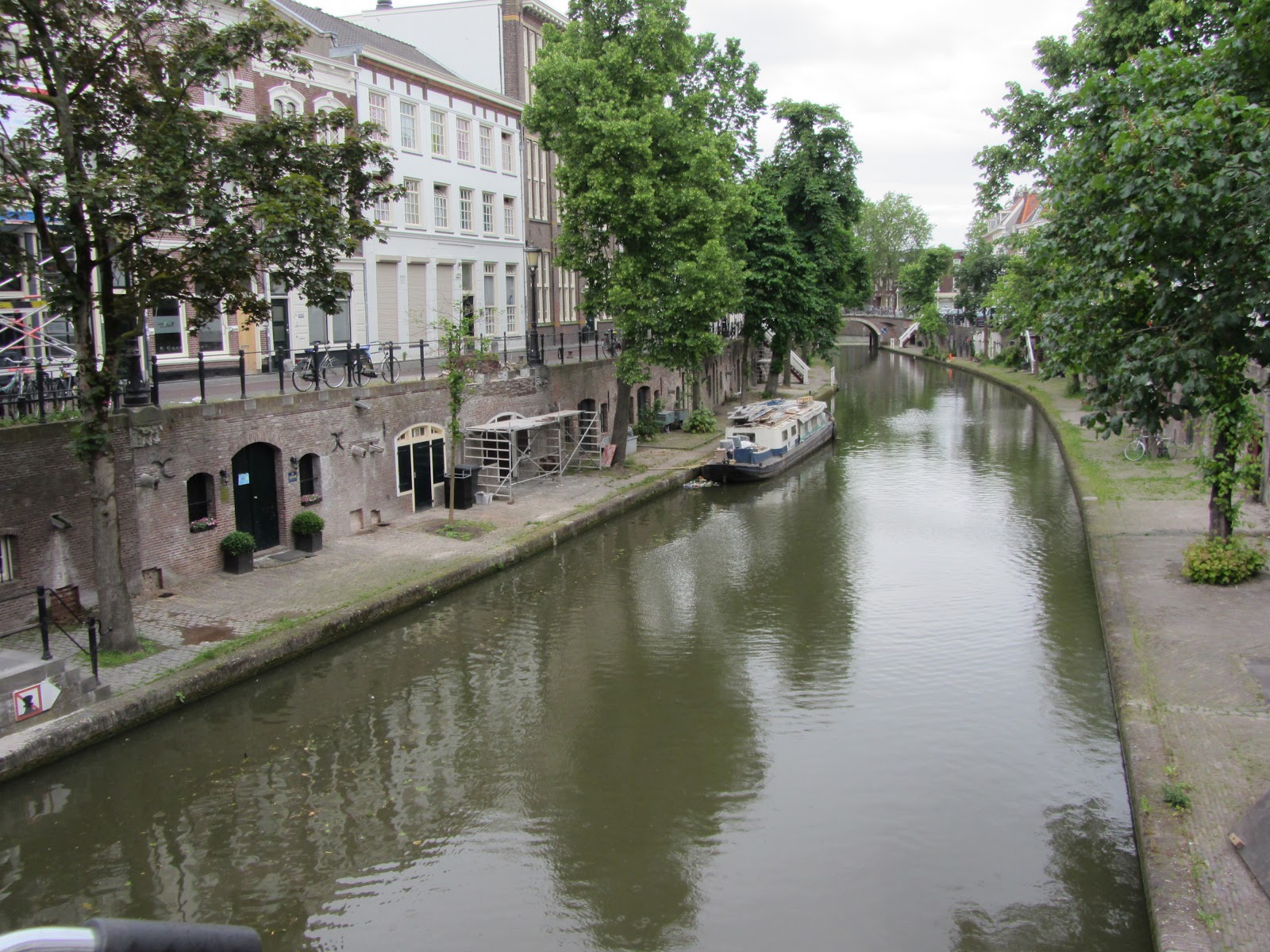
Moving a street or two in towards the centre and the houses got grander, shops were allowed and people appeared. Canals sulked through the town sunk well below the level of the road as if the town was ashamed of them.
Diligent footpaths followed the canals. These were built to provide access to the buildings and so they do not provide proper passage through the town, hence these were quiet too.
Each bridge encountered meant scrambling up to street level again and then tumbling back down the other side. The effort was worth it for the peace and, of course, the views.
There is an old and vibrant town centre made more interesting by the way that the canals cut it in to unusual shapes.
Here I found a large church and a larger town set a little distance from it. You can climb to the top to get stunning views as far, I guess, as Russia. The price put me off though. Not the height. Definitely not the height.
Utrecht is extraordinarily well served by cafes and I could easily have spent all day going from one to the other. They were all fresh and funky with refreshing options for vegetarians, usually involving exciting bread.
FourSquare reminds me that I went to Josephine which means that it had wi-fi (I was not going to pay for international 3G just to keep track of the places that I visited).
The cafes were a useful source of energy and a welcome respite from the frequent showers. This is the sort of exploring that I like to do.
Pretty, interesting and evocative though most of old Utrecht is it is the canals that define the town to a casual visitor and that is where I spent most of my time.
One of the things I noticed along the way was the number of comics shops. I went in a few just to soak up the atmosphere and to enjoy the artwork, the Dutch words meant nothing to me.
I also enjoyed the frequent street art and the Utrecht people's eagerness to wear anything orange, no matter how silly, in anticipation of the football game being played that evening. The less said about the Dutch performance in Euro 2012 the better.
Old Utrecht is small so I am not sure that it could entertain me for much more than one day. One day was all I had though and Utrecht easily kept me happily occupied despite the efforts of the unseasonal weather.
Showing posts with label utrecht. Show all posts
02 July 2012
28 June 2012
A mixed bag at Centraal Museum, Utrecht
I was enjoying my stroll in the south-east corner of the old centre of Utrecht when the threatened rains made their appearance and so I headed for the shelter of the Centraal Museum that I had just seen sign-posted.
I had no idea of what to expect and the broken English conversation with the receptionist did little to help. However, she did hand me a useful map of the buildings.
I headed for the section that I thought would be the history of Utrecht only to find piles of collections from digs that would probably be of interest to archaeologists but that's not me.
A little disappointed I headed for the top floor that promised architecture and furniture. There in an attic was a collection of drawings, models and furniture by Gerrit Rietveld. I was in my element. It had all the feel of an exhibition at RIBA and that is high praise.
The museum is oddly shaped which is where the map came in handy though it failed to point out that the cafe was closed on a Saturday afternoon.
Several of the exhibition spaces were devoted to modern art, some of it dating back almost a century so the epithet "modern" is less accurate.
An oddly shaped corner had an odd installation that I loved because there is so much going on it, right down to the copy of the English newspaper, The Mirror, on the bed. The white figure above the bed had a strangely haunting feel that evoked in me thoughts of some comic characters and their creators.
Other works were modern in a more traditional way and there were collections containing abstract paintings and landscapes that think they are abstracts.
One exhibition that I was keen to see was God Save The Queen covering the punk era in The Netherlands. I had to ask for directions to find it and then realised that the route shown on the map was a tunnel between the two buildings.
This was a large exhibition in its own right and I probably spent more time in this part of the museum than all the rest of it put together.
Of course that it helped that I liked the subject matter having been an early enthusiast of punk music in my student days.
There was plenty of memorabilia from that era to wallow in including record covers, posters, badges and newspaper clippings. I just have to see the number 999 and the song Emergency immediately bursts in to my head. Other songs came easily too and it took some effort to move on to other galleries.
The hardest one to leave had videos and comfy chairs and I spent quite a few very happy minutes watching Siouxsie and the Banshees in concert.
There was a lot more to God Save The Queen than the music and the contemporary art was excellent too.
While motivated by the same things as the music, or even the music itself, the art took different directions and it was hard to discern something that might be called Punk Art whereas Punk Rock is obvious.
The picture galleries were large, as they should be, and that meant that they could easily accommodate some huge pieces.
When it comes to art, size can make a difference and nothing quite makes an impact as walking in to a room and being confronted by a striking piece of art too large to fit in most houses.
The only thing I could possibly follow punk with was Miffy.
The Miffy exhibition was a relatively small display in a separate building, most of which was allocated to the Miffy shop. It was designed very much with the younger visitors in mind but there was also stuff there to engage the older people looking after them.
I liked the display showing the how a drawing is created and found examples of Dick Bruna's work interesting too. Though, in the final analysis, you just have to admit that Miffy is one cute bunny.
In the unlikely event that I ever find myself back in Utrecht one day then I'll certainly consider another visit to the Centraal Museum. Especially if it rains again.
I had no idea of what to expect and the broken English conversation with the receptionist did little to help. However, she did hand me a useful map of the buildings.
I headed for the section that I thought would be the history of Utrecht only to find piles of collections from digs that would probably be of interest to archaeologists but that's not me.
A little disappointed I headed for the top floor that promised architecture and furniture. There in an attic was a collection of drawings, models and furniture by Gerrit Rietveld. I was in my element. It had all the feel of an exhibition at RIBA and that is high praise.
The museum is oddly shaped which is where the map came in handy though it failed to point out that the cafe was closed on a Saturday afternoon.
Several of the exhibition spaces were devoted to modern art, some of it dating back almost a century so the epithet "modern" is less accurate.
An oddly shaped corner had an odd installation that I loved because there is so much going on it, right down to the copy of the English newspaper, The Mirror, on the bed. The white figure above the bed had a strangely haunting feel that evoked in me thoughts of some comic characters and their creators.
Other works were modern in a more traditional way and there were collections containing abstract paintings and landscapes that think they are abstracts.
One exhibition that I was keen to see was God Save The Queen covering the punk era in The Netherlands. I had to ask for directions to find it and then realised that the route shown on the map was a tunnel between the two buildings.
This was a large exhibition in its own right and I probably spent more time in this part of the museum than all the rest of it put together.
Of course that it helped that I liked the subject matter having been an early enthusiast of punk music in my student days.
There was plenty of memorabilia from that era to wallow in including record covers, posters, badges and newspaper clippings. I just have to see the number 999 and the song Emergency immediately bursts in to my head. Other songs came easily too and it took some effort to move on to other galleries.
The hardest one to leave had videos and comfy chairs and I spent quite a few very happy minutes watching Siouxsie and the Banshees in concert.
There was a lot more to God Save The Queen than the music and the contemporary art was excellent too.
While motivated by the same things as the music, or even the music itself, the art took different directions and it was hard to discern something that might be called Punk Art whereas Punk Rock is obvious.
The picture galleries were large, as they should be, and that meant that they could easily accommodate some huge pieces.
When it comes to art, size can make a difference and nothing quite makes an impact as walking in to a room and being confronted by a striking piece of art too large to fit in most houses.
The only thing I could possibly follow punk with was Miffy.
The Miffy exhibition was a relatively small display in a separate building, most of which was allocated to the Miffy shop. It was designed very much with the younger visitors in mind but there was also stuff there to engage the older people looking after them.
I liked the display showing the how a drawing is created and found examples of Dick Bruna's work interesting too. Though, in the final analysis, you just have to admit that Miffy is one cute bunny.
In the unlikely event that I ever find myself back in Utrecht one day then I'll certainly consider another visit to the Centraal Museum. Especially if it rains again.
Subscribe to:
Posts (Atom)
