Showing posts with label gagosian. Show all posts

16 February 2016

Avedon Warhol at Gagosian Gallery


I would have discovered the new exhibition at Gagosian Gallery at some point anyway but it was a mixed pleasure to be notified of it through a Facebook friend who went to the opening evening. I do not get invited to things like that and so I make do with visiting it during a lunch break.

Gagosian Britannia Street, one of a few Gagosian galleries in London, is about a ten minute walk from our London office and is slightly hidden between Gray's Inn Road and Kings Cross Road.

The gallery had changed slightly since my previous visit with the introduction of a glass door between the reception area and the galleries. Like the glass door at the entrance this had somebody standing by it to open it for visitors. With two doormen and a watchful guard in each room there were about as many staff there as there were visitors when I arrived. I have no idea how their funding works.

I had heard of Andy Warhol, obviously, but Richard Avedon was a new name for me. I learned that they were put together because they were contemporaneous and their paths had crossed, one of the large Avedon photographs was of Warhol's crowd of friends and associates.

Some other Avedon photos were facial portraits, of people like Marilyn Monroe and Bridget Bardot, and so were similar in style to some of Warhol's paintings and this also helped to make the pair a good match.


The picture above of the largest room in the gallery shows how the works of the two artists were displayed alongside each other.

The Avedon photo on the left were individual pictures of a large family. They were all taken with the people standing and almost all were waist-up shots. The identical compositions made the pictures more interesting for me and it also drew my attention to the variances in the ways that the arms were posed.

The photo above also shows how powerful Warhol's portraits are and they stole the show for me. However, I was less impressed with some of his more abstract works, like Red Skull.

My favourite Warhol portrait was of Liza Minnelli but for some reason it was one of the few works in the exhibition that we were not allowed to photograph. What makes that doubly odd is that it is easy enough to find copies on official sites on the internet, such as the Sunday Times.

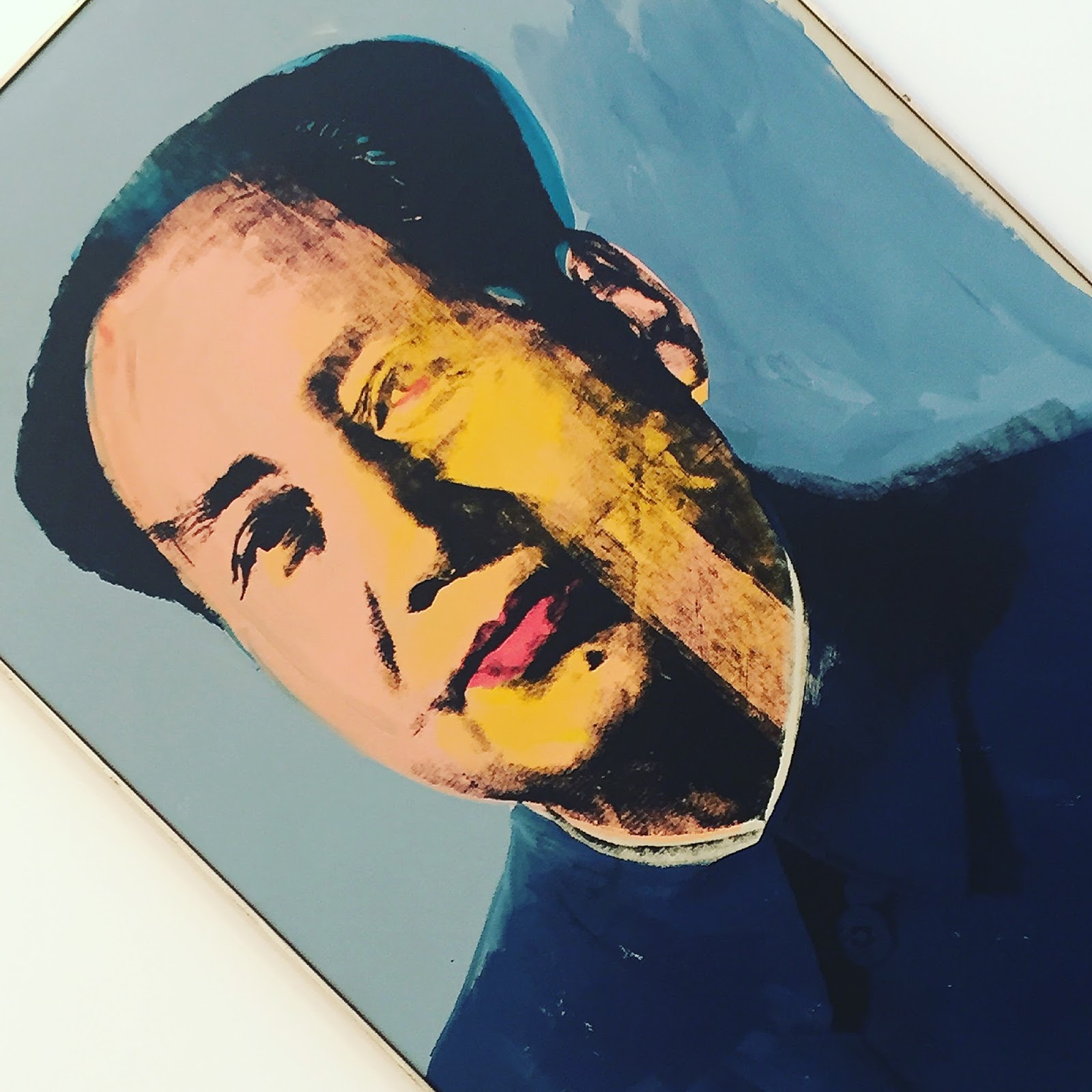
With Liza out of bounds I have chosen Mao to represent the portraits. I would like to have it in my house but it was not for sale and would have cost more than my house if it was. Mao was behind me when I took the picture of the room.

The only slightly annoying thing about the visit was that the pictures were not labelled on the walls and so I had to carry the two page laminated guide around with me. That was fine on my first two passes through the rooms when I was just looking at the pictures but was something of a hindrance on my third pass when I took the photos. I could have gone back to reception to return the guide but that would have meant going through the gallery door twice more and I would have felt awkward having it opened for me again.

The big positive for me in the exhibition was the number of Warhol portraits. I had seen several of them before in places like Tate Modern and the Rijksmuseum but never as many in one place. I also liked the way that Gagosian presented them with some in groups and then others, like Liza and Mao, on their own.

Avedon Warhol is on until the end of April so I shall be going back there for a refresher before it closes. That is what lunch breaks are for.

23 October 2015

Jonas Wood at Gagosian Gallery was bold and colourful

One of the very best things about working in London is the access that gives me to the arts, especially theatre in the evening and galleries at lunchtime.

I am currently working just north of Kings Cross Station which means that Gagosian London is just around the corner. It's a few corners actually and that is another good thing as a visit there gives me something of a walk too.

Gagosian Gallery is just my sort of gallery. It has big bright white spaces that are lightly filled with dramatic works of art. In that respect it is very much like the Saatchi Gallery but the Gagosian has the advantage of being smaller and so can be consumed in lunchtime sized chunks. Like the Saatchi, it is also free to enter so the experience can be repeated as often as you like.

On this visit I stumbled upon an exhibition by Jonas Wood who, the short guide tells me, was born in Boston in 1977 and lives and works in Los Angeles. That helped to explain why I had not heard of him before. That and my almost complete lack of knowledge of modern art. All I know is from exhibitions like this and I do not recall ever seeing any contemporary artist's work in two separate exhibitions.

Personally I like that lack of knowledge as it means that I have no preconceptions. If I knew beforehand that "Wood fuses artistic influences as diverse as the domestic interiors of Pierre Bonnard, Henri Matisse, and David Hockney to Chinese and Japanese still-life scenes, ancient pottery and the guileless textiles of Josef Frank" then expectations would have been set and missed.


There was certainly something of David Hockney in Wood's use of simple shapes and extravagant colours. The main difference was in the subject matter as Hockney makes me think of trees and fields and Wood presented busy interiors.

I always like art that has an abstract feel, that is you can appreciate just the use of colour without considering the subject as that gives an immediate hit, and also has detail in the subject that makes you want to look at the whole picture giving a longer and steadier pleasure.


I chose this picture for several reasons. It shows how that pictures were presented with each given plenty of space so as not to interfere with its neighbours. It also shows a series of paintings of pots that were different in style to the interior pictures. And, finally, it shows the complexity of some of his work.

The pot in the middle in particular had lots going on in it, such as the cycles, boats and aeroplane. I took photos of it close up to capture some of this detail but in doing so the context and scale of the rest of the painting and the pot were lost. I thought about posting three pictures of it with different levels of zoom but that would have swamped this post and unfairly highlighted one piece of work.

The pot in the middle was also the one most photographed by other people while I was there.


My final selection from the gallery is another interior. Despite the apparent simplicity and broadly grey feel, there is a lot going on here too from the complex roof to the banana packing cases and all the abandoned objects in between.

I spent an exhilarating half an hour in the gallery going around the rooms three times (context, detail, photos) before heading back to the office to resume battle with some spreadsheets. The brisk walk had exercised muscles and lungs while the exhibition had given my brain some playful exercise too. All lunch breaks should be like that.

26 June 2015

Sprayed at Gagosian Gallery was playful and provocative

There is something invigorating about modern art that makes me love it. The Shock of the New is part of the attraction but a good exhibition delivers more than that.

I also love the way that exhibitions, unlike scripted events such as plays and operas, let you enjoy the experience in any order and at any pace and with the opportunity to revisit sections.

On my most recent visit to the Gagosian Gallery (in Britannia Street by Kings Cross) I went around the exhibition three times; firstly to see how it was laid out and where I needed to spend most of my time, secondly to enjoy the art and thirdly to take some arty-farty photos of the pieces that I liked the most.

The title of the exhibition was Splayed which, their press release informed me, spanned four generations exploring the myriad ways in which artists have employed the impulsive yet de-personalised and non-gestural forces of spray.

I got off to a bad start by walking on the first one which had the utterly clear title Two Minutes of Spray Paint Directly Upon the Floor From a Standard Aerosol Spray Can. The floor it was sprayed on was just inside the entrance and I missed the attendant's warning because I still had my earphones in. Luckily I appeared to do no damage to it.


The gallery was not that large with just four rooms and the corridor that connected them. The works were presented as is the norm these days, far apart against white walls. It may be conditioning but that is how I like it.

Modern art needs big bright rooms but it does not need many of them, as places like White Cube also demonstrate. Big galleries, like Tate Modern and Saatchi, are great for days out and it is nice to also have a collection of smaller galleries available for shorter visits.

The pieces varied in form and format and it was the large paintings that had the immediate impact with me despite them being very different, they are both shown here. One was mostly black and arranged in horizontal lines (like a landscape) while the other was a riot of colour and curves.

To prove that it was not just the size that impressed me, the third large painting left me completely cold and to show how subjective art is that was the painting selected to advertise the exhibition.

Another surprise came from the inclusion of a small work by Paul Klee. This was little more than a few lines, something like a geometry lesson, but it was good to see it there. As if to make the point, on the wall next to it were some pieces drawn on graph paper. I liked those more.

There was little disputing the most popular pieces as almost of the pictures posted to Instagram of the exhibition, including mine below, were of the same ones. There was plenty of variety in the angle of the shots and the distance that they were taken from but they all included the remarkable inflatable animals trapped in stacking chairs, Seal Walrus (Chairs) by Jeff Koons, in front of swirling colours, Abhorrence by Albert Oehlen. Two works of art working as one.


I found Splayed to be a playful and provocative exhibition and Gagosian was an effective space for it. This is what lunch breaks are for and this is why I like working in London.


16 January 2015

Richard Serra at Gagosian Gallery

Richard Serra and the Gagosian Gallery were both new to me and it was a fortuitous situation that led to me discovering them.

I had an evening even booked close to work and had planned to work a little late and then walk along to it but the work withered away and so I looked for something else to fill the time.

The place that I looked was the Art Fund iPhone app and I used the Nearby function to find something, er, nearby. And there was Gagosian Gallery just a few hundred meters south of me in Britannia Street. So I packed my bags and off I went.

The gallery was relatively small, just four rooms, and was constructed in the standard form with tall rooms and white everywhere. The lighting helped to blur the boundaries between walls and ceilings by adding its own whiteness; it also played havoc with my camera's automatic focus.

As the announcement in the reception area made clear, there were just four pieces on show; Backdoor Pipeline, Ramble, Dead Load and London Cross. What it did not make clear was that those four pieces would do a fine job of filling the four rooms.


Ramble was a collection of steel slabs arranged in dead straight lines across the room but staggered in the other direction to create interesting spaces to ramble through.

There were 24 blocks in 12 sizes, 2 of each size. The blocks were all 23cm deep with widths varying from 71cm to 144cm and heights varying from 60cm to 72cm. That mixture of sizes produced an effect not unlike the holocaust memorial in Berlin.


Backdoor Pipeline was the oldest piece in the exhibition, it dated from 2010 whereas all the others were from 2014, and was the odd one out. While it was still made of metal it was curved and orange rather than straight and grey.

The two halves curved vertically to meet at the top and horizontally to hide one end of the halfpipe from the other. It was another piece that you could walk through and everybody did. I walked through it twice, once in each direction.


London Cross was my favourite piece. It was made for the room it filled with the two sheets running from corner to corner bisecting the room twice. The lower piece blocked passage across the room but there were two doors into it so it could be seen on both sides.

What made the piece for me was the way that it sat in the room so that the room itself, its two doors and the things beyond them were as much a part of the piece as the metalwork was.


Dead Load took a different approach and tried to look as small as it could by occupying the centre of a big room. It may not look it here but it was taller than me.

The neat trick here was how the slightly larger top piece seemed to hover over the base. I was not the only person who crouched down to try and see how that mystery was solved.

There were just the four rooms and these four pieces but they managed to captivate me for some time. I visited each room at least twice and walked all around all of them looking at the works from various angles. That is the difference between simple objects and art.