Showing posts with label belgium. Show all posts

10 March 2015

My last look at Ghent took me to museums and gardens

My last day in Ghent, a Tuesday, had to be a part-day as I was booked on the eurostar to catch at 6pm and that meant being back in Brussels around 5pm to allow time for the connection, a cup of coffee and some contingency.

That still left me with quite a few hours to play with and rather than wander the streets again I thought that I would go and see some things and I started with the City Museum (STAM). I chose this as I have generally found city museums (i.e. those that tell the history of the city) to be interesting and not too large to be daunting.

The museum was just the other side of the waterway that I had walked along on my first day in Ghent so it was both a short walk and easy to find.

I did, however, fail to find anything that looked like a decent cafe for my breakfast so I was delighted to find one at the museum itself. The section of the modern building with tables and chairs in the picture below was the cafe/restaurant and the rest of the new building and the old one behind it were part of the museum.


There was some sun that day, unlike the day before, and so it was good to get a table next to the large window overlooking the water. It reminded me, obviously, of the canteen at West Burton Power Station.


There was a set route through the museum and the first room was dedicated to a large model and satellite photograph of the city. The photograph was on the floor (it was all of the floor and part of one wall too) and I had to put on overshoes before going into the room.

The model was in the centre of the room and showed the city centre. The photograph started where the model ended and showed the rest of the city and its immediate environs.

The tall building half way down the left side of the model is the one that I photographed in its half demolished state. Rabot is just to the right of it and the castle is in the direction of 2 o'clock just before the small triangle of water. The heart of the old city is in the middle near the top and is distinguished by several tall buildings and the open spaces around them.

In contract, the section of the photograph that I have chosen shows the docks and is heavily industrial.

I like models and I like maps so I spent a lot of time in this room. A good start.


One thing that consistently confused me was that maps of Ghent were show with west at the top and I referred to my own map several times just to check this again (and again). The unusual orientation of the maps made some sense as the layout of the city best suited a landscape view and there may have been a historical reason for the choice; maps have not always had north at the top.

The rooms were laid out chronologically and each room had its own digital map of that period with options to zoom in and read details of the landmarks.

Ghent had an interesting political history having been part of many empires and countries, Belgium gained its independence as recently as 1830. Its importance waxed and waned too and there was something of a highpoint in 1500 when Charles V, who became Holy Roman Emperor and King of Spain, was born there.

Most of the exhibits covered the social side of history and showed how people lived. One room that I especially liked had hundreds of posters from the early twentieth century.  I could have chosen to share one of the Marx Brothers or something in the constructivist style but the beauty of art nouveaux won the day.

The museum seemed small, just fourteen modest rooms, with not much on display but this was deceptive and it took me a long time to get around it all, and I even deliberately avoided the separate exhibition that was on.


Part of the reason that it took so long to get around was because there were videos to watch and things to play with (as well as the interactive maps). One of my favourite toys was the virtual tour of an exhibition site. It covered a large area and the virtual tour went well beyond the gates. I had a happy time navigating out and then trying to find my way back to the centre again.


I was tempted to play with the Lego on the way out too but I was running short on time for the rough plan I had for the day. The next stage in that plan was to return to the museum cafe for a late lunch and a rest.


After lunch I walked east across the city to Citadelpark because I like parks and I had not been to one in Ghent yet.

I entered at the north-west corner and walked anti-clockwise, which was something of a mistake as the museum of modern art (S.M.A.K.) that I was looking for  was just a short distance away walking clockwise. I walked all the way around the park, which was a good thing to do, and then decided that I did not have enough time to see another museum, especially one that charged a noticeable entrance fee. If it had been free I would gave gone in for half an hour or so.

Instead I went to the botanical gardens situated next to the park on its south-east corner.


The botanical gardens were very modest when compared to Kew, as most botanical gardens that I have been to are, which was fine as I did not have that much time left before catching my train. It did have some nice greenhouses to walk through and so that is what I did.

It almost felt as if I was not meant to be there, despite all the welcoming signs saying the opposite, as there were so few people there and almost everybody else that I saw was working there. The advantage of the quietness was that I was able to take lots of photographs without having to worry about people spoiling them with their colourful clothes, something that is a persistent problem in Kew.

From the gardens it was a short walk back to Ghent station, via my hotel to collect my bag. The travel from there was easy and uneventful, not least because I had bought a eurostar ticket to/from any Belgian station. I even had time for one last coffee in the rather lovely cafe in Ghent station (the one next to Starbucks).

Ghent had surprised me and in a good way. I had thought that it might struggle to entertain me for the best part of four days and that I might have to seek pleasures in Antwerp but Ghent delivered the goods.

09 March 2015

A full day in Ghent following waterways to find stones and art

Monday was the one full day that I had in Ghent for exploration (I had travel on both Saturday and Tuesday, and the opera on Sunday) and I was determined to make the most of it.

I had seen some places that I wanted to visit on previous walks around the city and had identified some others simply by looking at the tourist map.

I had a fair way to go that day and while I probably could have walked all of it I thought that I would save a little effort and a little time by taking a tram part of the way to the first place that I wanted to see.

The tram conveniently dropped me off next to a bright baker shop and that was breakfast sorted. I had to wait a fair while for the two women police officers to get served, and they must have been buying things for the whole station, but I was in no rush and I was just pleased to find somewhere nice to eat in a part of town that looked somewhat seedy compared to the other parts that I had seen.

Once fuelled, I walked the short distance around the corner to the Begijnhof, where a small community of nuns lived. I went for the architecture, not the nuns, as I had at similar places in Amsterdam and Bruges. There were pretty white cottages and cobbled streets around a grassy square with a church.


From there it was a short walk to Het Rabot, a small castle built to defend the canal that ran under it. This dated from 1488 and had seen much change since then, not least the main road that now runs past it.

It was only a small castle but a castle is a castle and this one had the decency to look the part with two round stone towers.


It was not what I had gone there to see so it was a pleasant surprise to stumble across a tower block on the other side of the main road that was in the process of being demolished. In the process what was left of the interiors was exposed. The painted walls made it look like a work of art (I've seen worse) and I almost regretted that it was being demolished.


I followed the canal protected by Het Rabot back into the city where I found the main castle that I was my next planned destination, having walked around the outside of it the day before.

I just about managed to get my ticket for it ahead of the large party of school students and was able to find a quite route around without having to deviate from the official plan too much. There were about a dozen stops on the trail and I skipped the first and then did it as my final stop on the way out.

It was not the biggest castle that I had been to but it was a proper castle made with proper stone and there was something reassuringly atavistic about that. Grown men like stone in the same way that very young ones like sticks.


Climbing the prescribed route through the castle took me up to the battlements and that gave me some good views across the city. The weather was particularly unhelpful, it was a thick muggy grey all day, and my camera had problems finding any colour or detail to make something of but I was pleased enough with the conditions as it remained dry and was not that cold, which made it ideal walking weather.


The camera could cope better when taking pictures of closer things, simply because there was less water vapour between it and the object, and I took this one because I liked the juxtaposition of the rugged stone castle and the traditional looking buildings next to it.


A quick visit to the tourist information office alerted me to the Concrete Canvas Tour of street art. This was similar to the comic book tour that I did in Brussels the previous year in concept though the art was very different and, because it was not from comics, it was unknown to me.

I liked the art and I also liked the way that the tour took me to parts of Ghent that I would not otherwise have seen. In this case it was across the north side of the old town. There I had the same luck that I had in the morning and found a very nice cafe for a somewhat late lunch in a part of town that seemed devoid of such things. It probably helped that this one was opposite what looked like an art school.


Continuing east I hit another waterway, as the map assured me that I would. This was the Dampoort area and was the start of the main industrial port where the waters got wider and started to be flanked by cranes and warehouses.

It was still charming though this was one time that i wished there had been at least a little sun to make something of the colours of the buildings.


Colour was not a problem for this young woman listening to music while resting over the canal wearing just a pair of boots. She sat by the impressively named Slachthuisbrug (Slaughterhouse Bridge) but does not seem to have sat there for very long as I have been unable to find out anything meaningful about her on the internet.

Also next to the bridge was a little amphitheatre looking north up the river/canal. A more successful google search suggests that it is there for events like firework displays.

From there I headed west and south following the path of a canal that had been partially filled in at some point and which looked as though it was going to be opened up again. In the middle of this section a stretch of water lay landlocked and abandoned.


I soon rejoined a main waterway and I followed it west as it ran across the south of the old city. On the north bank were familiar buildings like the opera house but this was the side of themselves that not many saw and so they did little to make themselves lovely. That did not work on me as I find industrial views lovely too.

This section of the waterway was sunk a few meters below street level so it was pleasingly private, almost secret, and that is the sort of exploration that I love. It feels much more like proper exploration if there is nobody else there.

All to quickly the secret waterway joined one of the main ones and I was back in the heart of the city, just a few hundred meters more-or-less due south of where I had started my tour in the morning. It had been a long day with lots of walking so it was time to head back to the hotel for a rest.

I stirred up some energy later to go to Greenway for a nice vegetarian meal. The small cafe was full of students and that gave it a friendly buzz. The food was good too. Walking back to the hotel from there I made a short detour into Café De Karper (a pub!) for a Leffe. This was even livelier (I learned later that there was a party about to start) and was made more interesting by some unusual cycling memorabilia and a DJ playing an odd mix of even more unusual 60's and 70's songs, including Neil Young's Hey Hey, My My. A lovely ending to a lovely day.

08 March 2015

Stunning production of Akhnaten at Opera Vlaanderen Ghent

I have loved Akhnaten for many years, ever since I bought the CD, and have wanted to see it live for many years too. Some Philip Glass operas have made in onto the London stage, notably Satyagraha (which I saw in 2007, 2010 and 2013) and Einstein on the Beach (2012), but never Akhnaten.

I set my horizons a little wider and started looking at the calendar of events on the Philip Glass website looking for an international performance that I could get to and one came up in Belgium. Akhnaten was being staged in Antwerp and then Ghent with just a few shows in each city. After some consideration of other commitments I decided that the best time to try and get there was for a performance in Ghent on a Sunday afternoon.


I had a play with the theatre's booking system ahead of tickets for Akhnaten going on sale to make sure that I was ready. There were lots of seating options available and as they were very cheap compared to the UK so I set my heart on the stalls. In passing, I was intrigued to see that the seats were numbered with the odd numbers on one side of the house and the even numbers on the other.

Come the day I leaped on to the computer to buy my ticket and was alarmed to see that most of the seats had gone already. I counted myself lucky to get one at the back of the stalls, 15-13 (they do not use letters for the rows either), a bargain at €79.

I was a little concerned about the pole to the right of the stage but it stayed to the right of the stage and never got in the way.

What followed was strange and very beautiful, and not much of it made any sense.

I was not expecting to be able to follow any of the words and I was not expecting that to be a problem as a lot of them in the original recording were in the original languages anyway. The only significant text in English was the narration.

I half hoped that they would leave the narration in English but was not surprised that this was in Flemish. What was a surprise was that some of the other languages, i.e. those from ancient Egypt, were also translated into Flemish, which I could tell as the singer was clearly singing the same words as those appearing in the title screens at the sides of the stage. I did not see the point in this additional translation as nobody was meant to understand the ancient languages anyway.


The narration was a slight disappointment but only because the slow and very deep delivery of the original was very distinctive. This narrator also had to content with being filmed in a cardboard box most of the time, or at least that was what it looked like.

The original story of Akhnaten was fairly simple and told slowly exploiting as it did so the familiar Philip Glass repetitions and variations. In other words, the story did not matter very much.

Which is just as well as I had absolutely no idea what was going on for long periods. And I had even less idea what characters like the falling over woman were about.

So the story so far is of an opera in the wrong language and a confusing story. And I absolutely loved every minute of it.

Firstly this was Philip Glass' Akhnaten and his music was as beautiful as I expected it to be and the singing was excellent.

That alone might have been enough but what lifted this performance to the level of exceptional was the staging.  The two stock photos borrowed from the internet (the first and third pictures) are of the production should give some idea of the scale, colour and imagination. Adding to this bold use of props and costumes were projections and puppets. It was a fabulously rich staging and a feast for the eyes, as well as for the ears and mind. It was stunning; an experience rather than an event.

I sneakily took a photograph of the large cast taking one of their curtain-calls just to capture the moment and to remind me of the large cast and their extraordinary costumes.

It may have felt something of a gamble going all the way to Ghent just to see an opera but it was a gamble that easily paid off with an exceptional performance. More like this please.

Sunday stroll in Ghent

Sunday was the day that I was going to the opera, my main reason for visiting Ghent, but that was not until the afternoon and that gave me plenty of time to explore the city first. I had seen some of it the previous evening but that was in the dusk then dark so I was looking forward to seeing it in day light and in seeing more of it too.

The opera house was on the southern edge of the old town and so I did not want to go all the way back to the hotel beforehand, which meant exploring in my opera clothes. I was wearing smart-casual clothes which was fine but the choice of brogues was less sensible as my first serious act of exploration was to climb the tight stone spiral staircase in the belfry (Het Belfort).


I was inappropriately dressed and not very good at heights but places like this have to be climbed for the views that they offer.


Having dragged myself to the top I was delighted to find that there was a reassuringly high stone wall all the way around and solid refuges in each corner. These were necessary as the walkway was very narrow and any person walking past me was clearly going to put my life at extreme risk.

The morning was rather grey but I was very pleased with the 360% views and, as always, the climb proved to be worth the effort and the risk.


Back on the ground meant back among the waterways that thread through Ghent. I never quite worked out what was river (there are at least two in Ghent) and what was canal, not that it mattered as they all added to the beauty of the city.

Public spaces are only any good if the public actually uses them and this was most definitely the case here with all the benches claimed and a host of people risking losing their shoes (or more) in the water.


Following a waterway took me to the castle (Gravensteen). It was on the north-west corner of the old city on the confluence of several waterways. This time I only walked around it but having discovered it I put it on my list of things to do another day.


In showing off the main buildings and waterways it could be easy to forget that there were lots of pretty buildings in Ghent too. In picking just one for this blog post I went for this for the typical shape and the splashes of colour.


It was hard to get away from water in Ghent, not that I wanted to, and the smaller canals/rivers were just as pretty as the main ones. Who could resist a bridge as pretty as this one?

Apparently lots of people liked the bridge and I had to wait several minutes before I could take a picture without anybody spoiling the view.


Ghent does public squares well too. I thought that the Corn Market was the main square but I kept finding others. The Friday Market (Vrijdagmarkt) would have done any city proud and it must have felt unlucky to find itself in Ghent where there are many such spaces.

At times it felt a little like The House that Jack Built where every road looked much the same and every space that I arrived at looked much the same too. The big difference being that Emma Peel was trapped and was trying to get out whereas I was there by choice and was revelling in the beauty.


My exploration took a break for the opera but I was back out for more once that had finished. By then the light was fading and with it the remnants of the warmth (I should have worn a coat!). Luckily the bars and restaurants knew what the weather was doing and they had patio heaters on.

I sat at one of the bars by the water and let the atmosphere soak in before even the patio heater was not enough to keep me warm while sitting still (I should have worn a coat!). That was my prompt for the last bit of exploration that day.


I walked around some of the places I had been walking the evening before, and for the same reasons (exploration and looking for food). The difference was that this was a little later in the day so Ghent's lights were more impressive.

It had been a long day and a rewarding one too. In addition to the opera, I had seen lots of Ghent that I liked and had touched on other parts that could be explored another day. And so the plan for Monday started to form.

07 March 2015

To Ghent

It probably sounds a tad pretentious to say that I went all the way to Ghent just to see an opera but that is essentially true.

It also gave me a good excuse to spend a few days there exploring the city which seemed like a good idea after I spent a happy week in Brussels, Bruges and Antwerp last year.

The simple plan was to catch the eurostar to Brussels at a sensible time on Saturday morning and then a train to Ghent arriving there late afternoon with time to start exploring the city. The opera was on Sunday afternoon and I was travelling back on Tuesday afternoon so that gave me plenty of time to explore.

The journey to Brussels Midi was uneventful and I had a bit of time there before my next train to eat some lunch. I find Midi depressing in its structure, colour and content but it has one big redeeming feature, the little corner dedicated to Tin Tin.

I had chosen a hotel in Ghent close to the station to make handling bags easier and once settled in I quickly left again for the walk in to the centre. This was about 2km the first km of which was pretty dull. Then I took the hotel's advice and headed off the main road and on to the canal which I followed the rest of the way in.


It was late enough in the day for the light to be fading significantly but that did nothing to dampen the good spirits enticed by the water sprites.

For no logical reason, I had not expected to see so much water or for the waterside to be so pretty. I kind of assumed that all the pretty canals were in Bruges and had not considered that another city close by could share some of its beauty secrets.


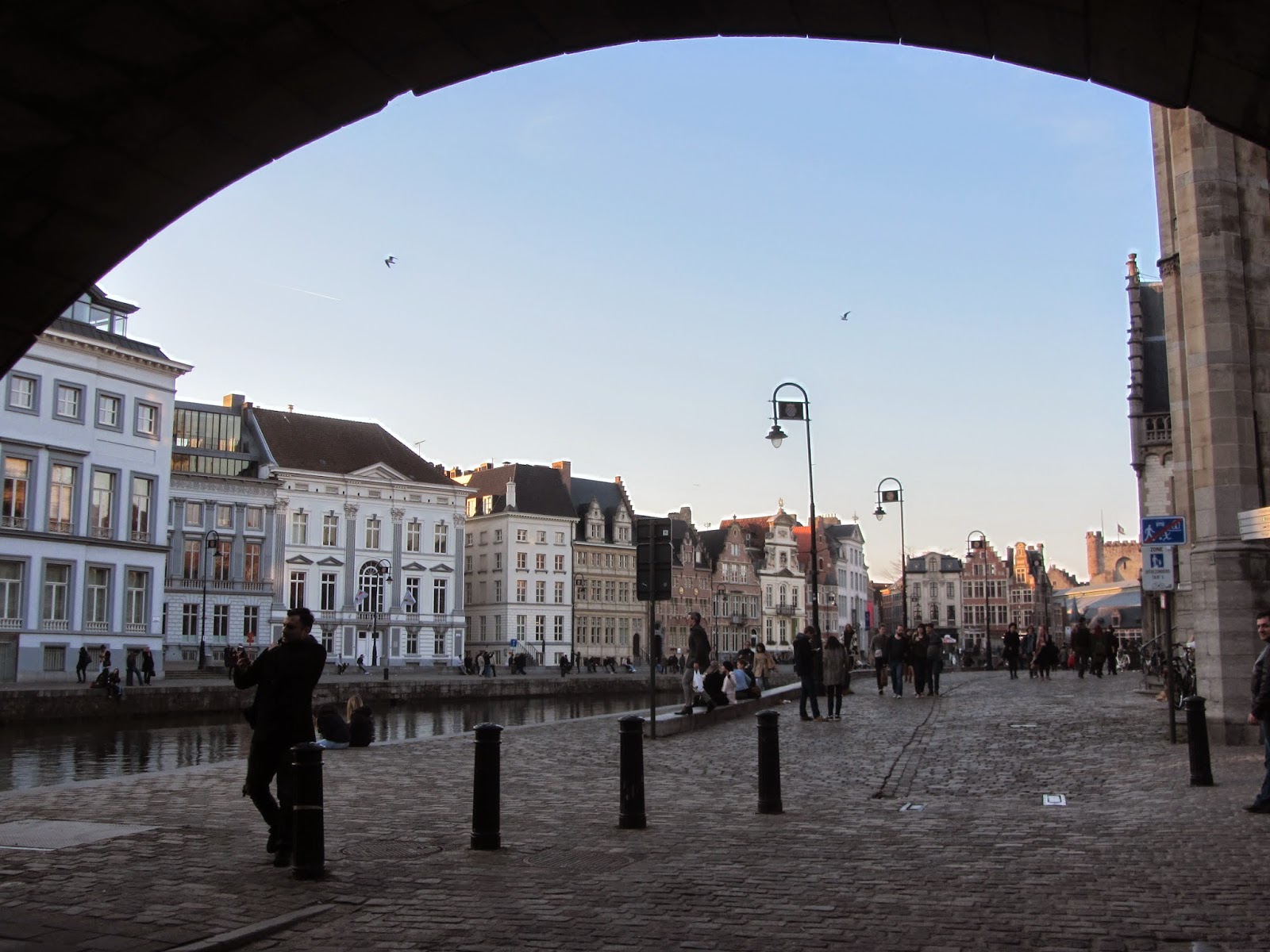
The old town proper started with the palace of justice and the public square in front of. A golden barge emphasised the grandeur of the place and tempted me over the bridge.


There were lots of bridges and I spent the next half an hour or so crossing lots of them as the middle of a bridge is the best place to get views like this, a view with two more bridges in it.

The city was lively on both banks. There were plenty of cafes, bars and restaurants, all of which looked busy. There were also seats and steps where people congregated to meet and drink the many cans they had brought.


Just in from one of the main waterways was Korenmarkt (Corm Market, obviously), a large square filled with restaurants. I chose a bistro that had a spare seat inside (it was moving from chilly to cold). It looked like a bit old fashioned but appearances were deceptive and the excellent food was presented in the style of a gasto pub.

When I came out after my meal the sun had all but given up for the day and could only reach the top of the buildings.


The gloom was no excuse for ending the exploration and I continued my wanderings around the centre of the city safe in the knowledge that I would have plenty of time to come back over the next three days if I found something that needed sunlight to be properly appreciated.

I was following an interesting road through the largely car-free centre when a lot of lights suddenly sprung on to highlight the back of the town hall. I learned later that Ghent made a feature of subtle lighting.

Walking around to the square in front of the town hall I discovered this amazing pavillion.


The futuristic wooden roof was a refreshing contrast to the traditional brick and stone buildings around it. Not only did it look great but it had wonderful acoustic properties that amplified the efforts of a busker at one end. I was tempted to shout to test the acoustics myself and it was only the fact that nobody else fell into this temptation that stopped me.

It was a fitting place to end my exploration and from there I walked the 2km or so south back to my hotel.

The first day in Ghent had delivered much and promised more.

09 March 2014

The Comic Strip Walk in Brussels is brilliant


If I had known beforehand that there was a Comic Strip Walk in Brussels then I would have gone there years ago. It became such an important part of my week in Brussels that it warrants

And when I did get to Brussels it took me a while to find out that the walk was there. I discovered the first two pictures, starting with Tintin above, by accident and it was a couple of days before I realised that the yellow speech bubbles with numbers in them on the map marked the drawings and that the blue lines connecting them were suggested walking routes.


Once I had worked out where the pictures were that guided my remaining time in Brussels.

Comics were not all that I did but when exploring a new part of the city I made sure that I saw all the drawings in the area even when it meant taking detours or doubling-back. It also helped me to decide which parts of the city to explore.

For example, I sought these two out on the Saturday when I went to the west of the city centre.

I recognised a few of the characters either from my previous knowledge of comics or from my visit to the Belgian Comic Strip Centre earlier in the week.

Those that I did not know I found out about from the handy guide and map from Tourist Information. This was about the size of a credit card an unfolded to the size of 2 A4 sheets.

There was a separate guide for Tintin which I also got but I had to settle for my third choice language version, German, and the English and French versions had sold out. This guide covered all of the Tintin related displays in Brussels, including the display at Midi that I found on my previous visit, and also had buildings in Brussels that featured in Tintin stories.


Young Albert, the boy in the red coat, played tricks on people in post-war Brussels and I liked the period look of this large piece with its old tram and cinema.


The character here is XIII who I did not know but the author, Jean van Hamme, also wrote Lady S who I did. Here I also liked the way that the street clutter, e.g. the sign on the left and the lamp on the right, were echoed in the picture.


I hope that everybody knows that this is Asterix (at the bottom with the winged helmet) here running with his friends including the large Obelix in the centre.

This was part of a large of a much larger picture but I could not get a satisfactory photo of all of it at once because it was in a school yard (hence the basketball hoop and goalposts) and there was a large fence in the way.


Another character that I knew was Lucky Luke who had been appearing in comics since 1946 and was still going strong.

It was claimed that he could shoot faster than his shadow and I like the way that the picture shows this. I also like the relationships between the four bandits and the wanted poster. Putting the Atomium in the background was another neat idea.


It was very hard to choose which of the comics to include in this summary and, to be honest, I have mostly gone for the ones that I took in landscape as they fit the blog format better. Unfortunately most of them were tall and thin, because that was the shape of the walls that they were drawn on, and so suited portrait more.

I chose these last two pictures because of the way that they work in their location.

The one above shows the characters (Broussaille is on the right) in the place where the picture was drawn so on the wall above the umbrellas you can see a copy of the drawing in the drawing. I liked that.

Broussaille was the first comic strip mural in the series to be drawn and dates from 1991. The pictures have aged well over the last twenty years and while the graffiti that some of them have acquired is to be regretted it is usually away from the main parts of the pictures and, in some cases, even makes them look more natural.

The final choice was a lot of fun and looked so realistic. The hero rescuing the damsel from the distress of the knife-wielding villain is Ric Hochet.

The selection of comics here is just my 9 best-of selection from the 27 that I saw. There are 50 places on the tour so I have a good excuse for going back.

I loved everything about the Comic Strip Walk; any street art is good and it was wonderful to see comics rather than statues for a change, the individual pictures used their unusual spaces imaginatively, the way that they were spread across the city encouraged exploration off the main tourist routes and many of the pictures were in heavily residential areas and so were there for the locals to enjoy more than tourists.

My only regret is that this brilliant idea has not been copied. I would even go to Dundee, home of D. C. Thomson, to see something similar done with characters from Beano and Dandy.

A farewell to Brussels


I had planned my trip to Brussels to get as much time there as possible. I got a train reasonably early on the Saturday morning when going there and took one back late in the afternoon on the following Sunday. That gave me a fair chunk of Sunday to have a final walk around.

I checked out of the hotel (the neat, functional but somewhat uninspiring Radisson Blu Royal Hotel) around 10am and left my bags there to be collected at 2pm.

I then headed back towards where I had been the previous evening because there was something there that I wanted to see again.

Along the way I took the usual pictures of the interesting buildings but I have shown plenty of those in previous posts so this time I thought that I would show some of the arty things instead.

These arty things came in three main varieties; street art, shop signs and graffiti, and I'll include some of all three starting with the three graffiti pigs above and the sex shop sign to the right.

I wandered through the Grand Market for one last time and then south to Coal Market before crossing the main road west to a park that looked attractive.It was on the way there that I found a series of aggressive pictures on a wall. I have absolutely no idea what they were about but I liked the angry red figures.


The reason that I was walking past the angry red figures was to get close to this large mural on a building (a school?) next to a park.

It looked like a series of panorama shots taken with an iPhone.

What I liked about it was its the way it showed people in places, which is what communities are. The pictures showed a real sense of belonging and helped to conform the human aspect of Brussels that had impressed me over the previous week.

The main objective of my walk was to get back to the former market Halles Saint-Géry. When I had walked past it on the previous evening it was packed inside and out with young people having a convivial drink with friends.

I liked that atmosphere of the area but it was the building that I went back to see. There is something about markets that I love and I have found nice ones in most places that I have been, even in the brutally ugly Sofia.


The inside was as gorgeous as I hoped and, even better, there were things in there to see.

But first I had a beer.

On the ground floor on the right was an exhibition on lifts. As well as historical photographs this included a wonderful art deco lift cage and some extracts from films that featured lifts. It was great to see a little bit of the Marx Brothers in The Big Store (1941).

At one end of the ground floor was a set of deckchairs. I never did work out why. Also at that end, you can see it just in front of the main pillar, was the opportunity to photograph yourself at the Manneken Pis, though why you would want to do this is beyond me.

Upstairs there was a display about Victor Horta, which was much more my thing. The simple but effective display boards covered Horta's main buildings in Brussels. They explained their histories (e.g. who commissioned them), the main design principles and features and showed these off with period photographs.

Without planning it, Horta had become a significant part of my time in Brussels and was one of the reasons that it was such a good break.


I had one regret about my week in Brussels, and it was only a small one. The good weather and fine walking kept me out of the main museums and galleries (I would have found time for the museum of modern art if it had been open). The one exhibition that I was hoping to find time for was The Art of The Brick which had works of art made from Lego.

All too soon it was 2pm and time to take the metro to Midi and then the Eurostar home. It had been a good break and one that reaffirmed my belief that by-and-large the countries in north Europe get things right, and we could learn from that.