Showing posts with label amsterdam. Show all posts
27 June 2012
The Amsterdam Style
Amsterdam is famous not just for its canals but also for its Amsterdam Style of architecture that gives the centre a consistent and cosy feel.
I took tons of photographs but I'll be kind and share just five of my favourites here.
I love brick and there is an awful lot of it here.
It is very pretty brick too that is prevented from being oppressive by rows of neat regular windows and playful decorations above them.
A lot of the windows are shuttered and those shutters are thrown wide open to show off their bright colours. Red is most popular.
An unintended feature of the buildings is that a result of building on wooden piles below sea-level. Sometimes they move and that makes the building lean.
Nobody seems to be too concerned by this and leaning buildings are not just tolerated they are as well looked after as any other building. I guess that if they have been leaning for ages then they are not going to fall over too easily.
Occasionally some concessions are made to the leaners but that is just to fix the appearance by, for example, filling a gap between two buildings that now lean away from each other.
Dutch gables are pretty common, if not ubiquitous, so I spent a lot of time looking up as I walked around.
Actually I do that in every city as the crushing uniformity of world-brands often stops at the ground floor and the history is preserved above.
This building makes the last five because it ticks all the right boxes; it has the brick, windows, shutters and gable. And it's beautiful.
The old-fashioned lamp post in the front adds that little extra too. I am not sure if this one actually is old as they are busy replacing the old ones with new ones that look the same (purple) but have different lights.
The final building was selected for its pristine condition (though that is hardly unusual as the other pictures show) and for the decorated gables.
All this just goes to show that Amsterdam is a great place to go for people who like to stroll through cities to soak up their character and history. People like me.
More stories like this:
amsterdam,
architecture,
nl,
travel
25 June 2012
Amsterdam means canals
Ever since I saw Puppet on a Chain (twice in one sitting) way back in 1971, Amsterdam has meant canals to me and naturally they were a key part of my city break there.
The hotel that I chose was sandwiched between two of them, each about 20m from the front door.
All my many walks around the town involved walking alongside them for long stretches and crossing over them frequently too.
In the centre of the town the canals are narrow and slide neatly between tidy residential streets. The small boats along each side are testament to the continuing usefulness of the canals for getting around the town.
The wider canals take bigger boats and while these days they are designed to be shallow enough for all the bridge this was not always the case and many of the bridges can lift to let taller boats through.
For some reason they did not pick one one design and keep to it and their are a variety of lifting mechanisms in place, some of which are still used. Others are kept for decoration, and I have no objections to that.
The paths either side of the canals vary greatly too.
A few are so narrow that they only allow pedestrians and the ubiquitous cyclists passage. Some are just about wide enough for cars who have to fight for space with the other road users. Only a few of the larger canals have the familiar (to us) roads and pavements.
Amsterdam is one of the cities that is sometimes known as the "Venice of the North" but the comparison is mostly false.
It is just the Red Light District that has the small bustling lanes that characterise Venice.
Elsewhere the tourists are far fewer and the city is remarkably quite even in parts of the city centre.
The canals also carry the proud hallmark of careful planning as they form a series of orderly horseshoes around the centre.
Canals mean bridges and, as with the paths, a good few of these are for pedestrians only and that only heightens the sense of calm.
Helpfully some of the bridges are clearly named with signs that decorate as much as they inform.
Amsterdam's canals are it brand. They are etched visibly across the city and they define it and shape it. They are a barrier to some and provide passage to others, they drag peace in to the heart of the city, and they provide vistas like no others.
The hotel that I chose was sandwiched between two of them, each about 20m from the front door.
All my many walks around the town involved walking alongside them for long stretches and crossing over them frequently too.
In the centre of the town the canals are narrow and slide neatly between tidy residential streets. The small boats along each side are testament to the continuing usefulness of the canals for getting around the town.
The wider canals take bigger boats and while these days they are designed to be shallow enough for all the bridge this was not always the case and many of the bridges can lift to let taller boats through.
For some reason they did not pick one one design and keep to it and their are a variety of lifting mechanisms in place, some of which are still used. Others are kept for decoration, and I have no objections to that.
The paths either side of the canals vary greatly too.
A few are so narrow that they only allow pedestrians and the ubiquitous cyclists passage. Some are just about wide enough for cars who have to fight for space with the other road users. Only a few of the larger canals have the familiar (to us) roads and pavements.
Amsterdam is one of the cities that is sometimes known as the "Venice of the North" but the comparison is mostly false.
It is just the Red Light District that has the small bustling lanes that characterise Venice.
Elsewhere the tourists are far fewer and the city is remarkably quite even in parts of the city centre.
The canals also carry the proud hallmark of careful planning as they form a series of orderly horseshoes around the centre.
Canals mean bridges and, as with the paths, a good few of these are for pedestrians only and that only heightens the sense of calm.
Helpfully some of the bridges are clearly named with signs that decorate as much as they inform.
Amsterdam's canals are it brand. They are etched visibly across the city and they define it and shape it. They are a barrier to some and provide passage to others, they drag peace in to the heart of the city, and they provide vistas like no others.
23 June 2012
The Museum of the Amsterdam Canals
The Dutch name for this museum, Het Grachtenhuis, translates as Canal House which is a better name for it than The Museum of the Amsterdam Canals as it says very little about canals.
What it says a lot about is the history of Amsterdam and it does this through the stories of real people.
This was my third history of Amsterdam in three days. The other two had primarily looked at buildings and planning so the people angle was different again.
The Canal House (as I shall now call it) was easily technically the cleverest museum that I have ever been to and the clever things were very clever without being so clever that they swamped the story that they were trying to tell.
You have to have the audio guide and that is magic too. It knows what room you are in and tells you the appropriate story. In some of the rooms you can choose additional stories too.
The main part of the museum, up on the first floor is where all the clever stuff is.
There are a series of rooms and each one does something involving movement and sound.
In the first room you sit and watch a short video (if that's the right word) of the early history of Amsterdam.
All the buildings and backdrop here are white and images play across them.
This is a clever way of showing the seasons and major events like fires.
Another room shows some of the houses being built and little models inside can be seen cutting wood and knocking it in to place while the audio commentary adds the sounds of construction.
A highlight was the cleverest room.
A model house shows how each of the rooms would have been used while video (again the word is wrong) figures enacted little scenes for us.
If you look carefully you can see the piano through the pianist.
Each room in the house has its own story that you can select from the commentary. Surprisingly the English translation is very modern and very good.
The rooms are laid out in a circuit and there is one way through. I wish I had understood that from the outset and then I would have spent more time in the map room and taken some pictures there.
At one point you are asked to look outside through a window at the garden below where, you are told, the flower bed has been divided with metal sheets to show the pattern of houses in a specific street. Most of the plots are the same size but richer people bought two plots together to build one large house.
Another room had a large model of Amsterdam and I mentioned in a previous post that I always take photos of such models, and I did.
There was another film in this room and that required the shutters to open and close, which they did all by themselves.
This was a good room and I sat through the film twice.
I think some of the guides who were making sure that people did not get lost or stuck were getting a little bemused by then at how slowly I was going round. There was so much to see and I wanted to see it all.
The ground floor was a touch more traditional though we still had the audio guides and one room was stuffed with iPads promoting their Go!Canals app.
We were told the story of one of the previous owners of the house. A family had fled to Amsterdam from the south (that seemed to happen a lot) and set up in banking and architecture.
For a while they owned a chunk of the new territories in what is now the USA before it got occupied by land-grabbers they had to sell it.
The reception rooms of the Canal House are decorated as they would have been when the house was built and on display are several items relating to the house and its first occupants, such as these plans for the house, paintings and some business accounts.
By focusing on the people who lived through the history the Canal House tells that history in an engaging way that imparts knowledge while pretending to be simple entertainment. Nice trick.
What it says a lot about is the history of Amsterdam and it does this through the stories of real people.
This was my third history of Amsterdam in three days. The other two had primarily looked at buildings and planning so the people angle was different again.
The Canal House (as I shall now call it) was easily technically the cleverest museum that I have ever been to and the clever things were very clever without being so clever that they swamped the story that they were trying to tell.
You have to have the audio guide and that is magic too. It knows what room you are in and tells you the appropriate story. In some of the rooms you can choose additional stories too.
There are a series of rooms and each one does something involving movement and sound.
In the first room you sit and watch a short video (if that's the right word) of the early history of Amsterdam.
All the buildings and backdrop here are white and images play across them.
This is a clever way of showing the seasons and major events like fires.
Another room shows some of the houses being built and little models inside can be seen cutting wood and knocking it in to place while the audio commentary adds the sounds of construction.
A highlight was the cleverest room.
A model house shows how each of the rooms would have been used while video (again the word is wrong) figures enacted little scenes for us.
If you look carefully you can see the piano through the pianist.
Each room in the house has its own story that you can select from the commentary. Surprisingly the English translation is very modern and very good.
The rooms are laid out in a circuit and there is one way through. I wish I had understood that from the outset and then I would have spent more time in the map room and taken some pictures there.
At one point you are asked to look outside through a window at the garden below where, you are told, the flower bed has been divided with metal sheets to show the pattern of houses in a specific street. Most of the plots are the same size but richer people bought two plots together to build one large house.
Another room had a large model of Amsterdam and I mentioned in a previous post that I always take photos of such models, and I did.
There was another film in this room and that required the shutters to open and close, which they did all by themselves.
This was a good room and I sat through the film twice.
I think some of the guides who were making sure that people did not get lost or stuck were getting a little bemused by then at how slowly I was going round. There was so much to see and I wanted to see it all.
The ground floor was a touch more traditional though we still had the audio guides and one room was stuffed with iPads promoting their Go!Canals app.
We were told the story of one of the previous owners of the house. A family had fled to Amsterdam from the south (that seemed to happen a lot) and set up in banking and architecture.
For a while they owned a chunk of the new territories in what is now the USA before it got occupied by land-grabbers they had to sell it.
The reception rooms of the Canal House are decorated as they would have been when the house was built and on display are several items relating to the house and its first occupants, such as these plans for the house, paintings and some business accounts.
By focusing on the people who lived through the history the Canal House tells that history in an engaging way that imparts knowledge while pretending to be simple entertainment. Nice trick.
22 June 2012
The Amsterdam Museum in, er, Amsterdam
Another damp day in early June in Amsterdam which meant finding another museum to shelter in.
And that's not a problem as Amsterdam has its fair share of museums and it is a small city so they are are close by.
The one I chose was the nearest, because it was the nearest, and that was the Amsterdam Museum.
Like the V&A in London, this has been pulled together from several building in the same area and retains their original layouts so, as a whole, it is bit of a confusing mess. Even with a map, and they copied theirs from the V&A too.
First it was upstairs to see the story of Amsterdam as it grew from a ditch to one of Europe's most vibrant cities. Here we got the good news that the Amsterdam Museum is one of the highest points in the city at 1.2m above sea level. Other parts have more confidence in the dikes than I think I would have.
The chronology runs along the length of a long room and seems to be aimed at people just like me, which is good because I am just like me.
The story flows logically (as time tends to) and the curators have selected some quirky incident to highlight along the way.
The red map of Amsterdam repeats and is bigger each time.
Unlike London, the growth is always in to pastures new, there are no villages to sweep up along the way, and this has enabled Amsterdam to keep its focus on the centre (where is the centre of London these days?).
The medieval street pattern is still very clear today as are the patterns of expansion.
Moving across the walkway to another building and going down then up (or was it up then down?) some steps takes you in to the main part of the museum where certain aspects of the history are expanded on.
A recurring theme here and in other museums is the planning that went in to Amsterdam.
All of Amsterdam's expansions have been carefully designed and controlled. It all fits together, it all feels the same, and it works.
I forget which phase of development this was, and that does not really matter. What is shows is various stages of planned and actual growth. This is a degree of planning that London gave up to speculative developers ages ago.
The museum continues its V&A look and feel in the other hard-to-find-again rooms that show aspects of Amsterdam's history in objects, drawings and film.
For some reason I did not take a photo of Rembrandt's painting of a brain being dissected with the skin peeled off the head of the corpse. Not really my cup of tea.
Kitchens are though. This is a reconstruction of one from a development that at the time would have seem very modern.
It is also designed to be functional and takes account of how people work and move in a kitchen. This was a novel idea then.
Similarly this painting shows the hopes and aspirations of another new development.
This photograph shows how much of a blank canvass planners had to work on.
The land is flat and there are no natural features to work around or fight with. Water is the natural enemy but that can be tamed with pipes and sluices.
While Amsterdam was building low-rise blocks like these London was experimenting with tower-blocks and mock-Tudor villages. Both failed in their own way.
Amsterdam has always allowed plenty of space between the buildings too so there is less of a split between urban and suburban areas - they all have space but not the profligate private space that our suburbs have.
If you put a model of a city in a museum then I am going to take a photograph of it.
It is either that or come up with a cunning plan to steal it.
This one is just lovely.
Here the zone and grid design is clear to see, as the parks and waterways.
I have focused on the maps and models because that is what I like the most but I do not want to give the impression that this is all the museum has, or even that this is what most of it is like.
I could have shared pictures of furniture, toys, fabrics, paintings, ceramics and plenty of the stuff. I did not simply because I ran out of space and wanted to show what interested me the most.
The Amsterdam Museum kept reminding me of the V&A and not least because there were unexpected surprises around every corner and I found interesting things that I did not know were going to be interesting before I found them. Like a kitchen.
The Amsterdam Museum is most definitely worth a visit, even if it is not raining.
And that's not a problem as Amsterdam has its fair share of museums and it is a small city so they are are close by.
The one I chose was the nearest, because it was the nearest, and that was the Amsterdam Museum.
Like the V&A in London, this has been pulled together from several building in the same area and retains their original layouts so, as a whole, it is bit of a confusing mess. Even with a map, and they copied theirs from the V&A too.
First it was upstairs to see the story of Amsterdam as it grew from a ditch to one of Europe's most vibrant cities. Here we got the good news that the Amsterdam Museum is one of the highest points in the city at 1.2m above sea level. Other parts have more confidence in the dikes than I think I would have.
The chronology runs along the length of a long room and seems to be aimed at people just like me, which is good because I am just like me.
The story flows logically (as time tends to) and the curators have selected some quirky incident to highlight along the way.
The red map of Amsterdam repeats and is bigger each time.
Unlike London, the growth is always in to pastures new, there are no villages to sweep up along the way, and this has enabled Amsterdam to keep its focus on the centre (where is the centre of London these days?).
The medieval street pattern is still very clear today as are the patterns of expansion.
Moving across the walkway to another building and going down then up (or was it up then down?) some steps takes you in to the main part of the museum where certain aspects of the history are expanded on.
A recurring theme here and in other museums is the planning that went in to Amsterdam.
All of Amsterdam's expansions have been carefully designed and controlled. It all fits together, it all feels the same, and it works.
I forget which phase of development this was, and that does not really matter. What is shows is various stages of planned and actual growth. This is a degree of planning that London gave up to speculative developers ages ago.
The museum continues its V&A look and feel in the other hard-to-find-again rooms that show aspects of Amsterdam's history in objects, drawings and film.
For some reason I did not take a photo of Rembrandt's painting of a brain being dissected with the skin peeled off the head of the corpse. Not really my cup of tea.
Kitchens are though. This is a reconstruction of one from a development that at the time would have seem very modern.
It is also designed to be functional and takes account of how people work and move in a kitchen. This was a novel idea then.
Similarly this painting shows the hopes and aspirations of another new development.
This photograph shows how much of a blank canvass planners had to work on.
The land is flat and there are no natural features to work around or fight with. Water is the natural enemy but that can be tamed with pipes and sluices.
While Amsterdam was building low-rise blocks like these London was experimenting with tower-blocks and mock-Tudor villages. Both failed in their own way.
Amsterdam has always allowed plenty of space between the buildings too so there is less of a split between urban and suburban areas - they all have space but not the profligate private space that our suburbs have.
If you put a model of a city in a museum then I am going to take a photograph of it.
It is either that or come up with a cunning plan to steal it.
This one is just lovely.
Here the zone and grid design is clear to see, as the parks and waterways.
I have focused on the maps and models because that is what I like the most but I do not want to give the impression that this is all the museum has, or even that this is what most of it is like.
I could have shared pictures of furniture, toys, fabrics, paintings, ceramics and plenty of the stuff. I did not simply because I ran out of space and wanted to show what interested me the most.
The Amsterdam Museum kept reminding me of the V&A and not least because there were unexpected surprises around every corner and I found interesting things that I did not know were going to be interesting before I found them. Like a kitchen.
The Amsterdam Museum is most definitely worth a visit, even if it is not raining.
More stories like this:
amsterdam,
architecture,
museum,
nl,
travel
20 June 2012
EYE on the Amstel
This was the third leg of a carefully planned day exploring the architecture of Amsterdam.
The day started with a walk around Zeeburg and continued with an exploration of NEMO and its neighbours.
To complete my objectives for the day I had to make the short walk north to the Central Station.
This looks and behaves just like a major station should. The building is both functional and decorative and has before it a large square where you can catch buses and trams.
But I was looking for another form of transport. Walking through the station takes you directly to the harbour side where ferries shuttle people and their bikes between the north and south shores.
There are three ferries that leave from adjacent docks. And that is my excuse for getting on the wrong one.
But that was no problem as the ferries are free and are walk-on-walk-off with no barriers, tickets or other such mularky.
The wrong ferry did not go very far so I just got off it long enough to take its picture before it turned around just a couple of minutes later.
It was second time lucky and the next ferry was the right one. That was just as well as the third ferry took a much longer route down the canal to the west and that would have been a much longer round trip.
The inadvertent detour was also an opportunity as a boat trip across a busy harbour is always worth doing.
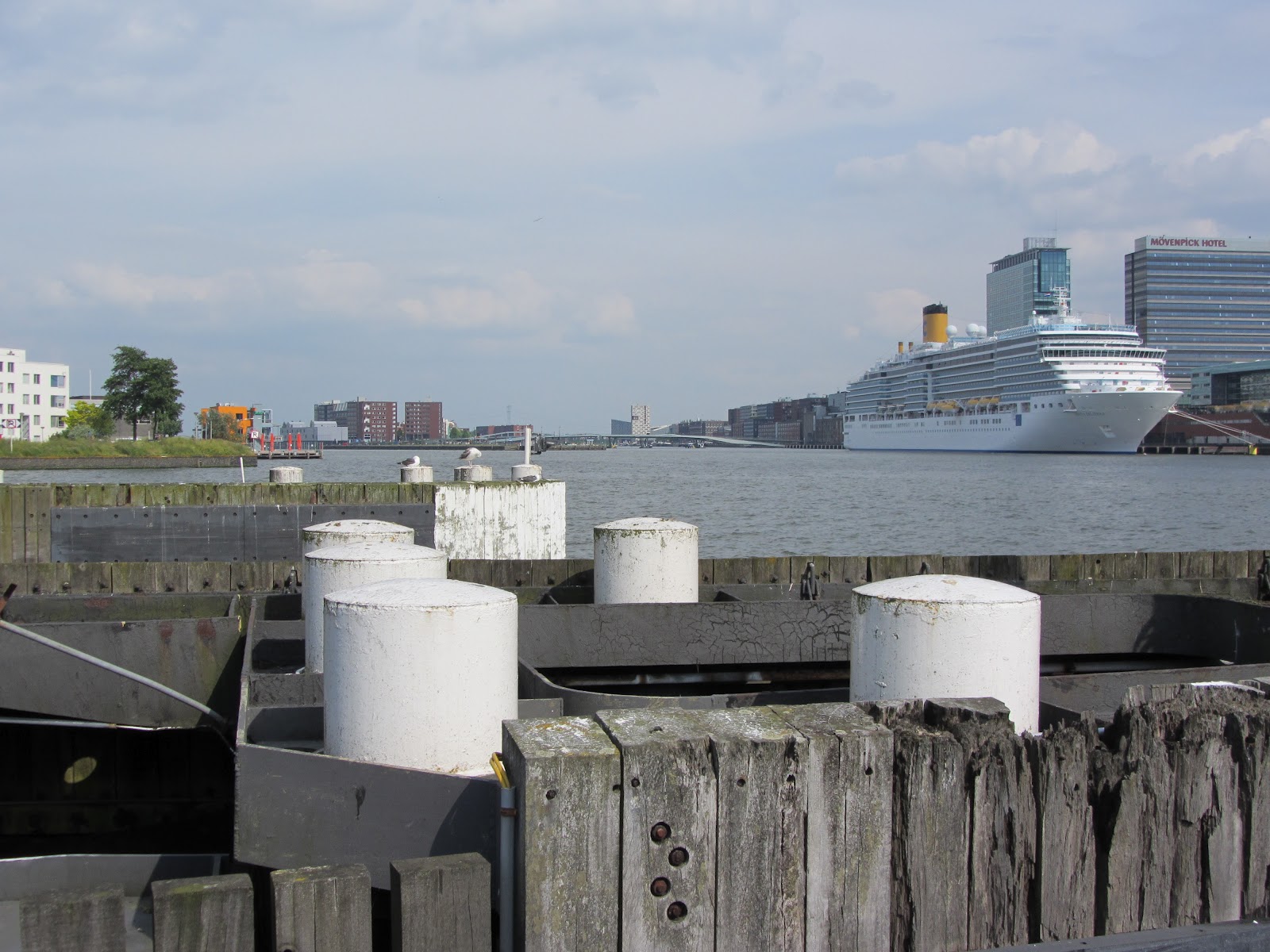
One of the more obvious sights was the vast cruiser moored at the passenger terminal. Even at a distance it looks big and it dwarfs all but the tallest buildings.
Seeing a boat as big of this in harbour and then head for the Atlantic along the canal made me think of London and how we have let our nautical heritage die with the exception of one or two show pieces like HMS Belfast.
Amsterdam was founded and grew on its nautical trade but, unlike London, it still fully embraces the water. I live just a couple of hundred meters from the Thames yet the only time that I go on boats is when I am on holiday.
Getting off the right ferry brought me directly to the building that I had come to see, the EYE Film Institute, and you can see why it interested me.
One of the ways that I fuel my interest in architecture is through the blog A Daily Dose of Architecture and that introduced me to the EYE earlier this year.
The building is clearly designed to be striking and is a riverside cultural monument in much the same way that the South Bank Centre is in London or the Opera House in Oslo.
The more obvious comparison is with Oslo due to the sloping white lines. Sadly you cannot climb these slopes.
Inside it is spacious and fresh if a little familiar in that this could be the interior of any number of modern buildings.
It is the outiside that is special and luckily that is where the bar is.
The EYE sits on a little headland and from the bar there are sweeping views of the harbour where you can marvel at how such a large boat as the cruiser can pass without hitting any of the other boats.
The return ferry is a chance to consider the ferry terminal on the south side, next to the station.
The metal and glass arches that cover the tracks have been copied by a new arch that covers the road, footpaths and cycle paths that fill the narrow stretch of land between the rails and the river.
The crane is just one of many on the south side that is part of Amsterdam's continual battle for space.
You can also see another one of the blue ferries edging in to the picture. It is pretty hard to take a picture of the harbour without at least one of them in it.
Turning to look back to face north reminds you just why you made the journey in the first place.
The EYE is a sumptuous building and the fact that you have to get there by ferry makes it even more attractive.
The day started with a walk around Zeeburg and continued with an exploration of NEMO and its neighbours.
To complete my objectives for the day I had to make the short walk north to the Central Station.
This looks and behaves just like a major station should. The building is both functional and decorative and has before it a large square where you can catch buses and trams.
But I was looking for another form of transport. Walking through the station takes you directly to the harbour side where ferries shuttle people and their bikes between the north and south shores.
There are three ferries that leave from adjacent docks. And that is my excuse for getting on the wrong one.
But that was no problem as the ferries are free and are walk-on-walk-off with no barriers, tickets or other such mularky.
The wrong ferry did not go very far so I just got off it long enough to take its picture before it turned around just a couple of minutes later.
It was second time lucky and the next ferry was the right one. That was just as well as the third ferry took a much longer route down the canal to the west and that would have been a much longer round trip.
The inadvertent detour was also an opportunity as a boat trip across a busy harbour is always worth doing.
One of the more obvious sights was the vast cruiser moored at the passenger terminal. Even at a distance it looks big and it dwarfs all but the tallest buildings.
Seeing a boat as big of this in harbour and then head for the Atlantic along the canal made me think of London and how we have let our nautical heritage die with the exception of one or two show pieces like HMS Belfast.
Amsterdam was founded and grew on its nautical trade but, unlike London, it still fully embraces the water. I live just a couple of hundred meters from the Thames yet the only time that I go on boats is when I am on holiday.
Getting off the right ferry brought me directly to the building that I had come to see, the EYE Film Institute, and you can see why it interested me.
One of the ways that I fuel my interest in architecture is through the blog A Daily Dose of Architecture and that introduced me to the EYE earlier this year.
The building is clearly designed to be striking and is a riverside cultural monument in much the same way that the South Bank Centre is in London or the Opera House in Oslo.
The more obvious comparison is with Oslo due to the sloping white lines. Sadly you cannot climb these slopes.
Inside it is spacious and fresh if a little familiar in that this could be the interior of any number of modern buildings.
It is the outiside that is special and luckily that is where the bar is.
The EYE sits on a little headland and from the bar there are sweeping views of the harbour where you can marvel at how such a large boat as the cruiser can pass without hitting any of the other boats.
The return ferry is a chance to consider the ferry terminal on the south side, next to the station.
The metal and glass arches that cover the tracks have been copied by a new arch that covers the road, footpaths and cycle paths that fill the narrow stretch of land between the rails and the river.
The crane is just one of many on the south side that is part of Amsterdam's continual battle for space.
You can also see another one of the blue ferries edging in to the picture. It is pretty hard to take a picture of the harbour without at least one of them in it.
Turning to look back to face north reminds you just why you made the journey in the first place.
The EYE is a sumptuous building and the fact that you have to get there by ferry makes it even more attractive.
More stories like this:
amsterdam,
architecture,
nl,
travel
19 June 2012
NEMO and neighbours
After the exploration of Zeeburg I headed for the eastern edge of the town, getting off the tram one stop before the Central Station.
This is an ugly industrial quarter and also home to the cruise ships passenger terminal. A few new buildings improve the area slightly but clearly there is more regeneration to be done.
My immediate target was another regeneration building, the NEMO Science Centre on the end of a long spur in to the harbour. There was a lot of water in the way and I had to cross three bridges to get their, the last of which is in the bottom-right of the picture.
It was the building that interested me, not the Science Centre inside it, though I did take advantage of the coffee bar on the ground floor to rest, drink, eat a little and make use of their free wi-fi.
Then the surprises started.
On the other side of NEMO was a collection of old boats, presumably connected with the Maritime Museum nearby.
Walking along the harbour south away from NEMO I found that you could climb up to the roof via a long set of shallow steps making a tall climb an easy one.
Climbing the steps slowly (I was in no rush to get anywhere) the views gradually changed and in a city that is relentlessly flat it was refreshing to be able to look down on things.
The whole of the rooftop of NEMO is laid out with steps to sit on, some games to play, falling water to paddle in (as people were, of course) and some of the best views in the city.
There was another cafe at the top and I was able to follow my earlier coffee with a leisurely beer while I took it all in. The beer and the views were all the better for being unexpected.
Climbing back down to the old boats I just had to take a picture of this one as Trot, or Trottie, was the name everybody called my Mum.
The other memory evoked by the boats was of the sea plays by Eugene O'Neill.
What I also liked about them was the obvious signs of function. Modern ships are like modern offices with little indication on the outside of how they work or of what is inside them.
In contrast the old boats are littered with ropes, sails, anchors, poles, winches and hooks.
The Maritime Museum is across some more water in a recently refurbished building that sits imposingly on the edge of the water certain that it has every right to be there. And it has.
Opposite, i.e. where I was standing to take this picture was a completely different building, the small, modern and oddly curved ARCAM Architecture Centre.
This was the last surprise of this part of the day's journey. If I had known the architecture centre was there then I would have planned to visit it.
It is a small building with a small exhibition space. It reminded me very much of the main exhibition room at RIBA that is also no size but somehow packed with interesting things.
One of the displays was on the architectural history of Amsterdam showing both how the city has expanded from its original centre and also the sort of buildings that made up each expansion.
The other main display was of a recent architecture competition with pictures and models of some of the entries.
Co-incidentally the winner was the Maritime Museum across the water. It won for a modern glass roof that covers the large courtyard in the centre. Not unimpressive but I thought that it been done many times before including at the British Museum and at Kings Cross Station.
NEMO and ARCAM are just a couple of hundred metres apart, the old boats lie between them and the Maritime Museum is almost in touching distance across the water. That is a lot of interesting stuff in quite a small space.
They are also exactly the sort of things that I go on holiday to see.
This is an ugly industrial quarter and also home to the cruise ships passenger terminal. A few new buildings improve the area slightly but clearly there is more regeneration to be done.
My immediate target was another regeneration building, the NEMO Science Centre on the end of a long spur in to the harbour. There was a lot of water in the way and I had to cross three bridges to get their, the last of which is in the bottom-right of the picture.
It was the building that interested me, not the Science Centre inside it, though I did take advantage of the coffee bar on the ground floor to rest, drink, eat a little and make use of their free wi-fi.
Then the surprises started.
On the other side of NEMO was a collection of old boats, presumably connected with the Maritime Museum nearby.
Walking along the harbour south away from NEMO I found that you could climb up to the roof via a long set of shallow steps making a tall climb an easy one.
Climbing the steps slowly (I was in no rush to get anywhere) the views gradually changed and in a city that is relentlessly flat it was refreshing to be able to look down on things.
The whole of the rooftop of NEMO is laid out with steps to sit on, some games to play, falling water to paddle in (as people were, of course) and some of the best views in the city.
There was another cafe at the top and I was able to follow my earlier coffee with a leisurely beer while I took it all in. The beer and the views were all the better for being unexpected.
Climbing back down to the old boats I just had to take a picture of this one as Trot, or Trottie, was the name everybody called my Mum.
The other memory evoked by the boats was of the sea plays by Eugene O'Neill.
What I also liked about them was the obvious signs of function. Modern ships are like modern offices with little indication on the outside of how they work or of what is inside them.
In contrast the old boats are littered with ropes, sails, anchors, poles, winches and hooks.
The Maritime Museum is across some more water in a recently refurbished building that sits imposingly on the edge of the water certain that it has every right to be there. And it has.
Opposite, i.e. where I was standing to take this picture was a completely different building, the small, modern and oddly curved ARCAM Architecture Centre.
This was the last surprise of this part of the day's journey. If I had known the architecture centre was there then I would have planned to visit it.
It is a small building with a small exhibition space. It reminded me very much of the main exhibition room at RIBA that is also no size but somehow packed with interesting things.
One of the displays was on the architectural history of Amsterdam showing both how the city has expanded from its original centre and also the sort of buildings that made up each expansion.
The other main display was of a recent architecture competition with pictures and models of some of the entries.
Co-incidentally the winner was the Maritime Museum across the water. It won for a modern glass roof that covers the large courtyard in the centre. Not unimpressive but I thought that it been done many times before including at the British Museum and at Kings Cross Station.
NEMO and ARCAM are just a couple of hundred metres apart, the old boats lie between them and the Maritime Museum is almost in touching distance across the water. That is a lot of interesting stuff in quite a small space.
They are also exactly the sort of things that I go on holiday to see.
More stories like this:
amsterdam,
architecture,
nl,
travel
17 June 2012
Bridges and buildings in Zeeburg, Amsterdam
The purpose in going to Amsterdam for a few days was exploration.
The limited research that I did beforehand suggested that the Python Bridge was worth seeing so a plan was formed to explore the Zeeburg area just to the east of the old heart of Amsterdam.
As with a lot of the Netherlands, this is reclaimed land. In this case it was dragged from the sea to provide more housing for the expanding Amsterdam.
Getting there was easy. A short walk towards the new opera house and then a choice of trams east. The No 9 came first.
I bought a daily travel card from the hotel which, for 7.5 euros let me travel anywhere for 24 hours. It works similarly to the Oyster card in London except that you have to swipe the badge when leaving the tram as well as when getting on. There is a conductor on board checking that you do this and who also sells tickets to those that need them.
It is set in a large square that cuts diagonally across the northern of the two artificial spurs built in to water.
Further down there is another diagonal cut, this time it is a wide open space. You start to get a clue for what Town Planning (long abandoned in the UK) can achieve.
The positive impact of good town planning is a subject that we will return to in other posts when I talk about some of the museums.
There are two similar bridges between the two spurs, similar in that they are both constructed of red metal with an open mesh style that offers you good views of the water. The first is a single low span with a smooth path that allows bikes to cross too.
There are large blocks of flats too and while these appear to be designed as (relatively) cheap housing there is the same care and attention to detail with, for example, coloured bricks, interesting windows and rooftop spaces.
The area is well maintained and looked after. There is no litter and no graffiti and, instead, there are flowers and private benches that reinforce the friendly and lived in atmosphere. Again this is so missing from many English developments.
The Python Bridge gets its name, and fame, from its double curve that creates a high channel for boats to pass through. The wooden path follows its own route and weaves a little less that the metal supports do.
At this point the primitive back brain argues that if you can see the water then you can fall in to it whereas the newer front brain points out that the gap is only 10 centimetres and you are considerably wider than that.
The reward for crossing (apart from getting to the other side) is the view from the middle. Looking west back towards the centre where the block we saw at the start of the walk makes a distinctive mark on the skyline.
It is good to see all the boats too. Amsterdam has never forgotten that it lives on the water in the way that London has.
The northern spur has the same feel as the southern and continues the variety of housing.
I could have picked any one of a number of examples and this one got chosen because it is so not England.
We still build twee houses that are a pastiche and a mockery of vernacular styles like Tudor and Georgian.
Amsterdam is bolder and is delighted to build new houses that look new.
Every step back toward the station is a reminder of what Amsterdam does well and England does not.
From the station two trams take me back in to the centre of Amsterdam along a different route and to a different quarter. There one story ends and another one starts. And I'll come to that one soon.
More stories like this:
amsterdam,
architecture,
nl,
travel,
walks
13 June 2012
Dutch Masters and more at Rijksmuseum
To be honest, my intention was to go to the Van Gogh Museum but I knew that would be difficult when the tram driver announced the stop before the museum as the place to get off to join the queue.
And he was right despite the steady rain.
So I got off the tram, caught one back the other way for just one stop (it was raining, remember) and went to the Rijksmuseum instead.
There was bit of a queue here too but it was much shorter, was under cover and was moving fairly quickly. I was inside within ten minutes.
The building has the same proportions and sense of grandeur as, say, the Natural History Museum with a decidedly Amsterdam feel to it with its neat brickwork and steeply pitched roof that is now clad in solar panels.
Inside the Dutch Mastery is immediately on show as you are greeted by this large picture.
And this is exactly why I was not keen on going to the museum in the first place, my expectation of the Dutch Masters is dull pictures of people of no historical importance.
Well painted maybe, but dull.
The dullest of these are the Rembrandts where the boring people are dressed in black and are painted against an ill-defined dark background.
Now that I've got that off my chest it is time for the good news.
There is a lot more to the museum than pictures.
Things like this dolls house that cost more than a typical worker's house at the time it was built.
That probably says as much about the workers housing as it does about this doll's house.
The detail here is amazing and the museum helpfully provides a step ladder to let you get up close to all the rooms.
All you have to do is fight your way through the horde of girls to get there. As a regular commuter in London that was not too much of a challenge!
There was also a lot of porcelain on display most of it relating to the days of the Dutch East India Company.
I could have chosen one of the objects with an oriental flavour, dragons and the like, but the piece that I found most attractive was this bust of some Dutch Queen (probably Mary, not that it really matters).
The museum was busy but not overly so and that made it easy to get to see most of the objects. Some, like the dolls house, were very popular and required a little waiting or jostling, as you would expect.
It helped that the rooms were spacious and with clear routes between them so most of us were walking in the same direction rather than competing with each other.
It feels like the Royal Academy rather than the V&A, both because of its layout and its safe content. There are some unusual things on show but this is nothing like as quirky as the V&A that turns quirkiness into an art form.
Another royal portrait was a big surprise, and a pleasant one.
This is Andy Warhol's 1984 picture of Queen Beatrix Of The Netherlands.
It is part of a series that includes our own Queen (who was busy celebrating her Jubilee while I was in the museum).
It is a simple and effective piece of art and is made more effective here through its shock tactics.
This is a museum full of old pictures of people in dark clothes in dark settings so a touch of colour is somewhat shocking.
At this point a coffee was needed but the refurbishment meant that the museum currently has no cafe, which is all but inexhaustible. At least some of the rooms had benches in where you can sit and rest while pretending to look at some of the pictures.
Amsterdam owes its wealth to sea trade and so you would expect to see quite a few nautical paintings, like this one.
It is always a little odd when visiting a museum in a country that we have had the odd spat with as you get a different perspective on some events and learn about some new ones.
An example of this was the daring raid by the Dutch on Medway that we somehow skipped over in our history lessons. I suspect that this is a case of the Dutch over promoting their achievements, but that may be my English bias.
Finally, there was one Dutch Master that I did like very much.
The Milkmaid by Johannes Vermeer shrieks at you in a way that this photo fails to capture. In real life the yellow and blue are vibrant and turn a typically dull Dutch painting in to something rather exciting.
The use of light featured in a lot of the pictures, either as an experiment to highlight an aspect of the countryside or as a device to artificially draw attention to something in the picture, and while some of those examples had merit it was this picture making use of the light through the window that shows how light can be used to transform a simple image.
The yardstick that I judge museums and galleries by is how easily they swallow time and at the Rijksmuseum took two and a half hours with no effort. And it did that with most of it shut.
Outside the rain had stopped, or eased enough not to matter, so it was a more leisurely walk to the tram stop and the short journey back in to the centre for a coffee and a rest content with a morning well spent.
And he was right despite the steady rain.
So I got off the tram, caught one back the other way for just one stop (it was raining, remember) and went to the Rijksmuseum instead.
There was bit of a queue here too but it was much shorter, was under cover and was moving fairly quickly. I was inside within ten minutes.
The building has the same proportions and sense of grandeur as, say, the Natural History Museum with a decidedly Amsterdam feel to it with its neat brickwork and steeply pitched roof that is now clad in solar panels.
Inside the Dutch Mastery is immediately on show as you are greeted by this large picture.
And this is exactly why I was not keen on going to the museum in the first place, my expectation of the Dutch Masters is dull pictures of people of no historical importance.
Well painted maybe, but dull.
The dullest of these are the Rembrandts where the boring people are dressed in black and are painted against an ill-defined dark background.
Now that I've got that off my chest it is time for the good news.
There is a lot more to the museum than pictures.
Things like this dolls house that cost more than a typical worker's house at the time it was built.
That probably says as much about the workers housing as it does about this doll's house.
All you have to do is fight your way through the horde of girls to get there. As a regular commuter in London that was not too much of a challenge!
There was also a lot of porcelain on display most of it relating to the days of the Dutch East India Company.
I could have chosen one of the objects with an oriental flavour, dragons and the like, but the piece that I found most attractive was this bust of some Dutch Queen (probably Mary, not that it really matters).
The museum was busy but not overly so and that made it easy to get to see most of the objects. Some, like the dolls house, were very popular and required a little waiting or jostling, as you would expect.
It helped that the rooms were spacious and with clear routes between them so most of us were walking in the same direction rather than competing with each other.
It feels like the Royal Academy rather than the V&A, both because of its layout and its safe content. There are some unusual things on show but this is nothing like as quirky as the V&A that turns quirkiness into an art form.
Another royal portrait was a big surprise, and a pleasant one.
This is Andy Warhol's 1984 picture of Queen Beatrix Of The Netherlands.
It is part of a series that includes our own Queen (who was busy celebrating her Jubilee while I was in the museum).
It is a simple and effective piece of art and is made more effective here through its shock tactics.
This is a museum full of old pictures of people in dark clothes in dark settings so a touch of colour is somewhat shocking.
At this point a coffee was needed but the refurbishment meant that the museum currently has no cafe, which is all but inexhaustible. At least some of the rooms had benches in where you can sit and rest while pretending to look at some of the pictures.
Amsterdam owes its wealth to sea trade and so you would expect to see quite a few nautical paintings, like this one.
An example of this was the daring raid by the Dutch on Medway that we somehow skipped over in our history lessons. I suspect that this is a case of the Dutch over promoting their achievements, but that may be my English bias.
Finally, there was one Dutch Master that I did like very much.
The Milkmaid by Johannes Vermeer shrieks at you in a way that this photo fails to capture. In real life the yellow and blue are vibrant and turn a typically dull Dutch painting in to something rather exciting.
The use of light featured in a lot of the pictures, either as an experiment to highlight an aspect of the countryside or as a device to artificially draw attention to something in the picture, and while some of those examples had merit it was this picture making use of the light through the window that shows how light can be used to transform a simple image.
The yardstick that I judge museums and galleries by is how easily they swallow time and at the Rijksmuseum took two and a half hours with no effort. And it did that with most of it shut.
Outside the rain had stopped, or eased enough not to matter, so it was a more leisurely walk to the tram stop and the short journey back in to the centre for a coffee and a rest content with a morning well spent.
07 June 2012
To Amsterdam by train
The double bank holiday at the start of June was an excellent opportunity to take a city break and to miss the Jubilee, so that is what I did.
Amsterdam became the venue of choice thanks to an advert on the Tube saying that you can get there by Eurostar for just £99.
Of course when you actually come to book the dates, times and class of travel that you want it comes to somewhat more than that but it is still an absolute bargain.
It is also an incredibly easy journey to make.
The District and then Piccadilly Lines take you straight from Richmond to St Pancras with the simplest of changes at Hammersmith, you just cross from one side of the platform to the other.
Check-in at St Pancras is easy and there is none of that arrive two hours before the flight to allow time for the security checks nonsense. And once checked in, there is wi-fi and power to keep you occupied for the half hour or so before the train is called.
Then it's a short escalator up to the platform - compare that with the huge distances that you have to travel in most airports.
The train glides off and you sit in your wide seat with plenty of legroom and relax.
Two hours later you are in Brussels.
It is best to leave enough time for the transfer (I missed the train to Koln two years ago when the Eurostar was delayed) but not too much because, frankly, there is not that much to do at the station and even less in the immediate area.
I did wander out a short distance and the only memorable point was discovering Avenue de Stalingrad.
The domestic platforms are new, clean and impressive. My regular stations of Richmond, Reading and Newport look nothing like this.
The Thalys train is impressive too.
And comfortable. I had forgotten that I had treated myself to first class (it is nothing like as expensive to upgrade in mainland Europe as it is in the UK) which meant that in addition to the usual comfortable seat I got a cheese sandwich and a couple of beers.
Time to relax again with the iPod and iPad thanks to the free wi-fi and power.
The two hours fly by and then you are in Amsterdam. I got in just before 6pm which still left plenty of time for the easy walk to the hotel before heading out for the first explore of the holiday.
Arriving relaxed is the biggest advantage of going by train rather than plane. Others are the lack of dead time queueing for security, walking out to the plane and waiting for it to take off, which can be spent on the iPad instead; the extra body space; having something to look at out of the window and keeping in touch with the rest of the world.
This is the third year in a row that I have chosen to go on holiday in Europe by train and I am more convinced than ever that train is the way to travel. And it will only get better once operators like Thalys are allowed to use the tunnel as that will give us direct trains to more locations.
Amsterdam became the venue of choice thanks to an advert on the Tube saying that you can get there by Eurostar for just £99.
Of course when you actually come to book the dates, times and class of travel that you want it comes to somewhat more than that but it is still an absolute bargain.
It is also an incredibly easy journey to make.
The District and then Piccadilly Lines take you straight from Richmond to St Pancras with the simplest of changes at Hammersmith, you just cross from one side of the platform to the other.
Check-in at St Pancras is easy and there is none of that arrive two hours before the flight to allow time for the security checks nonsense. And once checked in, there is wi-fi and power to keep you occupied for the half hour or so before the train is called.
Then it's a short escalator up to the platform - compare that with the huge distances that you have to travel in most airports.
The train glides off and you sit in your wide seat with plenty of legroom and relax.
Two hours later you are in Brussels.
It is best to leave enough time for the transfer (I missed the train to Koln two years ago when the Eurostar was delayed) but not too much because, frankly, there is not that much to do at the station and even less in the immediate area.
I did wander out a short distance and the only memorable point was discovering Avenue de Stalingrad.
The domestic platforms are new, clean and impressive. My regular stations of Richmond, Reading and Newport look nothing like this.
The Thalys train is impressive too.
And comfortable. I had forgotten that I had treated myself to first class (it is nothing like as expensive to upgrade in mainland Europe as it is in the UK) which meant that in addition to the usual comfortable seat I got a cheese sandwich and a couple of beers.
Time to relax again with the iPod and iPad thanks to the free wi-fi and power.
The two hours fly by and then you are in Amsterdam. I got in just before 6pm which still left plenty of time for the easy walk to the hotel before heading out for the first explore of the holiday.
Arriving relaxed is the biggest advantage of going by train rather than plane. Others are the lack of dead time queueing for security, walking out to the plane and waiting for it to take off, which can be spent on the iPad instead; the extra body space; having something to look at out of the window and keeping in touch with the rest of the world.
This is the third year in a row that I have chosen to go on holiday in Europe by train and I am more convinced than ever that train is the way to travel. And it will only get better once operators like Thalys are allowed to use the tunnel as that will give us direct trains to more locations.
Subscribe to:
Posts (Atom)