Showing posts with label compass. Show all posts

11 January 2025

My podcasts (January 2025)

Podcasts have become extremely popular in recent years allowing people to make podcasting their day job which is a far cry from when I first started listening to them in 2006.

I have written about podcasts a few times since then and I did a list of everything that I subscribe to in 2019. It is time for an update.

Looking back at that 2019 list there are a few podcasts that have been cancelled and which I miss greatly; these include Digital Planet, Material World and Stuart Maconie's Freak Zone. There are also several that I have fallen out of love with, hence the need for a new list.

I am not going to go through everyone of them, you can see what they are, but I will say something about some of the new ones.

The FT news briefing is my attempt to listen to financial news that focuses on the finance and leaves the political stuff to other shows. I gave up on all of the BBC finance shows for that reason and while it is far from perfect the FT news, being American based, is at least fairly neutral about UK.

Here Comes The Guillotine is funny chat with a twist of politics and I like that it is very Scottish with a strong dollop of Irish. The different perspective makes it more interesting.

Happy Heat Pump is new and has yet really to find its feet. I expect to be getting a heat pump in the not to distant future and I was hoping that this would help me with the various choices (water or air to water or air) but it, so far, added more complexity, e.g. solar panels and batteries, to what was already a difficult decision.

Trashfuture is an intelligent look at the world today through justifiable cynical eyes and is delivered with humour. I've been to see live recordings, twice.

The World This Week is another attempt to get away from the dreadfulness of BBC and covers the political news with a French perspective.
 
Cory Doctorow's podcast is cantered on his many books, fact and fiction, both of which have a heavy technical content which suits me.

Limelight is a BBC drama podcast. BBC seems not what to do with podcasts and it is unclear how they choose what to release as full podcasts, as podcasts that you can only subscribe to on BBC Sounds and which are just drama shows on BBC Sounds. I like the flexibility of podcasts (e.g. no 30 day limit for listening) and wish BBC would release more drama that way.

Moral Maze is there because sometimes we have Humanists debates on the same topics. It usually a pretty poor discussion and it drives me mad. I should stop.

The Political Fourcast is another BBC alternative, this time UK politics from Channel Four.

99% Invisible is a gem. It talks about design in a way that entertains and informs in equal measure. Unmissable.

No Gods No Mayors and Well There's Your Problem are adjacent to Trashfuture but lack its precise direction. If I walked less and so had less time to listen to podcasts then I would probably drop these.

The War on Cars does what is says on the tin. It is American where the car problem is even greater but the problems and solutions they discuss apply to us too.

Page 94 is a Private Eye fill-in between the print issues and is excellent.

It's Bloody Complicated is a political discussion from Compass, an organisation that I belonged to for a while. Not particularly original or challenging but it is good to hear something from the centre-left.

BBC Best of Today stopped before I could unsubscribe and is only here because of the special Christmas programmes where they have guest editors. If it every comes back properly then I will unsubscribe.

Trash Talk and Uncensored are comedy podcasts by well known comedians who manage to make some good political points along the way.

Michael Spicer No Room is a topical sketch show which manages to stand head and shoulders above the many other topical sketch shows. There has been one full series and a couple of once-offs. I am hoping for a lot more.


26 February 2018

Democracy for the many, not just the few


I was invited to this event my a Facebook friend and being interested in democracy I was glad that it was on a theatre-free evening so I could attend. The location suited me too though the 7pm start was bit of a challenge (theatres normally start at 7:30pm), luckily the staff at Wagamama were up to the challenge and I was in and out of there within twenty minutes.

I liked the format of the evening, which was not unlike Gurteen and LIKE events that I go to. We started with four speakers limited to just five minutes each (I'm not sure they all managed that) on why they thought Proportional Representation (PR) is a good think for democracy and for Labour. We then collected in four self-selecting groups to address four different questions. We did this for about half an hour before regrouping for a brief summary session.

As usual at these sort of events I talked a lot and struggled to keep notes while doing so. What follows is some highlights from those notes and some subsequent expansion of those ideas made after the event.

It was not clear whether democracy was seen as a good thing in itself, even though it can lead to the German stand-off situation, or whether it is the outcomes it is assumed to produce, like less inequality, that are important. This is very important as if we do not know what it is that we are trying to achieve and what the principles are that drive this, then we lack purpose and direction.

Everybody seems to agree that First Past The Post is deeply flawed not least because it creates many cases, such as Labour voters like me in Richmond Park, where my vote does not count as my party has no realistic hope of ever winning the seat. The problem is what system to replace it with as every system has strengths and weaknesses, e.g. they may balance proportionality with local accountability. At times it felt like we were saying PR means PR and were scared to go into what PR really means when we know that is a bad approach from the Brexit shambles.

The mood in the meeting was mixed on whether Labour should commit to one form of PR before the next General Election or not. My view is that we should. We should have a clear idea of what system is best and try to get other parties to agree to this before the election so that it can be implemented afterwards having already achieved majority support from the electorate. I also think that to be vague on this issues opens Labour open to the suggestion that they are looking to change the voting system just to suit them, much as the Lib Dems (probably rightly) were blamed for supporting AV.

If PR is a principle that we, Labour, believe in then we should insist that it applies to every election, particularly local elections. Most, if not all, of the regional assembly elections already use some form of PR.

There is a lot more that Labour could, and should do, to reinforce democracy than just change the voting system. We should address issues like voter registration, party funding (particularly by corporates) and also when we vote, Thursday evening does not suit everybody. It is good that we have committed to reducing the voting age to 16 and we should do more things like that.

There was some discussion about the Lib Dems and whether they should be included as a progressive party, particularly when on the one chance they had they put the Conservatives in power. I think of Lib Dems as Tories but the meeting was split on that.

We only discussed different PR schemes in passing but I think that I hardened towards the idea of top-up lists where most MPs/Councillors/etc. are elected as they are now with a few additional people  then appointed from party lists to make the overall totals roughly proportional. This is not straightforward, none of the system are, as, for example, it would create two classes of representatives and those from the lists would be seen by some as getting "jobs for the boys".

It is good that people are talking seriously about improving our democracy but I would like those debates to be more clearly driven by principle than opportunity, to cover all aspects of democracy and to be more detailed.

01 December 2014

Informative but directionless Compass debate on immigration

I go to far fewer political meetings than I would like, which I think says more about the lack of political discussion in this country at the moment than it does about me, so I was pleased to be able to go to a Compass event on EU Immigration fears: Who is to blame?

The timing, 5pm, was a little awkward because they had to meet the needs of the various presenters but the location was close to Victoria station and I was able to work in London that day and to get away at 4:30pm to make it on time.

The event was supported by Friedrich Ebert Foundation, a German think-tank. This meant that there was a decent menu, mince pies to go with the coffees on arrival and some refreshments afterwards.

I sat at a table at the back. I like to sit at the back of meetings as that gives me a view of the other people there so it is easier to judge the meeting overall and also to decide when to join in.

I was pleasantly surprised to be joined there by Alf Dubbs (now Baron Dubbs) who I had campaigned for when between jobs in 1992 and who I had met only the year before at the BCSA Annual Dinner. We had a short conversation and I was pleased that he remembered me.

The discussion on immigration was introduced by Neal Lawson then we had short talks from Michael Orton Senior Research Fellow Institute for Employment Research at University of Warwick, Martin Seeleib-Kaiser Barnett Professor of Comparative Social Policy and Politics Oxford University and (arriving a little late because of divisions in the House) Lisa Nandy MP Shadow Minister for Civil Society and Compass regular.

The usual disclaimer; these are my notes taken from the speakers, the other people at the meeting, my notes at the time and my subsequent thoughts.

We can see immigration through the lens of insecurity; insecurity through zero hours contracts, high rents, etc. leads to fear, and this leads to scapegoating.

About half the population are in the anxious middle, not opposed to immigration but wary of it.

Pro-immigration arguments only reach the liberal left (me!) who are already convinced and it scares the anxious middle. By arguing for immigration we raise the subject and make things worse.

We need a simple and different argument to change the game (the same is true for the economy). We have not been able to do this so far (why is this?, a serious philosophical question that may suggest a significant problem with the way that politics is framed in favour of the right-wing).

The (suggested) answer at the meeting was to oppose neoliberalism directly, i.e. attack the root cause of the problem and not the symptoms. I am happy with that but the problem remains that the riposte needs to be simple, understandable and convincing. The facts and figures are on our side but not the narrative.

One simple message might be We Are All Immigrants, It Is Just A Question Of How Many Generations You Go Back. But that in itself is insufficient, that fact that immigration was good for us in the past is no guarantee that it will be in the future. Blame The Bankers Not The Bulgarians was also suggested but this assumes that there is something wrong that needs to blamed on somebody/something rather than celebrating immigration in its own right.

The UK is not good at providing the data required to support pro-immigration arguments and is at odds with the EU on the conclusions it draws. EU funding is available to help communities most hit by immigration but the UK is not using this, on some bizarre principle.

Enforcing regulations, like minimum wage, would help locals and make jobs more open to other locals. The benefit changes proposed by the Tories would require a treaty change, and that would need an unanimous vote, which it would not get.

Not only is the UK's view on immigration shared across Europe but other countries have recently made moves to support immigration. The Swiss said yes to immigration on economic grounds and the USA recently admitted 5m illegal immigrants.

Immigration has some general flows, eg. south to North in EU. Climate change will exacerbate this. The free flow of capital should be supported by free flow of people.

The debate on immigration is too focussed on the economy, i.e. arguments over whether we have lost or gained financially through recent immigrations, when there is far more to consider, especially culture. This is a battle about values and we cannot afford to lose it.

The language used is a problem, e.g. immigration is tightly coupled with migration and emigration but these aspects are rarely spoken about. "Immigration" is a bogey problem that each person can interpret their own way, e.g. Lithuanians taking low-paid jobs here, some ethnic groups keeping to their own communities rather than integrating to the wider society or Russian oligarchs pushing up London house prices.

While some interesting facts and ideas were shared, I felt that the scope of the discussion was far too wide to reach any meaningful conclusions, particularly as we learnt during the evening that talks like this just preach to the converted.

What was a lot more successful was the informal discussions over drinks and nibbles after the main session. Lisa could not stay, they were voting in the House, but I managed to grab quite a few words with both Michael and Martin and several other people there. That was my favourite part of the meeting and a good end to the evening.

30 November 2013

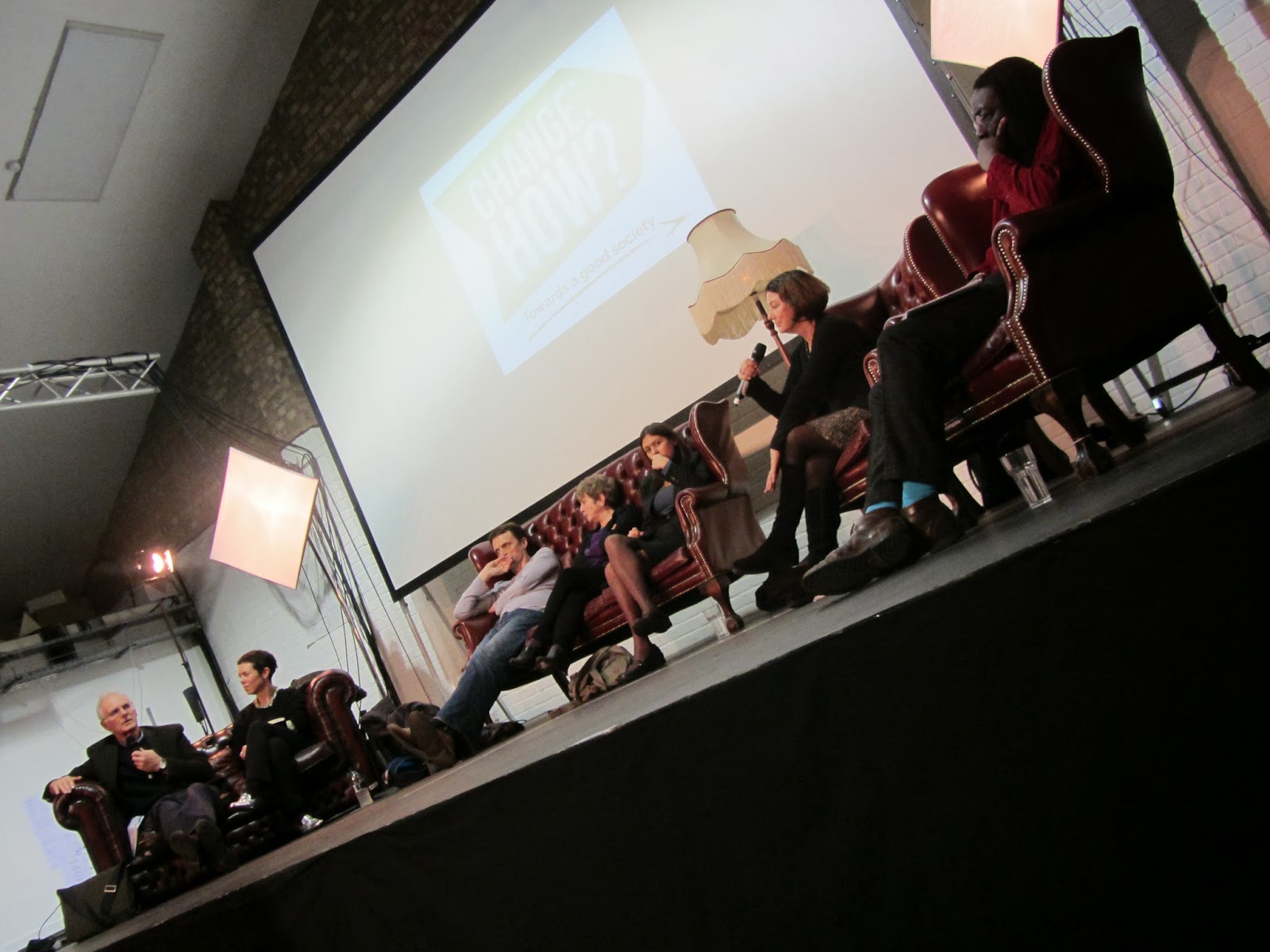
Compass Conference 2013 - Change: How?

Compass promised that this year's conference would be different, and it was.

Instead of being at the comfortable Institute of Education in the centre of London it was at the edgier and more industrial Oval Space in Cambridge Heath, Tower Hamlets. The location was one of the things that attracted me to the event as I like going to new places.

The big difference though was the structure of the day with more interactive sessions included at the expense of the standard panels, though these were still included.

Despite the remote location (and that's the view of somebody who lives in London) I was able to get there not long after registration opened at 9am. The 26 bus took me there directly from Waterloo along roads unfamiliar to me once we got past Liverpool Street station.

The venue had two main spaces, the large Oval Space itself that was used for the plenary and main sessions and the smaller Pickle Factory across the road for the other sessions. There were also some small spaces for stalls and escaping from it all. Overall we could just about fit in to the spaces but it was often cramped and I stood for some of the sessions.

We opened (a little late) in the Oval Space with three commentators responding to questions first from the host and then from the audience. Essentially this was a panel session with the panellists standing among us rather than sitting on a separate stage. I think that it worked well despite one of the panellists commentating on how scary the experience was for him.

The theme of that session was about the differing roles of campaigning organisations (like Occupy and Greenpeace) and elected politicians. Somebody said that you need the campaign groups to identify the problem and to build a solution (because they are on the ground and know what needs to be done) and then you need to politicians to implement the changes (because only they have the power to do so), but even if that is a fair representation of who things work today I am pretty certain that it is not the best way for things to work. Perhaps we should move to a more devolved system where campaigners could have knowledge and power.

We then had a short talk on the need for new models of (political) leadership that are based on collaboration rather than command and control. I have been reading this stuff for ages through work and I am still not convinced that we have a working model. Command and control works very well at times (e.g. the military and, to be honest, most organisations) and we need a predictable framework which says what is needed in each type of organisation.


The next session was more ambitious, interactive and did not work for me.

The aim was to fill the room with conversations (which it did) but it took too long to get there and was a bit shambolic when it did. People were asked to suggest topics for the conversations and then an elaborate process was followed to allocate the conversations to spaces and to restructure the spaces for group conversations.

People were asked to find move between the conversations as they liked.

I like the basic idea but doing it all on the day took too long and we ended up with some similar sounding topics. I would like to see something similar done next year but the topics should be submitted beforehand (to save the time it takes to find and announce 40 topics) and then they could be marked out clearly within the space (so that we can all find the conversations that we are interested in).

I failed to find the conversation that I was most keen on and the other interesting ones looked too cramped to join so I gave this session a miss and just stood at the side watching proceeding and trying to catch up with my note taking.


For the next session I headed across the road to the Pickle Factory for a panel discussion on some forgotten heroes who had made a difference and who could be useful examples for us to build on.

On reflection, this was the session that I found the most useful judging by the number of notes that I took. This is them.
  • An organisation's tacit knowledge lies with its workers.
  • Spencer - give land back to the people and organise at the parish level.
  • Inequality arises from theft of the land.
  • Hope comes through meeting, not meetings.
  • Combine labour value and land value, Marx and Spence (the weakest joke of the day).
The reason that I found this section so instructive is because it highlighted the need to land reform as well as labour reform. The Labour Party, working with the Unions, has done a lot on labour reform over the last hundred years or so but has not touched land reform and until this happens power will remain entrenched in the establishment that owns most of it.

Then it was time for lunch and my photography tour of the area.

After lunch it was back to the Pickle Factory for some stand-up comedy in a room so full that I had to stand-up for it behind the bar where I could not see it either. That was actually OK and I quite liked the session.

That was followed by a session on meditation which did not quite do enough to convince me to give it a go. I know that it works for many people but I am not one of them.


We then had a World Cafe session on lessons that we could learn from failure. Five people with a tale to tell sparked conversations of ten minutes each giving us time for two conversions each in the thirty minute session.

Again I liked the concept but some of the detail let it down. At ten minutes each conversation was too short and in the two that I joined we spent most of the time listening to the facilitator introduce the session and that left scant time for a conversation. And with a dozen or more people in each group I did not get to join in on either one, which is very unlike me at a debate.


For the final session we all went back to the Oval Space for, well, a panel session. I missed the start of this as the sessions across the road had run late so I am not sure what the theme was and what I caught was interesting but unstructured. It was also more intellectual, and hence less practicable, than the other sessions.

The only note I made was about the idea of creating platforms (or enables) for the Good Society that enable communities to implement their own local solutions, much like there are models for opening shops or banks.

It was a full, busy, varied and interesting day. Yes some things did not work as well as they could have done and I doubt that we actually found many new ways of implementing the change that needs to be made but there is always a great vibe when lots of people with the same interest work together. I left there feeling very positive and that is all that I wanted from the day.

28 August 2013

Putting myself forward

In the past I have held several positions in my Local Labour Party (Kingston upon Thames). I was on the General Committee for a few years, then the Executive Committee and was even Chair of the local party until I disqualified myself by taking a project in Prague.

All that was twenty years and more ago and I have not (often) felt tempted back into the organised fold, which is a little odd as I have taken on roles with other organisations like the British Czech and Slovak Association, Kingston Area Travellers Association and the Kingston upon Thames Society. My political activity has been limited to a few marches, signing lots of online petitions and tweeting furiously during programms like Question Time.

A call from Compass for members to volunteer for their Management Committee for a year fell on receptive ears and I have put myself forward. I do not for one moment expect to be elected but standing is a sign of interest and commitment and also gives me the opportunity to put my message to all members of Compass. This is what I said in my 150 words.

There is less than two years to go to the General Election that Labour must win to reverse the cuts and privatisations of the Con Dems and with the might of the media opposed to the Left, witness all the weak leader stories about Ed Miliband, it is vital that the Left finds a strong, clear and convincing voice to persuade the electorate that we do not need to live like this; there is an alternative.

I believe that Compass has an important part to play in countering the simplistic arguments of the Right, such as you cannot borrow your way out of a debt crisis, that they have been repeating so often that many people now believe them.

We need to be bold, loud and positive in putting the argument for the Good Society and that should be our priority for the next year.

12 March 2013

Compass: Plan B+1

Work has kept me away from Compass events for almost two years so it was good to get back in to the groove again. My current office is something like ten minutes walk away from the Houses of Parliament where Compass meetings are often held.

The subject this time was Plan B+1, Compass' analysis and response to the current economic climate. The panel consisted of Howard Reed (Author of Plan B+1), Claire Annesley (Women's Budget Group) and Chuka Umunna MP (Shadow Secretary of State for Business, Innovation & Skills) with Deborah Hargreaves (High PayCentre) chairing.

As is typical when MPs are involved, Chuka could only be there for part of the evening hence his absence from the photo. He had a good excuse though as the Division Bell could be heard clearly.

The three panellists each spoke for about ten minutes and then the discussion was opened to the floor. What follows is my usual mix of notes taken at the time so some of the points came from the panellists, some from the audience and some from me.

Plan B+1 was written because the predictions in Plan B proved to be too optimistic.

The Government's plans, like funding for lending, have had minimal impact, and some of those impacts have been bad.

Plan B is still to increase Infrastructure investment, tax reform to make it more progressive, e.g. wealth taxes, a bargain for labour through enhanced employee rights, and fiscal reform and reform of capital markets.

Is that still too little? Big capital will still win unless we take it through wealth taxes, Cyprus has the right idea.

Austerity is bad for people, especially women. There have been cuts on benefits paid to women and eligibility rules changed. Lone parents are particularly hard hit. Softening measures, e.g. raising tax allowances, do not benefit those at the very bottom. Job cuts in public sector hitting women more. Their employment is not rising.Go for Plan F; increase taxes more and reduce benefits less. Bring in the Tobin tax and a mansion tax. Invest in social infrastructure, e.g. child care, schools. Gender voting gap increasing as the political awareness of the impact rises.

This is a key moment. Budget in March and spending review on 26 June last chances to make a difference before the General Election. We have a demand problem but the government is just trying to increase supply. Demand is suppressed by a lack of cash in hand now but some is fear for the future, e.g. pensions, student loans etc.

We need a different model. The crash is just one symptom but so is inequality etc.New Labour's plan worked for the time and made significant social change, but not secured by significant reform. We need to pay a decent wage for a decent job, e.g. Living Wage. We need an industrial strategy, with strategic investment and a reform of corporate governance.

There were calls for a Big Bang - but is that a big enough bang?

We need to define what a good society is first so we know what the economic policy is trying to achieve. Need to look at redistribution of work, but should we also reclassify it, i.e. to include anything that delivers value to society including raising your own children.
The social recession is harder to fix than the economic one. The cultural issue to fix we need some sort of Cultural Revolution (!). The Tories have simple messages that we have not been able counter. So why is debt a problem? Just don't pay it back!

Time is the new currency, that's why we retire as soon as we can, but we are still measuring success in financial terms.Go for land value taxation. Stop corporate tax avoidance. Need to be careful about asset realignment, e.g. sell house and buy yacht.Need to be clever over tax havens. Should try and close the havens altogether, e.g. refuse to trade with companies established there.

Trident?? Nobody has mentioned it yet ...

Taxation is not free money. If Starbucks pay more tax they put up prices and customers have to pay so we have a transfer from corporate to personal taxation.

And that was it. An interesting and useful debate even if it went around the houses a bit and failed to nail any specific points down, not that it would have been fair to expect that. Most of my political debates these days are on Twitter so it was good to raise the bar and talk to real people with brains. Looking forward to the next one.

20 October 2012

Marching for A Future That Works

There are times when you have to stand up and be counted and Saturday 20 October 2012 was one of them.

The march for A Future That Works was organised by the TUC, and supported by a raft of organisations, in opposition to this Government's disastrous economic policies that have taken us from a position of growth in to a double-dip recession with no sign of any significant improvement for years to come.

The cuts are not working and we need an alternative approach that gives us growth and, through that, employment.

I had a choice of organisations that I could have marched with (last time I went with Kingston Peace Council/CND) and I chose Compass which I have belonged to for a few years.

Our muster point was St Pauls. We shared this with a few similar organisations, notably UK Uncut, and there was a good collection of banners to interest and confuse the foreign tourists.


From their it was a short walk to Blackfriars where we joined the back of the march that was strung along the Embankment. It was slow going from there, as expected, and we stopped-started our way for the next three hours or so.

The route was familiar. We followed Embankment all the way to the Houses of Parliament before doubling back to Trafalgar Square then along Pall Mall, St James Street and Piccadilly to Hyde Park.

The mood was familiar too and there was singing, chanting and drumming all the way.

Behind the good mood was the serious matter at hand. 150,000 people do not sacrifice a Saturday just for a slow walk through Central London. We all wanted to stand up and be counted.

This government is making a big mistake by trying to cut their way out of a recession and we needed to tell them that. I am fairly certain that they will not listen but that does not mean that we should not try. And we will try again and again if we have to.

30 June 2011

Compass conference 2011

The 8th Annual Compass Conference took as its theme Building the Good Society to give an alternative view to the cuts and privatization that we are seeing under the umbrella of the Big Society.

I had mixed feeling about the first Compass conference that I attended in 2009 so gave it a miss in 2010 but was tempted back in 2011 but the current political climate.

The venue and structure of the day were much as they were previously, and more on that later.

The day opened with a series of short speeches from a range of activists and campaigners, starting with two impressively young and active members of UKuncut. Their simple message of don't punish the poor - tax the wealthy caught the mood nicely. An excellent start to the day.

It was a little mixed after that and I thought that the feminist speaker was trying to relive old and irrelevant battles against the sex industry. I'm all for female (and male) equality but there are betters ways of doing this and better words to use.

A double surprise was the video of Ed Miliband. The first surprise was the Ed was not listed as a speaker and the second that he actually gave a good speech. One of the key points that he made was on the need for the Labour Party to re-engage with its members and for them to re-engage with the general public.

We also got the definition that the Bid Society is about participation whereas the Good Society is about outcomes. Working together is no use if we do bad things.

Ed also said that we need to be honest and recognise the inherent conflicts within society, e.g. one person's freedom of speech may anger another person.

It was then time to break in to the different sessions. There were many to choose from, too many in some respects in that you could only join one interesting debate by missing five others.

I chose the session on democracy having been fairly vocal in the recent AV debate where I was on the winning No2AV side against the Compass policy and the views of most progressives.

We had a panel of three, plus a chair, who gave us their views on the current state of democracy. I did not note who said what but here are some of the things that somebody said:
  • There is a general consensus that democracy is broken, even if there is not consensus on how to fix it.
  • Giving people more of a voice is the right way to go but it needs to be an informed voice.
  • We need to rethink where decisions are made (neighbourhood, town, county, etc.) and make sure that the resources are also allocated to the same place.
  • The media needs to talk more about politics and less about politicians. The Milibands are only a story because they are brothers, not because of any policy difference.

I stuck my neck out and said that we, the Left, need to have an argument that the best way to democratise society is to privatise it and let people make decisions with their money. This is a simple argument and can be compelling because it is partly true. We need to show its weaknesses and have an equally simple and compelling alternative.

Overall this was a positive discussion but I was just a little worried about some of the denial over the lost AV referendum and the tendency to look rely on formal organisations rather than loose collections of people or even individuals.

Time for lunch and a bit of fresh air and sunshine in Russell Square.

The afternoon started with more group sessions and I found myself back in room 639 that was at standing-room only for the debate on education led by three professors from the IoE.

I should have read my notes from two years before I did so as the criticisms are the same. we had a lot of fine rhetoric, that I generally agreed with, but nothing remotely approaching a policy other than reversing a few things that the Government has done that we do not like for reasons that we cannot quite articulate.

In contrast, the Government's message is simple; schools are not doing well enough, Academies work so we'll have more of them and we'll encourage Free Schools to introduce competition and to give parents more choice. As with the democracy session in the morning, Labour needs an equally simple and compelling message. I'm not convinced that academics will give that.

It was not all bad though and some good points were made by the panel and from the floor. I particularly liked the quote from William Morris, "I do not want art for a few any more than education for a few, or freedom for a few."

We ended back in the main lecture hall for the last two sessions of the day.

First of all we had a questions and answer session with a panel of politicians and commentators.

This was another uplifting session, and Caroline Lucas was the main reason for this making lots of pert comments that got to the core of the question.

She said that we should know who owns the land and tax ownership, the Big Society is unaccountable and nuclear power is not necessary, is not commercially viable and is an unacceptable risk.

Not the panels fault, but the audience's inability to ask questions on the subject in hand was a little worrying.

The day closed with some keynote speeches from the big guns.

First up was Lisa Nandy who repeated some of her themes from the previous Compass event that I went to, which was fine because I agreed with her then too. She spoke a lot of sense but the one point that especially stood out for me was that political change will come but it will won't be led from the centre, it will come from the grass-roots.

Simon Hughes spoke some sense too, and I hate Lib Dems. He pointed out that he has more council tenants and more immigration issues than almost any other MP and that he has seen no improvement in their conditions after 14 years of a Tory government and 13 years of a Labour one. A telling remark.

In conclusion, the good parts of the day outweighed the weaker parts and it was a day well spent. The keynotes and main panel sessions were very good (mostly) but the workshops need to be improved next time to make them more interactive and to get specific actionable results from them. I want to be a participant not a consumer.

13 May 2011

What future for centre-left politics?

My first Compass event for over a year confirmed both why I am a paid-up member and why I am not that heavily involved.

The event got off to a poor start when Compass Chair Neal Lawson announced that three high-profile speakers had pulled out at short notice. These were Caroline Lucas MP, Jon Cruddas MP and Polly Toynbee. Substitutes had been found but my immediate impression was that I had been short-changed.

Things got worse when Neal Lawson opened the meeting with an analysis of the current situation that over emphasised the need for analysis and also got some analysis wrong. For example, Neal professed himself to be collaborative rather than tribal but then went on to decry the success of the SNP in Scotland. Sorry, but I see that as a success for the centre-left.

I am always a softy for a 2x2 matrix so I liked Neal's with tribal/collaborative on one axis and public service/free market on the other (avoiding for the moment the problem that the second is not actually a valid axis). He put Compass in the collaborative/public service quadrant, New Labour in collaborative/free market and the Tories in tribal/free market. I guess the empty tribal/public service box is where Old Labour sits.

The other speakers proved to be more informative, interesting and inspiring.

Professor John Curtice explained how Labour had made the easy gains in the recent elections, mostly at the expense of the lamentable Lib Dems, but had struggled against more powerful opponents like the Tories in the south and Alex Salmonds's SNP.

The Green substitute, Darren Johnson, said a few things that I did not disagree with but which did not grab my attention either. Or, to put it another way, I took no notes while he spoke.

Then came the star of the evening, Lisa Nandy MP for Wigan.

And her opening comment was Wigan is not Westminster and with that she took us firmly out of the Westminster Bubble and in to her world where real people live.

People who care more about canoe facilities than they do about AV, judging by her mailbox.

Lisa said that Labour needs to engage with people in ways that matter to them. Management Consultancy speak is a big turn-off, what does "progressive" mean anyway?

We should not be afraid to talk about issues like immigration. When pressed, concerns here are usually a proxy for another issue, such as housing or unemployment, which we can fix. People need Labour to win to fix them.

Lord Matthew Oakeshott said that there were several opportunities for left leaning parties to work together, such as banking reform and opposing the proposed NHS changes.

Labour cannot win on its own, especially with the boundary changes, and so needs to form alliances to be in government.

Jon Trickett MP said that the frequent Tory U-turns are a sign of weakness that Labour should be exploiting.

The platform speeches over a few short questions were taken from the audience. Compass calls this a debate apparently.

Once the Q&A session was over most of the panel and audience disappeared rapidly but a few of us hung around briefly to catch a few words with our favourites. The longest queue was for Lisa and I was happy to wait my turn before getting my chance to say how much I agreed with her and also to swap some tales of Wigan. I've been there once so that makes me an expert.

The old-fashioned panel and audience format and the inward looking views of Neal Lawson were real low points of the evening but all the other speakers were reasonable, except for Lisa Nandy who was exceptional and made the event a success.

30 November 2009

In place of cuts - making taxation fairer

My latest foray into the world of politics was another Compass briefing, this time on their recently launched policy paper on taxation that responds to the almost unanimous call to slash cuts with an alternative approach. Hence the title, In place of cuts.

The meeting was held at the Houses of Parliament which is still not familiar enough to be mundane. It amuses me that the security is less there than at the BBC; both x-ray bags but the BBC always find my penknife whereas Parliament never does. After security comes the still impressive St Stephen's Hall then the long walk along grand corridors to the committee rooms with their narrow leather-bound seats.

Professor George Irvin, the main author of the report, introduced the report with three simple slides that analysed the problem and recommended a set of measures that would both increase tax income and make the overall tax system more progressive (the richer you are the more you pay).

This chart clearly shows the problem; the poorest people pay proportionally most tax and while the middle incomes pay progressively more tax this drops off at the high end.

The solutions proposed In place of cuts include a fair degree of tinkering with the tax system to smooth the curve out. I support some of the proposals, such as removing the the upper limit on National Insurance Contributions, but I think the overall problem cannot be fixed by playing around with income tax measures.

This graph tells me that taxation works well for, but only for, the middle income group (on, say, £10k to £80k) and that income tax is not the way to address the anomalies at either end.

One reason why this is the case is that any changes to taxation impact the middle income band as well as the band that you are trying to target.

The other reason is political. Nobody ever voted for tax increases even if they were for rich people only and tax cuts are soon forgotten.

Apart from correcting a few of the current anomalies I would prefer to help the lower end through benefits and schemes like Sure Start (i.e. giving them some things for free) and to tax the high end through, for example, capital and property taxes.

21 June 2009

A day of political talking and thinking

My re-engagement with politics continued with a whole day spent at the Compass Annual Conference listening to talks and participating in workshops with other people who believe that left-wing politics are the best way forward.

The pluralistic nature of the event was shown by the selection of main speakers which included representatives from the Greens and the Lib. Dems., as well as from Labour. Other parties and organisations, e.g. Respect and CND, were represented in the delegates and exhibition.


I was pleased to see that Harriet Harman had the courage in these difficult time for Labour to join the opening panel and her speech was well received.

However, my impression of what she said was that some of it was somewhat empty rhetoric. For example, the claim to be taking a string stance on climate change is hard to square with the decision to support another runway at Heathrow.

After the opening plenary session I decided to attend a workshop on real democracy. For me, this started off a little on the wrong foot with too much emphasis on some sort of proportional voting in parliamentary elections as there is a lot lot more to electoral reform than that.

The debate improved (from my perspective) when it moved from the panel to include the participant and several good points were made on the ways and means of engaging more people in more decisions that impact their lives. I commented that if increasing PR is the first step that we have to take to get electoral reform then the easiest place to do this is probably in council elections where we already have multi-member seats and these seats could be allocated more proportionally with little change.

After a lunch break spent in Gosh (a local comics shop where I was able to pick up Kick Ass #2), the British Museum and Russell Square Gardens, it was time for the second workshop, this time on education.

The room was packed for this one showing just how much this topic matters to people and also how much needs to change here. Unfortunately almost all of the changes that people were calling for were unwinding things that this government had introduced.


The day ended with two plenary sessions back in the main lecture hall.

First up was a question and answers question with the panel shown here answering questions from the audience.

This was all worthy stuff but some of it rather came across as naval gazing with an emphasis on procedures and organisation and not that much said on specific outcomes, such as reducing poverty.

The final session was three speeches from Baroness Helena Kennedy QC, Prof Richard Wilkinson and Dr Jon Cruddas MP.

Jon Cruddas closed the show and sent the crowd home happy but the enlightenment for me came during Richard Wilkinson's brief talk on the imperative for reducing the inequalities between the richest and the poorest.

Put simply, we can live happier, for just as long and more sustainably by reducing inequality. Put simpler, we should copy the Nordic countries. And that was a good positive and realistic thought to end on and to build on.

10 May 2009

Public Service Reform...?

Given my interest in Local Government, IT and left-of-centre politics it was an easy decision to attend the recent Compass talk on Public Service Reform...But Not As We Know It! based on the new book of the same name by Hilary Wainwright.

We were presented with the case study of Newcastle City Council where the union took the lead in ensuring that back office services that were under threat of outsourcing were kept in house and were transformed to deliver improved performance at reduced cost.

It was a pretty good story that was well told by various participants in the project. I was especially pleased to hear that front-line staff have taken a leading role in redesigning the services as this is one of the tenants of Systems Thinking, i.e. those that do the work know most about how the work is done.

However, I was less convinced by the argument that what worked at Newcastle can work everywhere else. For example, I am aware of case studies that show how effective outsourcing can be, when I worked at Lambeth we tried the in-house approach and that failed completely, and residents' surveys locally always show that the best council service is the outsourced refuse collection.

I was also a little concerned that the needs of the service users seemed to play a lesser role in the transformation that the needs of the staff.

Despite the success of the in-house approach, Newcastle continues to face pressure to outsource various services (as a cost-reduction measure) and the irony is that the in-house transformation would not have been attempted if not for this pressure.

The discussion on public service reform still has a long way to go but it is good that, in some places at least, that staff are being actively engaged in that discussion.

03 April 2009

No Turning Back for UK politics

A few years ago I was quite active in local politics helping Labour in election campaigns, standing for the council myself twice and almost getting in once.

Since then I have become sufficiently disillusioned with the Labour Party to leave it and with local politics (as represented by councils) to stop campaigning. My beliefs have not changed but my political association has (I now vote Green) and so has my activism, I prefer to work directly with schools locally and to join rallies on national and international issues.

For the last few years I have been on the mailing list for Compass, an independent democratic left pressure group, but have kept at arms length and have not joined the organisation nor been active within it. That has now changed.

The spur for getting involved was the excellent debate that I went to at the Houses of Parliament this week, hosted by Compass, on the subject of No Turning Back.

The key points for me were that now is clearly the time for change, with the demonstrable failure of the market system, and change is possible by using the techniques of, and harnessing the passion of, the many organisations and people who get involved in community politics. What we need to do is to bridge the gap between community politics and electoral politics where politicians are generally seen as unrepresentative, remote, ineffectual and even corrupt.

I also liked the comment made by the Chair of Compass, Neal Lawson, who quoted the statistics 9-6-0 in relation to the 10 ideas in the manifesto for change in the Spectator article that he co-wrote. Of these 10 points, the Greens said that 9 were also their policy, the Lib. Dems. claimed 6 and Labour none.

The next step is the Compass Conference on 13 June were over 1000 people will come together to discuss and debate how we build a new political economy for the 21st century.