Showing posts with label philosophy. Show all posts

28 April 2015

Big Ideas on the politics of personal debt

Some judicious planning meant that I was able to get a good run at attending Big Ideas discussions and at this time I was getting to most of them, mostly by arranging to work in London on the last Tuesday of the month.

The serious talking starts at 8pm, though I like to arrive well before that to secure a decent seat, and that allows plenty of time beforehand to grab some food, almost always a Large Thali at Govinda's just off Soho Square, and I sometimes get time to visit a gallery too.

Our topic this month was "What are the politics of personal debt?" and our leader in the discussion was Johnna Montgomerie, a lecturer at Goldsmiths, University of London, and a member of the newly formed Political Economy Research Centre. She has published widely on financialisation and household debt. She also managed to get more safely the previous month despite being taken to the wrong tube station initially by some fool (me).

As always these are my notes relating to the discussion, none of the words are attributable to anybody and all the mistakes are mine.

While there has been an awful lot of discussion about the deficit, the Government's increasing debt, little attention has been paid to household debt which is growing rapidly.

Part of this is a deliberate move by the Government, e.g. in moving some services from the public to the private sectors so we pay for what used to be covered by taxes (university education and prescriptions, etc.) and also by cutting benefits so that people are encouraged to borrow more to maintain their standards of living.

This is creating a personal debt problem that we have no answer to. Johnna's main hypothesis is that we should adopt debt forgiveness programmes, much as we had for many developing countries in the seventies and eighties when it became clear that either they could not pay the loans pack or to do so would cripple them.

I had some sympathy for this idea but the case for debt forgiveness lacked a compelling argument. In order to take action it has to be clear why this is necessary, i.e. it has to be shown that the household debt problem will become a crisis for us all, of the kind of the 2008 banking crisis, rather than just a problem for those individuals in debt.

A lot of the discussion that followed was on the "fairness" aspect of this, such as the fairness of letting somebody off their debt when other people had managed to live within their means. I made the point that I had played by the current rules and had paid for my two sons to go through university without any debt so if all student debt were to be forgiven (written off) then I would be tens of thousands of pounds worse off than if they had taken loans out.

If debt forgiveness is unacceptable then are there things that we can do to stop people getting to this extreme stage? Curtailing the maximum interest rates charged by pay-day lenders might be a help but there are many ways to get into debt, in particular it is very easy to get new credit and store cards.

Giving people more money through, for example, raising the minimum wage significantly, could be another way to reduce the debt problem.

I found the phrase "debt forgiveness" something of an issue. I have no problem with helping people who need help, that is what I hope my taxes and charitable donations do, but "forgiveness" suggests that those in need have knowingly done something wrong.

We spent some time talking about the role of banks in all this, in issuing the loans in the first place, but this strand got somewhat confused as few people there understood how banks work well enough to make meaningful contributions. For example, it was suggested that banks could create loans (assets) without hindrance or risk but this is not the case; if it was then they would be issuing even more loans and not worrying if some were not paid back.

Overall the discussion lacked some direction and faltered on some of the detail but the time spent in the middle territory, the politics of personal debt, was useful and thought provoking. There were definitely some good ideas trying to get out in there somewhere.

31 March 2015

Big Ideas on Making the economy fairer

The economy is always a hot political topic ("It's the economy, stupid") and fairness is a term that politicians love to throw around to justify whatever it is that they propose to do so, as somebody who is politically interested, a Big Ideas discussion on making the economy fairer was obviously an attractive prospect for me.

To be fair, a Big Ideas discussion on the economy or on fairness would have been good enough for me, so good is my experience of Big Ideas discussions, so getting the two together was like getting two slices of cake.

Our guide for the evening was Sukhdev Johal who lectured at Queen Mary, University of London. His research interests included how local authorities can promote economic democracy and rebuild local supply chains, which was one of the sources for the discussion. His main hypothesis was that Local Authorities could do more (if allowed by Central Government) to boost local economies and so help to counteract national trends.

Some of the following words are Sukhdev's,  most are mine, some are from the other people there, and any foolish errors are mine alone.

The problem is not economic growth, that is robust enough, the problem is the distribution of the benefits of this growth. For example, 40% of working households get more in benefits than they pay in tax, i.e. we have to subsidise work as many are not reaping the benefits of growth.

Labour raised the safety net for workers and business responded by lowering wages.

Also the majority of growth has been in the South East so there are large parts of the country that are losing out.

Some elements of the local economy remain strong because they are service we use every day and they need to be local, there is a limit how far somebody will go to get a pizza, shoe repaired or a newspaper.

If Local Authorities are to do more then they will need (some) more resources to do so. Land value taxes, e.g. a reform of the Council Tax or some form of a Mansion Tax, could be one source but there is an unwillingness to consider this for some reason. Another option is to leverage the power that LA's have through planning, e.g. if a new housing development is approved then a charge could be made against the local businesses that would benefit from this.

We struggled to identify other levers that LAs could pull and that may be a problem with the idea. And if those levers exist then why are they not being used?

The LAs do not have an unsullied history of meeting the needs of their citizens. They have been better at finding new ways of introducing charges and collecting fees than they have at providing new services. Similarly they have led the way on outsourcing and so devolving things like Health to LAs could be a short-cut to getting them privatised.

If LAs are going to take a greater role in locally then we need to think the democratic implications of this. Who defines what it is a locality needs.

A problem with localism is defining what we mean by local. For example, is it the Royal Borough of Kingston upon Thames, the town of Surbiton or the village (?) of Tolworth.

This was a somewhat looser Big Ideas discussion in usual in that we covered a broad theme, the role of localism in the economy, which produced a range of ideas from hippy to Stalinist without settling on any sort of framework to assess these against. I believe in frameworks so, while I enjoyed discussing the ideas, I found the debate lacked direction. Of course, pub discussions do not have to have a direction or purpose, other than to air the issue, so I cannot really hold that against it.

27 January 2015

Big Ideas on Mathematical Logic

My knowledge of Mathematics has dwindled substantially since I got my degree in 1978 but it is still a topic that interests me and I love the Big Ideas events so it was no surprise that I spent the evening of my birthday considering Big Ideas on Mathematical Logic.

Our guide for the evening was Brendan Larvor from the University of Hertfordshire where he specialises in the history and philosophy of mathematics and science.

Over a couple of hours we had an entertaining and thoughtful discussion on mathematical proof (discussion is the whole point of Big Ideas) during which I tried to take some notes while also trying to work out why I did not quite agree with the hypothesis presented. That is my excuse for why the following notes are unstructured and probably inaccurate.

Ancient Greeks first looked at methods of proof. Mathematics was proved using pictures as the use of mathematical notation did not start until around 1630.

Some pictorial proofs are easy and Brendan used the small panes in the windows behind him to prove the that the numbers in the sequence 1+3+5+7+.. are always square numbers (1+3 = 4 which is 2**2 and 1+3+5 = 9 which is 3**2). In pictures this can be seen by adding one more block to two sides of a square to make a slightly bigger square.

Similarly, it's is visibly obvious that 1/2 + 1/4 + 1/8 + ... = 1 as each additional step, 1/2**n, finishes half way between the previous step and 1. Drawing this on a number line makes it obvious.

The invention of mathematical notation made other proofs possible. It is easy to prove that 1/2 + 1/3 + 1/4 + 1/5 + ... is infinite as the sequence can be grouped into an infinite number of segments each of which adds up to more that 1/2, i.e. 1/3 + 1/4 and 1/5 + 1/6 + 1/7 + 1/8.

Mathematical notation is still not always capable of finding proofs. It is fairly easy to see physically that one knot on a line can pass by another (simply by loosening one of them) but there is no formal proof for this. Of course it may be that a proof is not possible because the question is badly formed, and that in itself would be interesting if we could prove it.

There are various standard ways of proving things. Mathematicians like to find other ways to prove things that have already been proved (we may have a proof for Fermat's Last Theorem but it is not the proof that Fermat had, if he had one) and to find other generic ways of proving things. Proof is very important in Mathematics.

The realm of Logic introduced words into Mathematics and, therefore into mathematical proofs. For example, if A implies B and B implies C then A implies C.

This logic is not generally well understood and people still use arguments like you are a man, men play golf therefore you play golf.

Using words to describe mathematics lets linguists into the game and that was the part of the discussion that I had problems with. Just because linguists have rules it does not mean that it makes sense to extend them to the use of language in mathematics. I think that Mathematics is supreme here and if there are any conflicts then it is the upstart linguists that have got a problem to solve.

Some proofs come without insight or meaning. For example computers have solved the four colour map problem by number crunching all possibilities that does not help us to understand why it is true.

It is often said, and I would tend to agree, that the best solutions are simple and elegant but it this just pretension (quite possibly!) or is there something more right about a simple proof than a complex proof. If Fermat did have a proof for his Last Theorem then it was a lot simpler than the one we have now.

We also touched on the world of proof in other areas where proving something absolutely is much harder. For example, Climate Change is accepted by most scientifically minded people, myself included, but without a parallel world that does not have Man on it it is impossible to say absolutely what the impact of Man is. Similarly economists do not have another global economic system to compare ours with.

Big Ideas on Mathematical Logic was two hours of brain stimulating talk with a group of intelligent and interested people in a room above a pub. It was a happy birthday!

25 November 2014

Big Ideas on What is Normal?

One of the attractions of the monthly Bid Ideas discussions, and one of the reasons that I keep going to them, is the variety of topics that are covered. I also like the way that most of them are on something that I know something about so that I can contribute to meaningfully but they are also something that I know sufficiently little about so that I can learn something too.

Writing these blog posts is part of the learning process and is where I can restructure, reprocess and rethink my notes from the evening. These write-ups are never a historical record of the evening and they are not meant to be.

What we mean by "normal" is something that I have thought about at various times over the years, usually prompted by a news story, so I was looking forward to this discussion.

Our thought leader for the evening was Richard Barnett (on the right) who describes himself as a writer, teacher and broadcaster, mostly on the cultural history of science and medicine, and a poet. This is what he said, what others said, what I thought at the time and what I thought (much) later when I wrote this up.

The word normal derives from mathematics and most people will be familiar Normal / Gaussian distribution from school mathematics. This was derived from coin tosses and demonstrated that while a 50/50 split is expected a range of results close to this are also common and, for example, 100/0 splits are also possible these happen very rarely.

The question posed here is where to draw the line (if it can be drawn) between normal/expected results and abnormal/unexpected results.

Other distribution models exist each of which poses the question as to what a normal result is.

The mathematical normal can lead to results that need further explanation. For example, the average (mean) number of children per family is 2.4 but nobody has 2.4 children. Some of this depends on the units of measurement. If we measure people's height to the nearest centimetre then we will find thousands of people of average height but if we measure it to the nearest nanometre then we might find nobody of average height.

Normal has other linguistic usages. It can mean to mean mediocre, conformity etc. Here normal means not special when special is something good that we aspire too. In other circumstances normal is what we want to be, especially when we are comparing ourselves to abnormal people like terrorists or paedophiles.

While the definition of normal is fairly static, what counts as normal changes all the time. It used to be normal to drink and drive and, until recently, it was normal for young men to shave. Normal moves slowly and it is not usually obvious when what was normal has become unusual or abnormal.

Normal becomes even harder to define when the thing being described is not easy to measure. You can count coin tosses, heights of people, pints drunk and beards worn but what is a normal book or a normal face?

The more we talked about normal the more that I thought that normal is not a good word to use, especially when there are often better alternatives, e.g. average/mean (mathematical) or commonplace (mediocre). Similarly, it is better to say "I am not a paedophile" than to say "I have a normal sex life"; the first is clear and unambiguous but the second is loaded with context, assumptions and interpretations, all of which change over time.

It was an interesting talk on the various uses of the word "normal", and the issues around each use, which made me realise how poor a word it is and I resolved to try and curtail my own use of it. It was also another win for the certainty of Mathematics over the vagueness of Language.

29 July 2014

Big Ideas on Neoliberalism

We skirted around neoliberalism at Big Ideas when we discussed Democracy in an age of Individualism and then we had the opportunity to discuss it head-on in an invigorating session lead by Will Davies, a Senior Lecturer at Goldsmiths, University of London.

I was not alone in wanting to explore the subject and the room was absolutely packed. I had got back from working in Reading in good time to grab some food, a beer and a decent seat before it started.

I do not have a regular seat and almost insist in trying a different one each time (I'll run out eventually). This time I was in the middle row right at the back.

Will gave us his view of the history of neoliberalism, which I will over simplify to make my point, and to save time! I'll also freely mix in some of the comments made during the discussion and some of mine from later.

Neoliberalism was the reaction to previous financial crises that had hurt the rich, through falling share prices etc., more than the poor who were protected by the collective power of Trade Unions etc.

Neoliberalism could be seen as a deliberate attempt by the establishment to protect their wealth from these threats and to undermine labour by cutting union powers and raising unemployment. This is the Marxist line and quite plausible. I'm convinced!

The main tactic employed is to force competition in to as many activities as possible, even those where competition was difficult to create due to natural monopolies etc.

Competitions need a place to happen and that is what markets are. Money is the predominant measure of success in those markets but others exist in things like school league tables. The State has no place in these markets as it would be an unfair competitor.

Monopolies may arise (and they do) but neoliberalism sees this as OK provided that the elements for competition still exist. For example, there is nothing, in principle, to prevent somebody starting a new Facebook or Amazon.

Competition identifies winners but it also creates losers when previously there had only been peers. Competition also has hidden costs, markets cost money to operate and some of them take a vast amount of money.

Power is entrenched in the establishment as they set the rules for the competition and ensure that they win or, if possible, do not even have to take part. Rather like trench warfare.

Neoliberalism wins on simplicity (competition is good) but is proving to be less successful in practise with, for example, China winning economically, social-democrat countries like Denmark winning on happiness and German team-work winning the World Cup.

And to reinforce the point, even a neoliberal fanatic country like the UK is conveniently avoiding its avowed belief and is doing many anti-free-market things like actively creating new banks and imposing a national curriculum.

After seeing how neoliberalism was invented to keep the rich rich and how competition does not actually produce better results it was something of a surprise to find a Tory voter in the room during the informal discussion that always takes place after the formal one.

My convictions went the other way and the talk help me to understand neoliberalism and, more importantly, its inherent failings.

27 May 2014

Big Ideas on Democracy in an age of Individualism

When Big Ideas works well it gets me thinking and that can take time, which is why I am writing this almost a month after the event!

The person inspiring my thinking was is Jeremy Gilbert, Professor of Cultural and Political Theory at the University of East London and the talk he gave to spark our discussion was on themes covered in his recent book Common Ground: Democracy and Collectivity in an Age of Individualism.

I have taken a slightly different approach to my write-up this time as there was an structure to this discussions that we leapt around and I want to record the talk, comments and my conclusions within this structure rather than as a chronology, which is how I took my notes originally (I do not use things like mind-maps).

This means that none of what follows can be attributed to any source and if anything is horribly wrong then that is almost certainty my fault and not Jeremy's.

Individuals v Groups

We spent quite a bit of time talking about the nature of Homo Sapiens and to what extent we are naturally individuals or social animals and we even argued over the neuroscience.

I think it is fair to say that man can be both depending on circumstances and will move between these two states frequently, i.e. several times a day.

Some political systems are based on individuals (neo-liberalism) or groups (communism) and try to force people more into one of these two camps. For example, Conservatives in the UK have reduced the power of Trade Unions and introduced Personal Pensions.

The UK and USA have swung heavily towards individualism since Thatcher/Reagan and this needs to be rebalanced with active support for co-operatives (better for consumers) and trade unions (better for employees).

Democracy

The strength of democracy is determined by how close we are to decision making and how frequently we are involved.

In the most direct form of democracy people make the decision. We are more used to representative democracy where we vote for a person who then makes all the decisions on our behalf. In more extreme cases, such as the President of the EU Commission, we vote for people who then vote for a person who will make the decisions and we are twice removed from the decision making.

We now have fixed-term parliaments in the UK with elections every 5 years. That means that an average person will get to vote for an MP about a dozen times only.

Local elections are better as there are more votes (usually 2 or 3 candidates are elected for each area) and the votes happen more often, usually every 4 years. That could be around 50 chances to mark a cross on a piece of paper in a lifetime.

Group democracy

Bringing the two themes above together asks the question of how democracy should work with individuals and groups.

At one extreme there is the X-Factor scenario where people vote as individuals based entirely on individual preferences and with almost no input from peers. At the other is the panel (or board) where a topic is discussed in detail and each person contributes to the debate and the joint decision.

Out side of the Labour Movement, e.g. Trade Unions, politics is mostly treated as an individual process and any debate happens in the media rather than the home or community.

Does democracy work?

Democracy is generally accepted as a good thing but we do nothing to measure or ensure its health. For example, one researcher recently classified the USA as an oligarchy rather than a democracy because of the way that campaign spending is now unrestricted and gerrymandering is an accepted fact of life.

We generally vote for one thing and get another yet political parties are not directly held to account for this. They have to stand by their record at the next election but there is no independent assessment of the promises kept and broken.

Conclusion

We need to have many more debates like this on the nature and purpose of democracy otherwise the powerful will continue to modify it to suit them rather than us.

29 April 2014

Big Ideas on Modernism in Mathematics

Big Ideas is one of my very favourite talking-shops (I mean that in a nice way) amongst some stiff competition so I was delighted to be able to attend April's meeting. I was even more delighted than usual as the topic was "What is Modernism in Mathematics?" and my degree is in Mathematics.

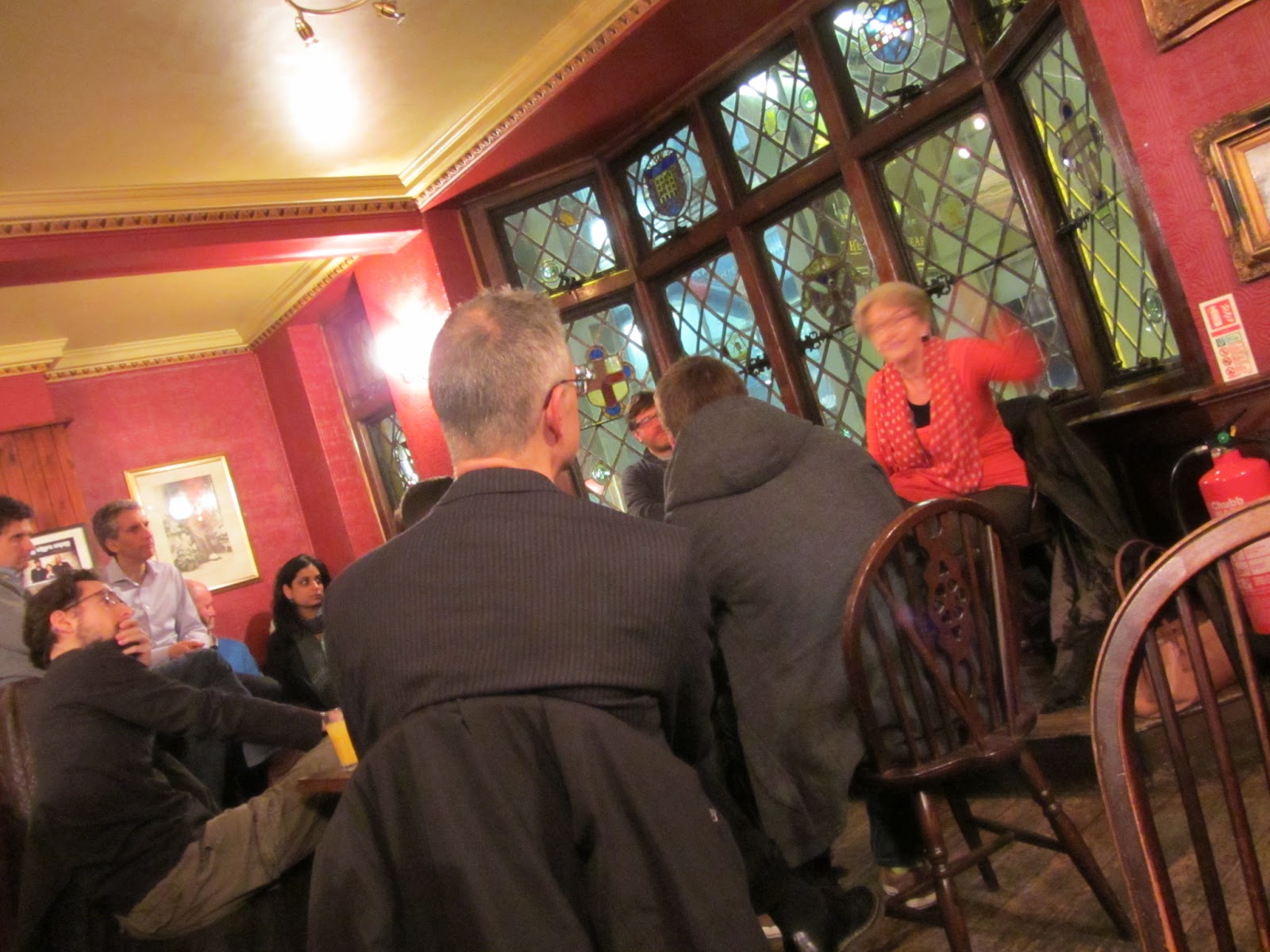
Our guide for the evening was Jeremy Gray, Professor of the History of Mathematics at the Open University, pictured below on the right in the cute mock-Tudor bay window of the upstairs room at The Wheatsheaf in Fitzrovia.

As usual with these things, what follows is a mash-up of what the speaker said, what other people said, what I thought at the time and what I think now when writing it up. It is my summary of the topic based on this meeting but is not a summary of that meeting.

While Mathematics always had been abstract in became more so in the late 19th Century. Previously Mathematics had dealt with understandable thing like numbers and shapes but then mathematicians created new things like Sets and Fields to play with. The Algebra that was developed for numbers (2x+y=5) was extended to these new things.

Numbers themselves became from complicated with the addition of Real Numbers, i.e. numbers that are not fractions.

Euclidean Geometry was challenged and found to be lacking.

Some inherent paradoxes were discovered, e.g. does the set of all sets that do not contain themselves contain itself or not?

Euclidean Geometry starts with some basic axioms that do not need proving because they are true by definition, e.g. it is possible to draw a straight line from any point to any point. First it was shown that Geometry was still consistent if some of these were changed, e.g. parallel lines could meet, and then it was shown that any axiomatic Mathematics has inherent paradoxes.

The outcome of this was multiple domains in Mathematics where everything worked nicely in each one but they were all different and so there was no one single truth.

In trying to understand what a single truth might mean or be we discussed how much of Mathematics would we expect an alien civilisation to share. They would have numbers and shapes but would they also have Sets and Fields? And what could they have that we have not thought of? Could they have solved the one truth problem and, if so, would we be intelligent enough to understand it (you cannot teach a dog French).

The conversations we had spent a lot of time on how this new Mathematics of options was mirrored in the real world (Physics) and in Art.

Quantum Mechanics has shown us that the real world is a lot more complicated than we thought (and more complicated than we yet know). For example, particles are also waves and can be in two places at the same time. Perhaps the real world also has many truths like our Mathematics does.

Art changed around the same time and new rules were created for Impressionism, Cubism, etc. For centuries a portrait only had one rule and that was to be a reasonable likeness then other rules were invented that said that a portrait could be something else. Each school of Art has its own rules and each school is equally valid, there is no one truth for what a portrait should look like now.

It was a very animated, intelligent and thought-provoking discussion and I think we were all a little reluctant to end it after only an hour and a half, though quite a few of us stayed on for a while longer just to make that final comment or ask that final question.

I left understanding more about the multiple truths problem than when I went in (we had touched on this at university) but I think that the Physics and Arts analogies made me more relaxed about it.

28 April 2014

Humanist Debate: The Decline in Violence

The monthly debates at organised by the South West London Humanists Group have quickly established themselves in my calendar as they are proving to be very interesting and thought provoking.

April's meeting was no different when we packed in to the upstairs room of the Old Ship in Richmond to discuss the decline in violence. This is a theory from Steven Pinker that has had much coverage in recent years thanks to his talks at TED and the RSA etc. We used one of his videos to spark our debate.

Pinker's talk was wide-ranging and delivered quickly so there was little time to understand, much less challenge, any of his points.

I was happy to accept his general theory that our chances of dying a violent death are now much less than they ever have been but less convinced on some of the reasons that he gave.

I think that there are three possible reasons why violence has reduced:
  1. We have got nicer (enlightened) and no longer accept violence as the means to solve conflicts.
  2. We have better policemen, including the UN, who stop us from being violent.
  3. It is just an accident arising from other changes, e.g. better trade has reduced the need for wars.
It is important to understand the causes for reduced violence if we wish to keep the peace. It is hard to undue enlightenment, though people like Hitler have had a good go at it, but it would be a simple matter to remove global policing.

In our discussion we also looked at what was meant by "violence". Pinker's focus was rather narrow in that he was taking about violent deaths but there are other ways to threaten, subjugate and defeat people. These include bullying at the individual level up to cyber wars at the national level.

Violence may have reduced but that does not mean that conflict has.

I suspect that violence has reduced because we have found better, not nicer, ways of fighting our battles, e.g. an internet troll can abuse somebody with virtual impunity.

There must be a risk that as we plug the holes that allow other forms of conflict, e.g. financial sanctions, that we will return to violence as the best (or least-worst) option for resolving disputes.

The example that most tables came up with was Crimea with Russia seemingly impervious to the sanctions imposed on it which may force the West to consider some for of military engagement. Incidentally most tables also thought that Russia was not as guilty on Ukraine as the West is claiming.

And being Humanists we had to consider the role of religion in this. One argument is that most religions tell us to be nice and that has led to a fall in violence but all the major religions are centuries old and and we are becoming less religious so that does not explain the continued fall since they were established.

A more worrying thought was religious fanaticism (from any religion) could create more conflicts and the promise of life after death could reduce the fear of using violence to resolve those conflicts. Many religions have martyrs.

Or, is religion, like war, a solution to a problem that is now being solved in other more enlightened ways?

25 February 2014

Big Ideas on Has Britain bankrupted its youth?

This was another Big Ideas event that did not especially appeal beforehand but which I went to on the strength of the Big Ideas brand and then had a great time.

I was working in Birmingham that day so the late start (8pm) suited me well. I got in to Euston soon after 7pm, was in The Wheatsheaf around 7:30 and was soon upstairs with my first pint and a sharing portion of Nachos (they do not do a smaller one).

The topic followed on from the previous one where we had discussed generations in general and this time we looked at the economic impact on one specific generation.

Our guide was Shiv Malik, one of the authors of the Jilted Generation.

He explained that young people are getting poorer and old people are getting richer. This had been a trend for a while and the post-crash austerity had accelerated it.

Middle-class parents were now giving birth to working-class children.

Of course this has to be balanced by some non-financial considerations and the young will live longer, have grown up without the threat of an European war and have much better technology to enhance their lives. We did not get a TV at home until I was about ten. That made such an impact on me that I can still remember that the first programme that we watched was Hector Heathcote.

In considering the causes we quickly reached the consensus (at least I think that we did) that this was all Thatcher's fault.

The neo-liberal approach to giving boosts to the current generation had led to fewer resources for the next one.

This largess had include selling off council houses, giving away revenue from the North Sea as tax cuts and giving home-owners mortgage tax relief.

This contrasted badly with Norway where oil and gas revenues had been saved to create a sovereign wealth fund that is helping future generations.

An impact of this is that the older generation (myself included) have a lot more capital than our parents did and we are looking for things to spend it on. Some of it now goes on university fees for our children but it also goes on assets like houses (buy to let) and football season tickets and this is pushing the prices of these up so that the younger generations without the same capital behind them struggle to afford them.

I think that, just for once, we got to some sort of conclusion, or at least I did. The real topic that we were discussing was economics and generations were just a way of showing the impact of failed Conservative policies.

24 February 2014

Humanist Debate: Ethical Consumerism

I had to make a mad dash back from working in Birmingham for this discussion and it was worth it. The three trains ran on time and I arrived just before the 8pm start with a pint in one hand and a dish of peanuts in the other.

Instead of the usual speaker, the discussion was sparked by a film of a conference where strong views for and against the fair trade model of ethical consumerism were presented.

Please note that when I say "fair trade" I mean all schemes that aim to improve the deal for the local farmers of which FAIRTRADE is but one example.

After watching the film from the side I was able to join a table in the main room for the discussion that followed. I started the evening thinking that fair trade was a no brainer but the discussion showed that it was a complex problem with many aspects to it.

As always I juggled participating in the debate with taking notes and tweeting some of them so what I managed to capture is just my partisan view of part of what we covered.

Fair trading requires intelligent and rational consumers. Which we're not.

Is our new found desire for fair trading White Guilt at how we exploited these countries in the past, and does it matter if it is?

Most of the arguments against fair trade are the much the same as those used to justify attacks on the benefits system here, e.g. taking a grotty low paid job is better than nothing, the money children earn helps their families, etc.

Fair trade is not us doing things to them (the farmers and their communities), not doing fair trade is us doing things to them. Not buying fair traded goods is as much a statement as buying them and if we must but something, e.g. coffee, then we must make a decision between fair traded or not.

Can we export our poverty and close our eyes? We stopped bad working conditions in this country, including child workers and health and safety, because we want better for ourselves and I think it is wrong to expect other countries to adopt a standard that we rejected just to provide us with cheap goods.

Can technology help people more than we can? Or is that just our excuse for dong nothing? This argument is also put for doing nothing about Climate Change, i.e. the scientists will sort it all out somehow before it becomes a real problem so there is no need for us to do anything about it. This may be true (we won't know until we get there) but there is a risk that it does not work and is it fair for us to take that risk when it is other people who will suffer more?

Government's have more power but that does not mean that we should not do what we can. Buying fair trade coffee is one small thing and while it is only a small imperfect step it is better than doing nothing. Do we need more, such as insisting that our pension funds are only invested in ethical companies, and are we prepared to pay the price for this in lower pensions? Sacrificing a few pence on a jar of coffee may be one thing that many people would be prepared to do but how many would sacrifice a few thousand pounds?

Economics is the real problem, again. By that I mean that money incentivises children to work and farmers in Kenya to grow flowers for us rather than food for themselves, etc. We are also encouraged to spend money on things that we do not need (and to borrow to do so) because that boosts the economy.

The root cause is that we have the capital. The local farmers need this capital to invest in their farms and their communities (schools etc.) so they need to sell things to us. And one of the reasons that we have so much capital is that we stole wealth from their countries.

I found the debate fascinating because starting from the simple concept of buying fair trade coffee we quickly got in to some much larger and more difficult subjects.

28 January 2014

Big Ideas on Generationalism

I have been really missing the Big Ideas debates while working away from London so I went to the one on the Battle of the Generations, despite having so previous interest in the subject.

Our guide for the evening was Jonathan White, Associate Professor of European Politics at the London School of Economics. He is pictured here on the left sitting on the dais with Nathan Charlton who chaired the event and who is one of the masterminds behind Big Ideas.

Jonathan spoke for about half an hour framing and posing some questions then we had a lively debate for an hour around those. It was a very broad subject and we Bigideasians are seasoned veterans at wandering off topic so it was hard to reach any significant conclusions, not that we expected to as we were interested in the journey more than the destination.

I took a reasonable amount of notes, and managed to tweet some during the debate too, but rather than present these with my subsequent analysis, which is what I usually do, this time I'll just post my main learnings.


The use of "generations" to describe a group of people who shared experiences just because they happened to be there at the same time is useful. For example, the generation that lived through World War II share things with each other that are not shared with subsequent generations.

Generations can be thought of as the equivalent of geological eons, eras and periods. When we talk about the Jurassic Period we know that we are talking about a period of time with some characteristics that apply just to this period.

Generations are also a useful way to personalise time. We may not care too much about the future world that we are creating but we do care about what happens to our own future generations, at least the next three or four who may know something about us.

Future generations will always have reasons to complain about previous generations as we always make mistakes, and there are also unintended consequences, that do not become apparent until much later.

It has always been assumed that the next generation would be better off than the previous but this is seen as natural progression rather than any inequality against the previous generation that has lost out in this comparison.

There are active and passive generations. Active generations make the change that defines them (e.g. the increased personal debt in the 80's and 90's) while that passive generations just live through them (e.g. those who lived through the post-war austerity).

Those comments go some way to show why I enjoy going to Big Ideas. Topics like this can be covered in, say, Thinking Allowed, but it needs the intellectual rigour of debate to tease the details out and to make the learning personal.

28 October 2013

"Written in the Stars" with Prof Jim Al-Khalili

This was another those confluences of good things in one place which meant that I had to be there.

I think that Jim Al-Khalili is the best science broadcaster currently (TV and radio) because of the amount of hard science that he includes. He gave this talk in his role as President of the British Humanist Association, which I belong to. And the talk mixed very hard science with a touch of philosophy.

The question Jim tried to answer was that of free will and he addressed it from a scientific angle, i.e. if the future predetermined and predictable then we have no free will whatever philosophers may think.

He started with four hypotheses drawn from a simple 2x2 matrix, which is exactly how you should approach problems like this.

One on axis there were the choice of the universe is predetermined or random and on the other that we have free will or we do not.

Newton thought that the future was predictable in a mechanical sort of way and Einstein said it was already there, i.e. other times exist in the same way that other places do.

The scientific consensus seemed to be that the universe was both deterministic and predictable, then Quantum Mechanics came along and through some crazy random stuff in to the mix.

Jim spent most of his time showing us just how weird QM is, which was understandable given that is what he does. He talked us through the slit experiment that shows particles behaving as waves except when we watch them. I had seen this done many times before but this was the clearest explanation of the lot.

As a mathematician (well, I do have a degree in mathematics even if it is rather old now) I love the fact that mathematics explains QM perfectly (e.g. the probability model for where a particle is) but physicians do not know what is actually happening in the real world, e.g. what the particle is doing to behave like a wave.

Having spent a long time taking us through QM weirdness, Jim then said that this weirdness disappears as we scale up and disappeared well before we get to human scale and so can be discounted from the deterministic argument, e.g. it does not matter how an individual electron behaves at a point in time as it has now discernible effect even at the molecular level.

So the universe could be deterministic (i.e. it has to behave the way that it does) but that is not the same as saying that it is predictable (i.e. we can tell what it is going to do).

The main argument here came from an extrapolation of Poincare's three bodies proof which showed that even very small differences in the starting conditions can lead to very different outcomes. This has been popularised as the Butterfly Effect. The point of this is that we can never know enough about the starting conditions to predict how things are going to behave.

The summary of all this is that Jim claimed that the world is deterministic but we can never know enough to predict it, so it is undetermined to us and, for all practicable purpose, we have free will.

The QandA session that followed showed how little most people know about QM and a lot of time was spent revisiting some of the arguments.

It struck me then that we, the human race, have a cognitive issue here (Martin Rees has said much the same) in that our thinking is conditioned by and limited by our brains which have evolved to solve one set of problems. That is why we cannot comprehend the scale of the universe or the behaviour of very small things. For example, in our human-scale world we are used to an object being in one place at two times but we cannot make sense of an object being in one time at two places.

There is also the very real possibility that our brains are incapable of understanding everything about the way that the universe works, much as a dog is incapable of learning French. That we may never know how QM works is a sobering thought.

During the QandA Jim opened a potential gap in his argument from his current work in the new field of Quantum Biology where a quantum change in a single molecule of DNA could lead to a significant change to the observable world.

I think there is a more obvious flaw. It is easy to devise a mechanism that scales the random quantum world up to the observable world and thus stops it from being deterministic - and you only have to devise the mechanism to make the world non deterministic, you do not actually have to build it. One such a machine would be to select a single Uranium atom and take one significant action if it decays in less than the half-life and another if it does not.

Sadly we ran out of time for me to put this him but I was able to grab a very quick word with Jim on his way out. Obviously that quick word was about Leeds United, the team we both support.

I might dispute his conclusion but Jim is a good presenter and he put the question and some of the implications very well, and dealt with the questions likewise, which made it a stimulating and though-provoking evening.

26 March 2013

Big Ideas on Social Sciences and The Arts

I must admit that a debate on how Social Sciences can support The Arts is not the sort of thing that I would normally go to. I am a heavy consumer of The Arts, especially theatre at the moment, but my exposure to Social Sciences goes little beyond Radio 4's Thinking Allowed and that merely confirms my view that there is very little Science in the Social Sciences.

What convinced me to go was that the debate was organised by Big Ideas who have a deserved reputation for staging good discussions. The social aspect was another plus and I chose to sit at the front table with two of the Big Ideas regulars.

Our guide for the evening was Dave O’Brien, Lecturer in Cultural and Creative Industries in the Centre for Cultural Policy and Management at City University London.

Dave started the debating ball rolling with an introduction to the topic which we, the eager listeners, then took in all sorts of vaguely related directions.

As is my customer, what follows is my notes from the debate which include comments made by various people and also my thoughts sparked from these.

Why we fund The Arts has been an issue for many years and various approaches have been tried to determine which Arts to fund given the almost limitless opportunities to do so.

At different times The Arts have been funded because they were a "good thing" and because they were thought to generate economic benefit, e.g. through improving the education of the public.

Cost / Benefit analysis now in vogue with the Treasury. The language has moved from artistic terms (excellence) to financial (benefit). The Government sees its role to interfere when market fail.

One approach is to argue that people who don't go to the British Library, for example, would still pay for it and so it has a nominal value that can be estimated, if not actually calculated.

These approaches are now seen to have failed. For example, providing free swimming did increase the amount of swimming that was done but this was mostly existing swimmers. Similarly cheap theatre tickets are not taken up by new people, they just benefit people who already so yet, to the bean counters, the benefits seem to have materialised.

Art segregates people on social grounds, e.g. music is now very tribal. The label "classical" is too wide but if we consider the classical mainstream (Beethoven et al) then young people are not consuming it and it will die (at this rate). Modern classics, like Reich will survive for longer.

The headline claim from when Liverpool was European Capital of Culture that every £1 paid generated £8 for the city is often quoted but is widely disputed. Even if true, this does not mean that every £1 spent on The Arts generates that sort of financial return.

If we move away from the dubious financial arguments then we can use the Social Sciences to help us to understand genres and segregation, but not the politics of making choices.

The question, What are we funding arts for?, still remains unanswered.

We need to explain why museums are good to encourage more people, being free is not the factor.

The Royal Opera House is the biggest recipient of funding, but why is it sacrosanct? Glyndebourne, a far better opera house, thrives without any state funding.

A lot of art is under the radar of the Arts Council and Local Authorities, e.g. local bands and arts fairs. Is Eastenders art? Funding bodies tend to assume a consumption model of art, i.e. we watch it rather than make it, and this is not what happens at the local level.

There has been some stealth privatisation, e.g. paid exhibitions within the Tate and the V&A. Boundaries are blurring as a result, is the V&A a museum, an exhibition space or a restaurant?

If we cannot use financial arguments to justify supporting the arts then perhaps we can use time as an alternative currency. This is a better, more equitable, measure than money, as we all have the same amount of it.

26 February 2013

Big Ideas on Macroeconomics

Working in Cardiff for a year and a half severely curtailed my London-based activities and while I was able to keep the theatre going simply by booking for weekends I was force to miss most events that had fixed dates.

One casualty of this was Big Ideas which meeting on the last Tuesday of the month and work kept me away for a whole year. A new project back in London meant that I could make February's meeting and I was desperate to attend despite not being that interested in the subject, macroeconomics.

The format, and my ritual, remained the same. I walked there from Victoria stopping at Govinda's on the way for a vegetarian curry. I got to the Wheatsheaf not long after 7pm giving me plenty of time for a leisurely pint before heading upstairs to claim a good seat for the discussion starting at 8pm.

Our guide for the evening was Ann Pettifor who is an economist of some renown. She spoke for about twenty minutes to introduce the subject that was then taken up by the rest of us in a group session with Ann responding to the questions raised.

What follows is my notes from the meeting, taken on my iPad for the first time. I was also able to use it for tweeting (#bigideas) thanks to the pub's wi-fi.

Ann Started working on sovereign debt of weakest countries, now a lot has been written off.

Debt is now a first world issue, both private and public borrowings have increased dramatically over the last twenty years or so.

It is wrong to try and use micro economic arguments to arrive at macro economic solutions, e.g. comparing public debt to a credit card. This metaphor is liked by politicians but the two situations are not the same.

Public debt as ratio to GDP, around 70%, is not the problem, we been there several times before and have always emerged strongly.The real problem is private debt that is running at over 400% of GDP.

Private debt is being completely ignored but we cannot have a recovery until it is fixed.

Allowing individuals to walk away from their debts (e.g. returning house keys to the mortgage provider) is a disorderly way to escape from debt. Rescheduling debt is orderly.

Or, we generate income so that the debt can be repaid. This is the best approach but the government is doing the opposite by making cuts.

Ann said that we cannot finance recovery through taxation but I do not agree. Income tax might not work but some form of wealth tax (imposed without notice) would. The 1,000 richest persons in the UK have increased their wealth by so much in the last 3 years, £155bn,  that they themselves alone could pay off the entire UK budget deficit. We could/should simply take that money.

We have the money, we found £16t to save the banks, mostly invented money.This is a great power so there are questions over how this power is used and controlled.

We should regulate the banks rather than nationalise them (why?). Not convinced by the argument that housing is a bubble - people have to live somewhere and houses are in short supply. House are useful assets unlike, say, art or tulips, so are less susceptible to bubbles.

The evil guys are the bankers, apparently. Nobody agreed with me on the problem being caused by customers demanding loans and also high savings rates. Banks are just meeting customer demand.

We should reintroduce Capital Controls to manage capital flows. Tobin tax is small in comparison - and it's trying to do something else. There is a political issue here as Capital Controls are associated with the old days and with totalitarian regimes. As a country we seem reluctant to give power to democratic bodies in Europe but are happy to be controlled by unelected market players.

I had a good evening and the ninety minutes flew by. I would have stayed on too for more chat, and more beer, if not for a pressing need to get home. I also felt that Ann and I were broadly on the same side so I was surprised to find myself disagreeing with so much of what she said. I think that some of this may have been down to the way that the arguments were put which I thought lacked rigour and flow.

A day or so later I listened to an RSA Podcast on The Inequality Crisis that I found more logical and more convincing.

11 February 2012

Big Ideas on Social Justice

Recent meetings of Big Ideas have been busy and an early arrival is advised so when the star turn was Newsnight's Paul Mason I got there around 6:30pm for an 8pm start. It was a good move.

There were other early birds and I was soon juggling conversations with beer and cheesy chips. By the time we got to the bewitching hour they were standing in the aisles ready to hear Paul Mason espouse on his chosen subject, What Would Be A Socially Just Solution To The Current Economic Crisis?

Paul told a history of Social Justice starting with the interesting claim that Social Justice was invented by the Catholic Church centuries ago to keep their followers away from Socialism and, in the modern day, has been refined by the likes of Rawls to remove the original concepts of power and hierarchy.

An early sound-bite was that neo-liberalism had converted the rural poor to the urban poor.

This stalled a decade or more ago and since then growth has been maintained by borrowing rather than increases in pay. This form of capitalism has run its course and the question now is what will replace it?

The current approach to debt bankrupts countries not banks and this impacts most on the young who need governments to provide the services and pensions etc. that earlier generations have enjoyed.

An example of what this means is cutting the minimum wage in Greece and threatening to do so here.

As times become harder the call for protectionism grows. There will be a trade war with China.

There is also a growth in the appeal of marginal parties, both left and right, as the mainstream central parties are seen to have no answers. Or, more worryingly, are too myopic to see the real problem that they face.

Opening the debate up to the floor we got our first mention of Marx, no Big Ideas meeting is complete until he gets mentioned.

I made the point that the young have been loosing out for some time but they have not noticed. For example, I was paid to go to university whereas today they have to pay $9,000 a year. Similarly Legal Aid has withered away.

The People: Planet: Profit: mantra is just a disguise and copies the factory acts of a century ago. The real aim is not to be nice to people but to make sure that there are still markets and employees in the future. It is the system that is being protected.

It is no longer clear what the working class believe in or are prepared to fight for, which makes it difficult to engage with them politically. We do not have a modern equivalent of a Land fit for Heroes.

The debate was wide-reaching and absorbing. Paul answered eloquently and at length pulling stories from history to make his points. I was seriously impressed.

Less impressive, but sadly not uncommon for Big Ideas, was some of the intellectual snobbery on display where people were criticised for not having read something or other, e.g. Rawls, or for having, done so, come to a different conclusion from the questioner.

But I can let intellectual snobbery pass me by and the overwhelming impressions of the evening were Paul Mason's authority and the conversations with friends. Another excellent evening at Big Ideas.

22 December 2011

Big Ideas for a Christmas Social 2012

The Big Ideas Christmas social was a blast despite, or because of, its simplicity.

The venue was the same as for the monthly meetings, the upstairs function room at The Wheatsheaf in Fitzrovia with its fake but cute Tudor windows, the people were the same and the eagerness to talk was the same.

The only difference was that we did not have a theme for the evening or somebody to guide us but we did have a good finger buffet that I visited more often than I probably should have.

Seasoned conversationalists need no encouragement to mix and that's what we did but this time I did not take any notes.

Without a set theme the talk veered in several disparate directions, most of which I've forgotten.

The ones that I do recall were the crisis of capitalism (always a good choice at Big Ideas), our relentless animalistic pursuit for sex (always difficult discussing that one with women) and the architecture in Minsk.

In the middle of all this we had time for a quiz on philosophy and mathematics. We formed ourselves in to small teams and attacked the questions with vigour.

Round One was on logic and that meant using lots of algebra to work out the agree of five brothers and their cats. This should have been my strong point but the forceful Alicia insisted in taking control. Luckily she is good at this stuff.

Round Two was anagrams of philosophers names with helpful pictures of them all as clues, if you had any idea of what they looked like. Somebody on our table, Sam maybe, did and we got most of them. Examples included bent gift idolizer, exam brew, impale glacial, magicians or not, much facile lout, and, sweet indulging twit.

Round Three was DitLoIDs, a combination of letters and symbols that represented a philosophical saying. For example, G = D meant God is dead. Simples. Other clues included H = OP, M = by N a PA, M = the M of all T, and, B that S which 1Tl. I was pretty useless on these due to a weakness in all areas philosophical but as a team we were OK.

Round Four required us to draw lies that did not cross on a torus (ring-doughnut). This should have been a cinch for somebody who studied Topology at university, like I did, but I failed miserably. Luckily none of the other teams could do it either.

And so we won. The prize was a large tin of Celebrations chocolates which we promptly shared with everybody. It seemed appropriate.

The quiz over we returned to our conversations and drinks until the pub quietly told us that we had to go home as they were closing.

I love Big Ideas for its thought-provoking discussions and the Christmas social was just a bolder brasher and slightly less structured evening of what they do well. A great event.

05 October 2011

Big Ideas on Money

Being detached from academia (amongst other things) I had no idea who the Big Ideas speaker on How Much Money Do We Need To Lead A Good Life? was but I was assured when sitting in an almost empty room beforehand that he was a big draw.

And so he proved to be. The room was as full as I have ever seen it and comfortably exceeded any reasonable fire limit that might apply to it.

The speaker was introduced to us as Robert Skidelsky, Emeritus Professor of Political Economy at the University of Warwick, which enlightened me not a whit.

I deliberately sat at a table I'd not sat at before (the antithesis of Kermit's nephew) more or less in the middle of the room which was great for the talk and the subsequent debate but not so good for photography so you are spared the traditional picture of the bay window at The Wheatshef.

Robert Skidelsky started the evenings' discussion by outlining the arguments in a new book that he had just finished writing with his son.

The main point seemed to be that the love of money differs from other wants in needs in that it is finite whereas there are limits to, for example, how much you can eat. As a consequence we have Avarice and measures need to be taken to address this.

I felt that the argument fell at the first fence, and said so in the debate. Biological needs (food, drink, warmth, sex, etc.) are finite because they are immediate but the wish for money addresses future needs to food, drink, etc. and so has no limit.

Other people also questioned Avarice as more and more groups, e.g. the people in the room, were excluded from those considered avaricious.

In the debate we spent some time exploring whether Fear was more of a factor that Avarice, i.e. do some people work longer and harder because they want more money or are they just scared that they will lose their jobs if they don't. My vote goes for Fear.

I had problems with some of the proposed solutions too, such as unimposable rules on restricting advertising and unworkable nudges.

My mood on the evening can be gauged by my tweets:
  • Ten minutes in brings the first reference to Marx. #bigideas
  • Biological needs are now and finite (even sex) but money is future and insatiable. #bigideas
  • Poor analysis names Avarice as the guilty party and the subsequent arguments fail on this false premis. #bigideas
  • And now a plug for Nudge. This is an ill structured and inaccurate argument. Glad the Hobgoblin is on form. #bigideas
  • Claims that an insatiable desire for money is the problem then excludes many groups from having this. #fail #bigideas
  • Getting a bit heavy now with constant references to Aristotle, Plato, Hume, etc. #bigideas
  • The ghost of Stalin stalks the room. And not in a good way. #bigideas
The debate was lively and my assessment was that there were more debaters against the argument presented than for it but the speaker got a long and sincere round of applause when the more formal part of the evening and we were left to carry on the conversations by ourselves with just some more Hobgoblin to help.

I may not have been remotely convinced by the speaker's argument but it did trigger a good debate that I enjoyed being part of. That's why Big Ideas works.

31 July 2011

Big Ideas on Communities and Laws

I had to miss a Big Ideas discussion or two so it was good to get back in to the swing in July.

There was a familiar and pleasant start to the evening with a vegetarian and alcohol-free curry at Govinda's Restaurant just off Soho Square. Then it's back off the waggon with a pint of the guest ale at The Wheatsheaf. This month it was the very acceptable Cumberland Ale by Jennings.

Beer in hand, I headed upstairs traditionally early to ensure a decent seat.

Our topic for the evening was Do Communities Make Laws Or Do Laws Make Communities? and we were guided by Roger Cotterrell, Anniversary Professor of Legal theory at Queen Mary College, University of London.

Law is not one of the subjects that I claim to know much about so I was a little surprised at how engaged I got in the debate, that I raised a few points and easily filled the allotted one page in my A5 notebook.

Roger started by showing how laws are increasingly being divorced for states (nations) with the growth of European and International courts on one side and the call for regional, or even neighbourhood, laws on the other.

An example of judicial pluralism is Malaysia where the Malay, Chinese and Indian communities have separate courts. Nearer to home there is the suggestion that Sharia Law could be used alongside national laws in countries like the UK.

Sometimes states have to recognise other laws by default. For example, if a man who is legitimately married in his home state to more than one woman moves to a state where only one wife is allowed then that state need rules to handle things like divorce and death.

Laws are there in place of trust. If two parties trusted each other then they would not need a contract backed by laws in order to do business. Communities can build trust but laws cannot.

Roger's hypothesis was (if I understood him correctly) that laws arise from communities and not from states.

During the long discussion that followed I'm not sure that anybody agreed with that but that was hard to tell as we wandered well around the subject, as usual. In particular we drifted away from laws to consider other judicial aspects like policing and judges.

We looked at some examples of how communities react to laws. In some cases, such as the right to bludgeon a burglar, the general population had a perception of what the law was that proved to be wrong. Some other laws, like the motorway speed limit or using a mobile phone while driving, are simply ignored.

This attitude to specific laws can change over time and, for example, drink driving has gone from the norm (I drive better when I've had a few) to a complete no-no (not for me thanks, I'm driving).

State laws have the legitimacy of democracy to support them. We vote for the government that we want, they make laws and so these are our laws. And if we do not like the laws that they make then we can vote for somebody else.

Knowledge of laws is becoming increasingly problematic (in the UK at least) with even judges making mistakes over what the actual law is in some cases. It is completely unreasonable to expect communities to understand the law in these circumstances. This government's cuts to Legal Aid will make this even worse.

Even when laws do have the support of communities they are usually imposed by people outside of those communities. Judges are very different from the rest of us.

The powerful are best placed to take advantage of laws that were created for the benefit of the community.

We said a lot more than that as the conversation ebbed and flowed for the best part of two hours but I've still not mastered the art of being in a discussion and taking notes at the same time so these notes are all I've got. I hope that they are enough to give you a flavour of what the evening was like and to show why Big Ideas is worth going to every month.

27 April 2011

Big Ideas on Cooperation

This month's Big Ideas discussion on Cooperation got off to a bad start when the billed speaker, Richard Sennett, failed to show. This left Big Ideas. Nathan Charlton and Rich Cochrane to run the show and it also meant a slightly delayed start while they worked out what to do.

I do not know what direction Richard would have take us but Rich opened up a broad canvass from social technologies to human evolution with lots of points in between.

As a result the discussions wandered in many directions, sometimes simultaneously, and, as a group, we failed to focus on any particular aspect of cooperation, much less get to any sort of agreement on it.

That said, it was a good discussion with many people contributing, including a few newcomers, and nobody hogging the debate.

The experimental twitter stream (#BIGI) was a little thin in Danny's absence but other people besides myself made some contributions. This is what we said:

reesmf Technologies like Twitter and Facebook help us to collaborate but the baddies use it too. #bigi

reesmf Collaboration needs a purpose. #bigi

reesmf Connection is not the same as collaboration. #bigi

reesmf Evolution getting lots of name checks but no votes for Marx so far. #bigi

dannyrye @reesmf tolpuddle martyrs. That's *quite* marxist #bigi

reesmf Big Society is looking to change the social framework within which we collaborate. Better than state diktat. #bigi

reesmf Current NHS framework encourages collaboration on research etc. Proposed changes will prevent this. #bigi

reesmf Are there situations where cooperation is better than competition and can we identify rules for this? #bigi

leighblue #bigi interesting debate on cooperation. Though without a clear question, hard to distinguish between coordination, collaboration and co-op.

A few broad themes emerged during the debate, including frameworks, game theory, evolution and economics.

A framework defines the context within which the cooperation happens. In some cases this is very visible, e.g. Facebook defines what we can do with our connections there, but in society as a whole they can be less obvious and generally fall under the headings of expected or acceptable behaviour.

Game Theory shows us that cooperation can be a winning strategy. Professor Martin Nowak's work got a few mentions here. Somebody (must be an academic) had read his books but you can learn all you need to know about his theories from his recent RSA talk.

The discussions on Evolution and Game Theory were linked (by me!). Evolution is driven by variation which means that various strategies are always in play from the outright selfish to the martyr and Game Theory shows us how different strategies will have prominence at different times.

Not quite sure how, or why, we got on to economics but we spent some time talking about the demutalisation of building societies and the privatisation of BT. I think that Rich made the most interesting point here when he asked if we could be considered to be all cooperating within a competitive market.

Words like "good" and "sinister" got quite a few mentions but we failed to identify any inherent goodness or evil in cooperation or competition. The question that left me with (briefly tweeted above) was whether there are identifiable characteristics of situations where cooperation or competition are clearly the better strategies.

For example, can we prove that the health service needs to be cooperative (so that practitioners can share "best practice") and that car manufacturers need to be competitive to drive innovation.

Having written that, it now occurs to be that a difference (or THE difference?) is in the nature of the customer choice; in health we just want the best care and don't mind who fixes us but with our car we all have different desires.

That sounds like a topic for another debate on another day. Perhaps Richard Sennett will make that one.

06 April 2011

Big Ideas on religion in US political life

March's Big Ideas asked the provocative question, What Is The Role Of Religion in US Political Life?

Religion and US political life are two topics that I know little about but I am always happy to learn so I went along.

But first a slight change of routine; instead of cheesy chips from the bar I stopped off at Govinda's Restaurant on Soho Street, just north of Soho Square. It's run by the Hare Krishna people and does a great line in veggie food, including curries. I'll be back!

Once at The Wheatsheaf I got a pint and headed straight for the upstairs room to grab a decent seat.

A psychologist may be able to tell me why I gravitate to the right of open rooms but, whatever, the reason is, that is what I did taking a chair at a table next to the wall about half way back.

Just to prove that I'm not a saddo, it was not the same table I had the last time. But it was next to it.

I was not the first person there by any means but it was empty enough for me to take a clear picture of the impressive front windows.

By 8pm the room was full, but not to overflowing this time, and we were off.

Dr Tim Stanley (the other person in the room wearing a tie) kicked the debate off in traditional Big Ideas style with a short talk thick with hooks to hang the discussion on.

This is some of what was said over the following hour or so.

The separation of Church and State is there to protect Churches from the State; this is why the founders had fled Europe.

The Democrats are just as guilty as the Republicans of playing the Church card when they can.

The Religious Right is losing the moral battle with things like Gay Rights and abortion now generally accepted by the public and increasingly by the Church. Capital Punishment is an odd exception.

America was founded by white men for white men and is obsessed by it's history.

The Constitution has achieved Biblical status and to question the Constitution is to question America, even though it has been changed in the past.

America is a young country that has yet to decide what it wants to be, with sharp divided between the small-state Right and the social-democratic Left.

Europe sees America as a cute but troublesome teenager who has yet to grow up.

For some reason we spent quite a bit of time on philanthropy and charitable giving which caused the only significant split of the evening with some quoting Katrina as an example of the USA helping each-other out and others pointing out that Comic Relief had raised £17 million in one evening. I made the Comic Relief point so you can tell what side of the split I was on!

The mechanics of the debate were good with Tim Stanley responding well to all comments and questions, Rich Cochrane controlled us calmly and fairly and, by and large, we stuck to the rules allowing others to contribute and not being too dismissive of their views.

It's because Big Ideas addresses unusual and challenging concepts in a balanced way that I find it so stimulating.