Showing posts with label travel. Show all posts

15 November 2016

Two days near Chicago

While I quite enjoyed my last trip to Chicago, sometime in the late 1990s, I was not that keen to get back there and so I manage to restrict a business trip there to just two working days with a day travelling either side of that. I caught a flight Sunday lunchtime that arrived in Chicago Sunday afternoon, I worked two full days on Monday and Tuesday, then caught a flight back late on Tuesday arriving back at lunchtime on Wednesday.

One of the reasons for my reluctance was that, unlike last time, I was not in central Chicago but about 45 minutes north of there in a suburb galled Grayslake and I do not like suburban America as it is designed solely for the car and I insist on walking. There was a pavement by my hotel but that ran for a full 20m before disappearing. I have no idea why it was there.

The hotel was on the crossroads of two busy multi-lane roads (IL 120 and US 45) and the only interesting things that I could see were in the opposite corner and to get there I had to cross 12+ lanes of traffic with no pedestrian lights and only a narrow refuge in the middle of each road.

It was there that I went each morning for a long walk as part of my £14k steps a day regime. Because of the six hours time difference I was working on a three hour time shift which meant getting up at 5am Chicago time / 11am UK time instead of 8am UK time. As a plan that worked well and it gave me a good hour of walking time before breakfast and the drive to the office for an 8am start.


Grayslake is just one of hundreds, if not thousands, of small lakes made by glaciers scraping the ground during the last ice age, a geology I had also seen in Finland. Many of the lakes are small and ugly while others have been used to centre housing developments around. One of these is Grays Pointe and I did a lot of walking there.

Grays Pointe has two unnamed lakes and on my first morning, the Monday, I walked around the main one (150m long) half a dozen times waiting for the sun to come up. This lake had a fountain. On my second visit there, a very misty Tuesday morning, I found a second smaller lake. This one was more natural and had a bridge over it. This is the photo I took approaching the bridge, one of a very few photos that I took on the trip.

Other walks were less interesting. I did about 5km doing loops in the hotel and neighbouring hospital's car parks on Monday evening and a similar distance walking up and down Concourse C (500m long) at the airport on Tuesday.

On the plus side, the work went well, relationships with the customer were reinforced and all the travel plans worked out fine so I consider the trip to have been a success.

10 March 2015

My last look at Ghent took me to museums and gardens

My last day in Ghent, a Tuesday, had to be a part-day as I was booked on the eurostar to catch at 6pm and that meant being back in Brussels around 5pm to allow time for the connection, a cup of coffee and some contingency.

That still left me with quite a few hours to play with and rather than wander the streets again I thought that I would go and see some things and I started with the City Museum (STAM). I chose this as I have generally found city museums (i.e. those that tell the history of the city) to be interesting and not too large to be daunting.

The museum was just the other side of the waterway that I had walked along on my first day in Ghent so it was both a short walk and easy to find.

I did, however, fail to find anything that looked like a decent cafe for my breakfast so I was delighted to find one at the museum itself. The section of the modern building with tables and chairs in the picture below was the cafe/restaurant and the rest of the new building and the old one behind it were part of the museum.


There was some sun that day, unlike the day before, and so it was good to get a table next to the large window overlooking the water. It reminded me, obviously, of the canteen at West Burton Power Station.


There was a set route through the museum and the first room was dedicated to a large model and satellite photograph of the city. The photograph was on the floor (it was all of the floor and part of one wall too) and I had to put on overshoes before going into the room.

The model was in the centre of the room and showed the city centre. The photograph started where the model ended and showed the rest of the city and its immediate environs.

The tall building half way down the left side of the model is the one that I photographed in its half demolished state. Rabot is just to the right of it and the castle is in the direction of 2 o'clock just before the small triangle of water. The heart of the old city is in the middle near the top and is distinguished by several tall buildings and the open spaces around them.

In contract, the section of the photograph that I have chosen shows the docks and is heavily industrial.

I like models and I like maps so I spent a lot of time in this room. A good start.


One thing that consistently confused me was that maps of Ghent were show with west at the top and I referred to my own map several times just to check this again (and again). The unusual orientation of the maps made some sense as the layout of the city best suited a landscape view and there may have been a historical reason for the choice; maps have not always had north at the top.

The rooms were laid out chronologically and each room had its own digital map of that period with options to zoom in and read details of the landmarks.

Ghent had an interesting political history having been part of many empires and countries, Belgium gained its independence as recently as 1830. Its importance waxed and waned too and there was something of a highpoint in 1500 when Charles V, who became Holy Roman Emperor and King of Spain, was born there.

Most of the exhibits covered the social side of history and showed how people lived. One room that I especially liked had hundreds of posters from the early twentieth century.  I could have chosen to share one of the Marx Brothers or something in the constructivist style but the beauty of art nouveaux won the day.

The museum seemed small, just fourteen modest rooms, with not much on display but this was deceptive and it took me a long time to get around it all, and I even deliberately avoided the separate exhibition that was on.


Part of the reason that it took so long to get around was because there were videos to watch and things to play with (as well as the interactive maps). One of my favourite toys was the virtual tour of an exhibition site. It covered a large area and the virtual tour went well beyond the gates. I had a happy time navigating out and then trying to find my way back to the centre again.


I was tempted to play with the Lego on the way out too but I was running short on time for the rough plan I had for the day. The next stage in that plan was to return to the museum cafe for a late lunch and a rest.


After lunch I walked east across the city to Citadelpark because I like parks and I had not been to one in Ghent yet.

I entered at the north-west corner and walked anti-clockwise, which was something of a mistake as the museum of modern art (S.M.A.K.) that I was looking for  was just a short distance away walking clockwise. I walked all the way around the park, which was a good thing to do, and then decided that I did not have enough time to see another museum, especially one that charged a noticeable entrance fee. If it had been free I would gave gone in for half an hour or so.

Instead I went to the botanical gardens situated next to the park on its south-east corner.


The botanical gardens were very modest when compared to Kew, as most botanical gardens that I have been to are, which was fine as I did not have that much time left before catching my train. It did have some nice greenhouses to walk through and so that is what I did.

It almost felt as if I was not meant to be there, despite all the welcoming signs saying the opposite, as there were so few people there and almost everybody else that I saw was working there. The advantage of the quietness was that I was able to take lots of photographs without having to worry about people spoiling them with their colourful clothes, something that is a persistent problem in Kew.

From the gardens it was a short walk back to Ghent station, via my hotel to collect my bag. The travel from there was easy and uneventful, not least because I had bought a eurostar ticket to/from any Belgian station. I even had time for one last coffee in the rather lovely cafe in Ghent station (the one next to Starbucks).

Ghent had surprised me and in a good way. I had thought that it might struggle to entertain me for the best part of four days and that I might have to seek pleasures in Antwerp but Ghent delivered the goods.

09 March 2015

A full day in Ghent following waterways to find stones and art

Monday was the one full day that I had in Ghent for exploration (I had travel on both Saturday and Tuesday, and the opera on Sunday) and I was determined to make the most of it.

I had seen some places that I wanted to visit on previous walks around the city and had identified some others simply by looking at the tourist map.

I had a fair way to go that day and while I probably could have walked all of it I thought that I would save a little effort and a little time by taking a tram part of the way to the first place that I wanted to see.

The tram conveniently dropped me off next to a bright baker shop and that was breakfast sorted. I had to wait a fair while for the two women police officers to get served, and they must have been buying things for the whole station, but I was in no rush and I was just pleased to find somewhere nice to eat in a part of town that looked somewhat seedy compared to the other parts that I had seen.

Once fuelled, I walked the short distance around the corner to the Begijnhof, where a small community of nuns lived. I went for the architecture, not the nuns, as I had at similar places in Amsterdam and Bruges. There were pretty white cottages and cobbled streets around a grassy square with a church.


From there it was a short walk to Het Rabot, a small castle built to defend the canal that ran under it. This dated from 1488 and had seen much change since then, not least the main road that now runs past it.

It was only a small castle but a castle is a castle and this one had the decency to look the part with two round stone towers.


It was not what I had gone there to see so it was a pleasant surprise to stumble across a tower block on the other side of the main road that was in the process of being demolished. In the process what was left of the interiors was exposed. The painted walls made it look like a work of art (I've seen worse) and I almost regretted that it was being demolished.


I followed the canal protected by Het Rabot back into the city where I found the main castle that I was my next planned destination, having walked around the outside of it the day before.

I just about managed to get my ticket for it ahead of the large party of school students and was able to find a quite route around without having to deviate from the official plan too much. There were about a dozen stops on the trail and I skipped the first and then did it as my final stop on the way out.

It was not the biggest castle that I had been to but it was a proper castle made with proper stone and there was something reassuringly atavistic about that. Grown men like stone in the same way that very young ones like sticks.


Climbing the prescribed route through the castle took me up to the battlements and that gave me some good views across the city. The weather was particularly unhelpful, it was a thick muggy grey all day, and my camera had problems finding any colour or detail to make something of but I was pleased enough with the conditions as it remained dry and was not that cold, which made it ideal walking weather.


The camera could cope better when taking pictures of closer things, simply because there was less water vapour between it and the object, and I took this one because I liked the juxtaposition of the rugged stone castle and the traditional looking buildings next to it.


A quick visit to the tourist information office alerted me to the Concrete Canvas Tour of street art. This was similar to the comic book tour that I did in Brussels the previous year in concept though the art was very different and, because it was not from comics, it was unknown to me.

I liked the art and I also liked the way that the tour took me to parts of Ghent that I would not otherwise have seen. In this case it was across the north side of the old town. There I had the same luck that I had in the morning and found a very nice cafe for a somewhat late lunch in a part of town that seemed devoid of such things. It probably helped that this one was opposite what looked like an art school.


Continuing east I hit another waterway, as the map assured me that I would. This was the Dampoort area and was the start of the main industrial port where the waters got wider and started to be flanked by cranes and warehouses.

It was still charming though this was one time that i wished there had been at least a little sun to make something of the colours of the buildings.


Colour was not a problem for this young woman listening to music while resting over the canal wearing just a pair of boots. She sat by the impressively named Slachthuisbrug (Slaughterhouse Bridge) but does not seem to have sat there for very long as I have been unable to find out anything meaningful about her on the internet.

Also next to the bridge was a little amphitheatre looking north up the river/canal. A more successful google search suggests that it is there for events like firework displays.

From there I headed west and south following the path of a canal that had been partially filled in at some point and which looked as though it was going to be opened up again. In the middle of this section a stretch of water lay landlocked and abandoned.


I soon rejoined a main waterway and I followed it west as it ran across the south of the old city. On the north bank were familiar buildings like the opera house but this was the side of themselves that not many saw and so they did little to make themselves lovely. That did not work on me as I find industrial views lovely too.

This section of the waterway was sunk a few meters below street level so it was pleasingly private, almost secret, and that is the sort of exploration that I love. It feels much more like proper exploration if there is nobody else there.

All to quickly the secret waterway joined one of the main ones and I was back in the heart of the city, just a few hundred meters more-or-less due south of where I had started my tour in the morning. It had been a long day with lots of walking so it was time to head back to the hotel for a rest.

I stirred up some energy later to go to Greenway for a nice vegetarian meal. The small cafe was full of students and that gave it a friendly buzz. The food was good too. Walking back to the hotel from there I made a short detour into Café De Karper (a pub!) for a Leffe. This was even livelier (I learned later that there was a party about to start) and was made more interesting by some unusual cycling memorabilia and a DJ playing an odd mix of even more unusual 60's and 70's songs, including Neil Young's Hey Hey, My My. A lovely ending to a lovely day.

08 March 2015

Sunday stroll in Ghent

Sunday was the day that I was going to the opera, my main reason for visiting Ghent, but that was not until the afternoon and that gave me plenty of time to explore the city first. I had seen some of it the previous evening but that was in the dusk then dark so I was looking forward to seeing it in day light and in seeing more of it too.

The opera house was on the southern edge of the old town and so I did not want to go all the way back to the hotel beforehand, which meant exploring in my opera clothes. I was wearing smart-casual clothes which was fine but the choice of brogues was less sensible as my first serious act of exploration was to climb the tight stone spiral staircase in the belfry (Het Belfort).


I was inappropriately dressed and not very good at heights but places like this have to be climbed for the views that they offer.


Having dragged myself to the top I was delighted to find that there was a reassuringly high stone wall all the way around and solid refuges in each corner. These were necessary as the walkway was very narrow and any person walking past me was clearly going to put my life at extreme risk.

The morning was rather grey but I was very pleased with the 360% views and, as always, the climb proved to be worth the effort and the risk.


Back on the ground meant back among the waterways that thread through Ghent. I never quite worked out what was river (there are at least two in Ghent) and what was canal, not that it mattered as they all added to the beauty of the city.

Public spaces are only any good if the public actually uses them and this was most definitely the case here with all the benches claimed and a host of people risking losing their shoes (or more) in the water.


Following a waterway took me to the castle (Gravensteen). It was on the north-west corner of the old city on the confluence of several waterways. This time I only walked around it but having discovered it I put it on my list of things to do another day.


In showing off the main buildings and waterways it could be easy to forget that there were lots of pretty buildings in Ghent too. In picking just one for this blog post I went for this for the typical shape and the splashes of colour.


It was hard to get away from water in Ghent, not that I wanted to, and the smaller canals/rivers were just as pretty as the main ones. Who could resist a bridge as pretty as this one?

Apparently lots of people liked the bridge and I had to wait several minutes before I could take a picture without anybody spoiling the view.


Ghent does public squares well too. I thought that the Corn Market was the main square but I kept finding others. The Friday Market (Vrijdagmarkt) would have done any city proud and it must have felt unlucky to find itself in Ghent where there are many such spaces.

At times it felt a little like The House that Jack Built where every road looked much the same and every space that I arrived at looked much the same too. The big difference being that Emma Peel was trapped and was trying to get out whereas I was there by choice and was revelling in the beauty.


My exploration took a break for the opera but I was back out for more once that had finished. By then the light was fading and with it the remnants of the warmth (I should have worn a coat!). Luckily the bars and restaurants knew what the weather was doing and they had patio heaters on.

I sat at one of the bars by the water and let the atmosphere soak in before even the patio heater was not enough to keep me warm while sitting still (I should have worn a coat!). That was my prompt for the last bit of exploration that day.


I walked around some of the places I had been walking the evening before, and for the same reasons (exploration and looking for food). The difference was that this was a little later in the day so Ghent's lights were more impressive.

It had been a long day and a rewarding one too. In addition to the opera, I had seen lots of Ghent that I liked and had touched on other parts that could be explored another day. And so the plan for Monday started to form.

07 March 2015

To Ghent

It probably sounds a tad pretentious to say that I went all the way to Ghent just to see an opera but that is essentially true.

It also gave me a good excuse to spend a few days there exploring the city which seemed like a good idea after I spent a happy week in Brussels, Bruges and Antwerp last year.

The simple plan was to catch the eurostar to Brussels at a sensible time on Saturday morning and then a train to Ghent arriving there late afternoon with time to start exploring the city. The opera was on Sunday afternoon and I was travelling back on Tuesday afternoon so that gave me plenty of time to explore.

The journey to Brussels Midi was uneventful and I had a bit of time there before my next train to eat some lunch. I find Midi depressing in its structure, colour and content but it has one big redeeming feature, the little corner dedicated to Tin Tin.

I had chosen a hotel in Ghent close to the station to make handling bags easier and once settled in I quickly left again for the walk in to the centre. This was about 2km the first km of which was pretty dull. Then I took the hotel's advice and headed off the main road and on to the canal which I followed the rest of the way in.


It was late enough in the day for the light to be fading significantly but that did nothing to dampen the good spirits enticed by the water sprites.

For no logical reason, I had not expected to see so much water or for the waterside to be so pretty. I kind of assumed that all the pretty canals were in Bruges and had not considered that another city close by could share some of its beauty secrets.


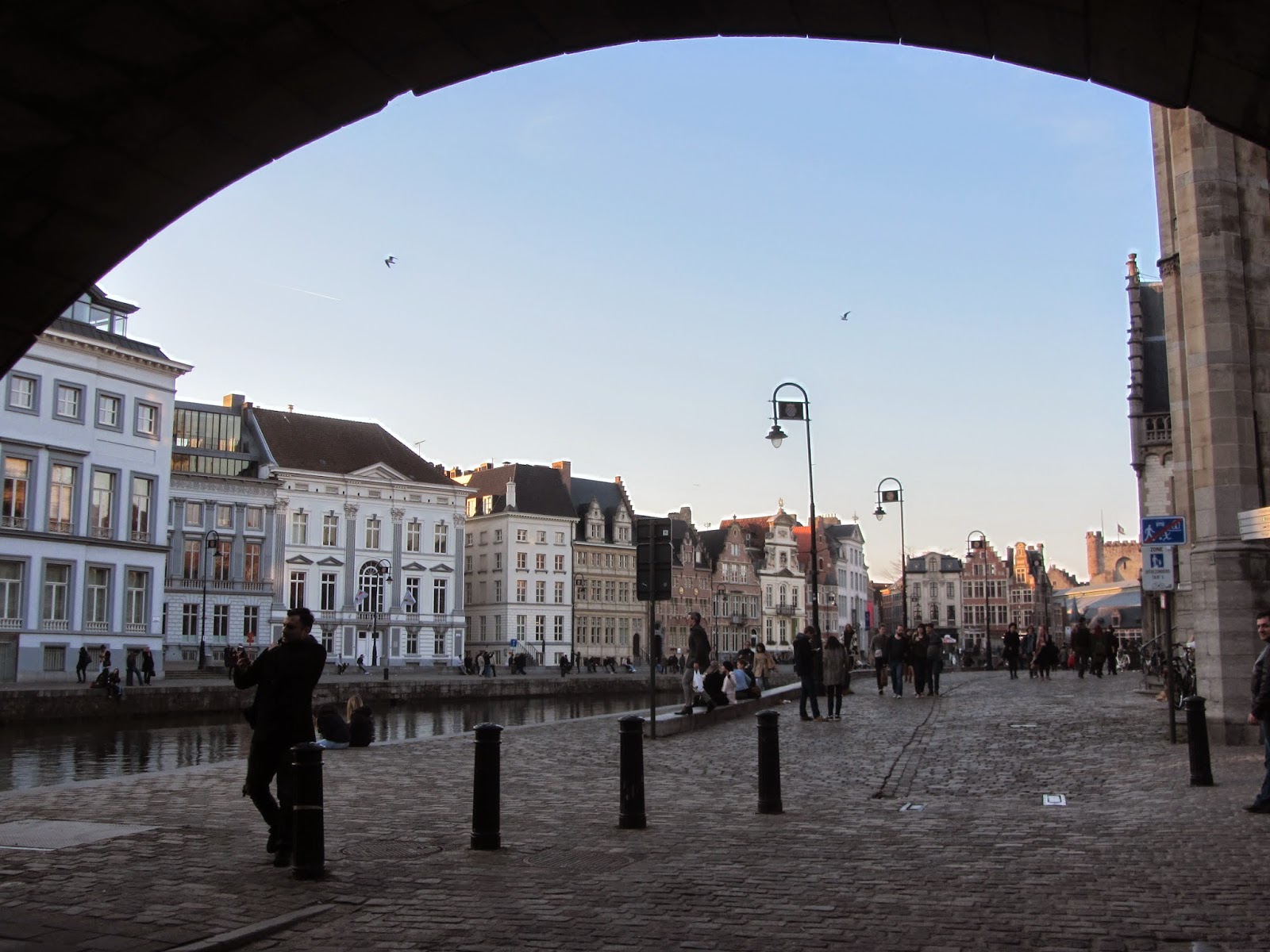
The old town proper started with the palace of justice and the public square in front of. A golden barge emphasised the grandeur of the place and tempted me over the bridge.


There were lots of bridges and I spent the next half an hour or so crossing lots of them as the middle of a bridge is the best place to get views like this, a view with two more bridges in it.

The city was lively on both banks. There were plenty of cafes, bars and restaurants, all of which looked busy. There were also seats and steps where people congregated to meet and drink the many cans they had brought.


Just in from one of the main waterways was Korenmarkt (Corm Market, obviously), a large square filled with restaurants. I chose a bistro that had a spare seat inside (it was moving from chilly to cold). It looked like a bit old fashioned but appearances were deceptive and the excellent food was presented in the style of a gasto pub.

When I came out after my meal the sun had all but given up for the day and could only reach the top of the buildings.


The gloom was no excuse for ending the exploration and I continued my wanderings around the centre of the city safe in the knowledge that I would have plenty of time to come back over the next three days if I found something that needed sunlight to be properly appreciated.

I was following an interesting road through the largely car-free centre when a lot of lights suddenly sprung on to highlight the back of the town hall. I learned later that Ghent made a feature of subtle lighting.

Walking around to the square in front of the town hall I discovered this amazing pavillion.


The futuristic wooden roof was a refreshing contrast to the traditional brick and stone buildings around it. Not only did it look great but it had wonderful acoustic properties that amplified the efforts of a busker at one end. I was tempted to shout to test the acoustics myself and it was only the fact that nobody else fell into this temptation that stopped me.

It was a fitting place to end my exploration and from there I walked the 2km or so south back to my hotel.

The first day in Ghent had delivered much and promised more.

31 October 2014

Passing through Montpellier on the way from Narbonne to Paris

My original plan was to stay in Montpellier for a couple of days but the lack of hotels on the required dates scorched that idea so I moved to Plan B which was to spend more time in Narbonne and do a quick tour of Montpellier on my way to Paris and then on to London.

I had booked a fairly late eurostar train out of Paris (20:13) to give me as much sight-seeing time on my final day and so I took the earliest practicable train out of Narbonne having first had breakfast in the fine cafe at the station.


Montpellier provided a grand welcome with a stunning modern station.

I failed to find a tourist information office there but I had come prepared with a maps of the city saved on my iPad the night before, another reason for insisting on hotels with wifi.

The station was just to the south of the old town and that is where I headed.


Just up the road from the station I found Place de la Comédie which immediately impressed with its size and grandeur. I learned soon after that it was the largest square in Europe, or something like that. This fact came from the tourist information office at the east end of the square which also provided me with a map.

With a tourist map I soon had a plan for the rest of my day in Montpellier.


My tour started with a stroll north through the park running north of the square and in that park I was delighted to see this playground that looks as though it was inspired by somebody with a child-friendly imagination like Dr Seuss.


There was more fun at the end of the park with a series of colourful and unusual statues. This was after I had walked past opera house and before I walked to the unexpected escarpment at the end with its views north across the newer parts of Montpellier.

But it was not the new Montpellier that I was interested so I turned west through the top of the old town looking for some of the things that my tourist map suggested that I should look at. I was starting to feel like Michael Portillo clutching his Bradshaw's, except that I was doing all of my journey by train.


Going down the hill took me back in time to the old heart of the city. This was something of a shock, a very happy one, after the beautiful baroque on the south side of the old town the north side was basic almost to the extent of being grim. I like basic and grim too.

The old town behaved like old towns should with roads that refused to run straight as they made their way around and over the hill.


Turning south brought me back toward the centre of the old town where things started to get smarter and posher though not necessarily better. At least the older part of the town had almost no traffic.

I had to settle for the traffic though as I could not find a cafe until I reached the brow of the hill. At least the cafe was by a nice square.


Montpellier kept being pretty as I walked south down the hill. The roads were no less straight as they crawled from square to square, each of which was thick with cafes, restaurants and people.

There was lots to see along the way from old buildings to an old moped in a shop window. I paused many times to soak up the atmosphere and savour the urban scenery. I was really enjoying my time in Montpellier and had already decided to try and stop there for longer the next time that I was passing through.


Given the limited time that I had to see the city my first priority was to walk around as much of it as was possible (I had my suitcase with me as I was between trains) and I spent less time than usual on taking photos and on coffees. I would have plenty of time for a coffee and some food on the next train.

Of course I did take a few photographs, around fifty, of the prettier things that I saw, things like this ornate door and balcony.


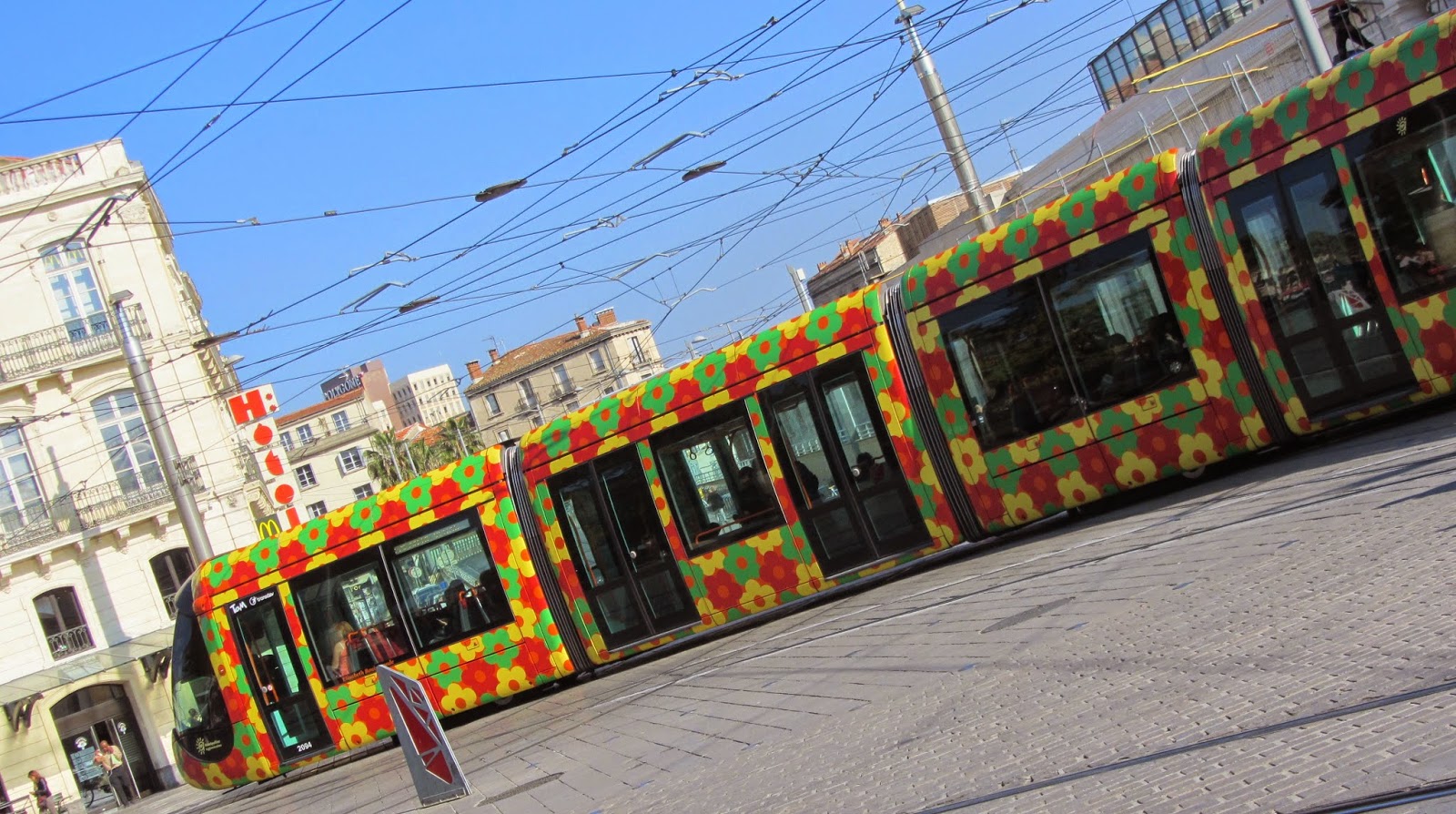
The prettiest things that I saw where the trams.

These were not allowed in the centre of the old town but seemed content to skirt around it. They were all heavily decorated and very colourful. This one was turning slowly in the square outside of the station. It was just a shame that I had no excuse to go on one. Next time.

The rest of the day was good but uneventful. I bought something to eat at the station, the train to Paris was on time, I met some friends there for a drink, and the eurostar was as simple as always.

Montpellier was forced to play just a bit-part in my holiday but it grabbed that limited opportunity to show me that it is exactly the sort of place that I like to go to on holiday and that I should make more of an effort to do so next time.

Montpellier is a very pretty town and the trams make it even prettier


30 October 2014

Narbonne Day Four took me out to the seaside at Port-la-Nouvelle

One my fourth and final day based at Narbonne I decided to head for the seaside at Port-la-Nouvelle, because that is where the railway line went.

Once upon a time Narbonne was on the coast and it owed its wealth and purpose to its port. Then the river got curmudgeonly and moved a few kilometres to the east and the port moved to Port-la-Nouvelle, i.e. new port.


I was looking forward to the short rail journey as on my previous journeys along that route to/from Barcelona I had enjoyed the scenery and I was not disappointed this time either. The line skirted with water all the way a lot of which was managed wetlands of artificial lakes and shallow rectangular bays which I presumed where there to harvest salt.

There were flamingos too.


Port-la-Nouvelle made Narbonne look large and busy. The station was little more than a halt and the station cafe that I assumed would be there was not to be found.

Walking the 300m or so in to town was like being on the set of 28 Days Later. I saw nobody else. This was a Thursday morning on a fine day and nobody was around.

There were a few faces once I got in to the centre of the town where a few shops were clustered for safety. Several of the cafes were closed which suggested that this was a tourist resort and I had arrived out of season. I did find a cafe that was open and managed to get a coffee but they had no croissants and even a trip to the local supermarket failed to produce any.

My breakfast plans were rescued by another supermarket further down the road and I sat down by the harbour to eat it.


The west end of the harbour, especially the south side, was mostly given over to pleasure boats and these were a pretty backdrop to my breakfast and the start of my walk.


Walking east towards the sea and the harbour quickly turned to industry. I stopped and watched one boat being loaded with what looked like coal by a crane with a Clam Shell Bucket. It looked like a very slow process and I wondered why they were not using some sort of belt.

The town (south) side of the harbour got quieter too and my expectations of finding somewhere nice to have lunch were beginning to erode, There were no more shops either.


At the end of the harbour there was a breakwater crowned with a lighthouse to stop ships running in to it. I was half tempted to walk out along it but only half as I was not sure that the view back would be worth walking all the way out to the end and then back again.


Looking the way there was a long sandy beach that looked strangely deserted given the warm weather. I am sure that Weymouth beach would have been much busier than this on an equivalent day.

I walked along the beach, south, a little way before heading to the line of buildings on the right of the picture. I was hoping to find a restaurant there. Not only did I find one but it was good and busy. It felt rather weird after an hour or so with seeing hardly anybody to suddenly find so many people all in one place and lively people too.


Judging by their familiarity with the staff I guessed that all the other people in the restaurant were all locals. They were certainly more interested in their food than in the view which enabled me to claim on of the seats outside facing the beach.

I had a relaxing light lunch with a drink and consulted my map. Port-la-Nouvelle was almost exactly rectangular and I has walked all along one of the long sides (north) and most of the way down a short side (east). That meant that the only sensible option open to me was to head west back towards the town centre.


The south-east quarter of Port-la-Nouvelle seemed to be devoted to holiday homes, though some were clearly occupied in October. These houses were arranged in strangely curved roads that seemed devoid of names so it was easy to get lost. Which I did more than once.

Helping me to get my bearings again were two artificial lakes that it was hard to miss, though I almost did. The lakeside properties looked nice enough though out of season the area was disturbingly quiet.


Port-la-Nouvelle was defined by water from the salt beds to the harbour to the sea to the lakes to the canals and ditches. In the absence of any notable buildings I used the water as my guide moving from one blue mark on the map to another.

There was not much else to see apart from a couple of holiday parks that confirmed the purpose of this part of the town.


Returning to the town I found it as quiet as it was when I left it. Still, there is nothing wrong with peace and I wanted variety on this holiday.

Knowing there was little or no hope of finding a restaurant open in the town, much less one that catered for vegetarians, I trekked back to the station, took a train back to Narbonne and went to the fresh food restaurant that I had been to on Tuesday, which I was relieved to find open after the disappointment the previous day.

I am not quite sure what I expected from Port-la-Nouvelle but with its harbour, beach and lakes it offered me a fine walk through different and interesting zones. My last full day on holiday did all that I could have asked for it, as had all the others.