Our first day in Marrakech proved to be a busy one.
Our hotel was a little way from the city centre, about 1km, so we were taken on the coach to the fringes where our long walk started.
Inside the medina walls felt very different from the other medinas I had been too (Casablanca, Rabat and Tunis) in that it was very open. It felt much like any other town and it just happened to have an old wall around it.
The feeling of openness was encouraged by the various parks and gardens that we saw on our short ride.
Just inside the wall was some of very old Marrakech. This is Koutoubia Mosque. It is the largest mosque in Marrakech but its main point of interest is that it dates from the 12th century. This is on the edge of one of the parks and the approach to it walking through the park built the sense of anticipation and excitement.
Marrakech is pink.
Apparently it is some sort of diktat but whatever the reason it give the town a distinctive feel. Much like all the sand coloured buildings in Dubai do.
It looked busy and worn, like a vibrant old town should. There were people out shopping, shop keepers sitting half in and half out of their shops and a fleet of small vehicles providing them with goods to sell.
We were led along a couple of streets to a palace. The name escapes me, but that does not matter. The point is that in a town that looked a little worn in places there were places where beauty was allowed to flourish.
The design and features were similar to other buildings that I had seen decorated with intricate plaster and coloured ceramics so to ring the changes slightly I've chosen a picture of some patterned wood. This was also a feature of the other grand buildings that I had seen but it was often hidden on high ceilings in dark rooms and so did not photograph very well (I refuse to use flash as it destroys the colour).
Back outside it was getting hotter but it was still very pink. As always I found myself taking lots of pictures and my daily total reached almost 250. That's how good Marrakech was.
The next place we were taken was a small mausoleum.
The arrangement of the graves was according to set rules with only direct members of the family included in the mausoleum itself, that meant daughters but not wives, and outside were the rest of the family and also the most important servants. People like Bruce Wayne's Alfred.
The graves were essentially flat and some had a raised block with the height of the block indicating the importance of the person buried beneath.
There was also a cat and while I usually avoid animals as much as I avoid people I took a picture of this one because I liked the contrast of the square-patterned graves and the dishevelled white ball of the cat.
We were next treated to our first Intense Retail Experience (IRE) of the holiday. We coined the term IRE on our China holiday to describe the frequent attempt to sell us things often disguised as a visit to something cultural.
We were taken to a shops selling goods derived from local plants, e.g. cooking oils, face creams, tea and herbal remedies. A lively and effective salesman gave a good explanation of each item and was rewarded with some good sales afterwards.
Then it was back to the hotel for lunch. We were left to our own devices for this and I went to the pool bar in the even grander hotel that shared the site.
We regrouped later in the day to go back to the medina and we started with another IRE. This time is was carpets.
The show was less impressive in that we were not given much information about the different techniques or styles. Instead we had different rugs thrown before us at an extraordinary pace.
One couple had gone to Morocco with the intention of buying a rug and they were the only people to so so. Luckily it was a short stop and we were soon back on the street.
We were led to the main square in the old town that was getting livelier as the sun set on a hot day.
In addition to all the stalls that we had seen elsewhere in the medina there were also lots of entertainers (using that term in its widest sense) there to entice coins from the many visitors and tourists. There were jugglers, fire-eaters, henna tattooists, people in regional costume and people with monkeys. I had to be careful when taking photographs not to include an entertainer otherwise payment would have been demanded.
The square was ringed with bars on the upper level and we were advised by our guide to go up there to get a fuller view of the square.
The rules were you had to buy a drink on the way in and they did not do beer so I found myself on the terrace with a bottle of Fanta. A first for me.
Most of the people on the terrace with me seemed to be foreigners too but the square was mostly filled with locals doing what they had done for centuries.
The atmosphere was lively and expectant. After a quite afternoon in the hot sun the locals were getting ready for a long evening, we were told by one person that the main events would be happening around 10pm, but we had to move on.
Like the China holiday, we were taken to a large local restaurant that only had tourists in and clearly did not expect anybody else. As with most meals on the tour the vegetarian option was unimaginative but the meal was good enough and the local musicians were not too distracting. The belly-dancer was distracting, as she was meant to be, as she moved around the room pausing to do a little turn for each group. I have no idea how genuine it was but it did liven up a quiet evening that I would rather have spent in a bar/cafe in the square.
Even with the siesta in the hotel and a couple of retail sessions, we had done and seen a lot that day and Marrakech started to feel like a friend.
11 October 2013
10 October 2013
From Rabat to Marrakech via Casablanca
This was another day of travelling, this time down from Rabat to Marrakech which was to be our base for the next few days. This meant passing through Casablanca and we could not do that without pausing to see The Hassan II Mosque which is staggering.
I thought that it was staggering when I visited it in 2007 and I thought so again in 2013.
The mosque impresses in several ways.
The setting is magnificent. It sits next to the sea, and is partially built over it, and has a large square in front of. This absence of anything else near it emphasises its scale.
The headline figures is that it can accommodate 20,000 men inside on the ground floor and 5,000 women on the raised level. Another 80,000 can fit in the square outside.
For once I've deliberately included people in some of the pictures so show its size. It kept reminding me of the enormous buildings drawn by Philippe Druillet in his fantastic stories like Urm the Mad.
The building works just as well on the small scale too and meticulous attention was paid to the detail throughout. Everywhere is spectacularly pretty as well as spectacularly large.
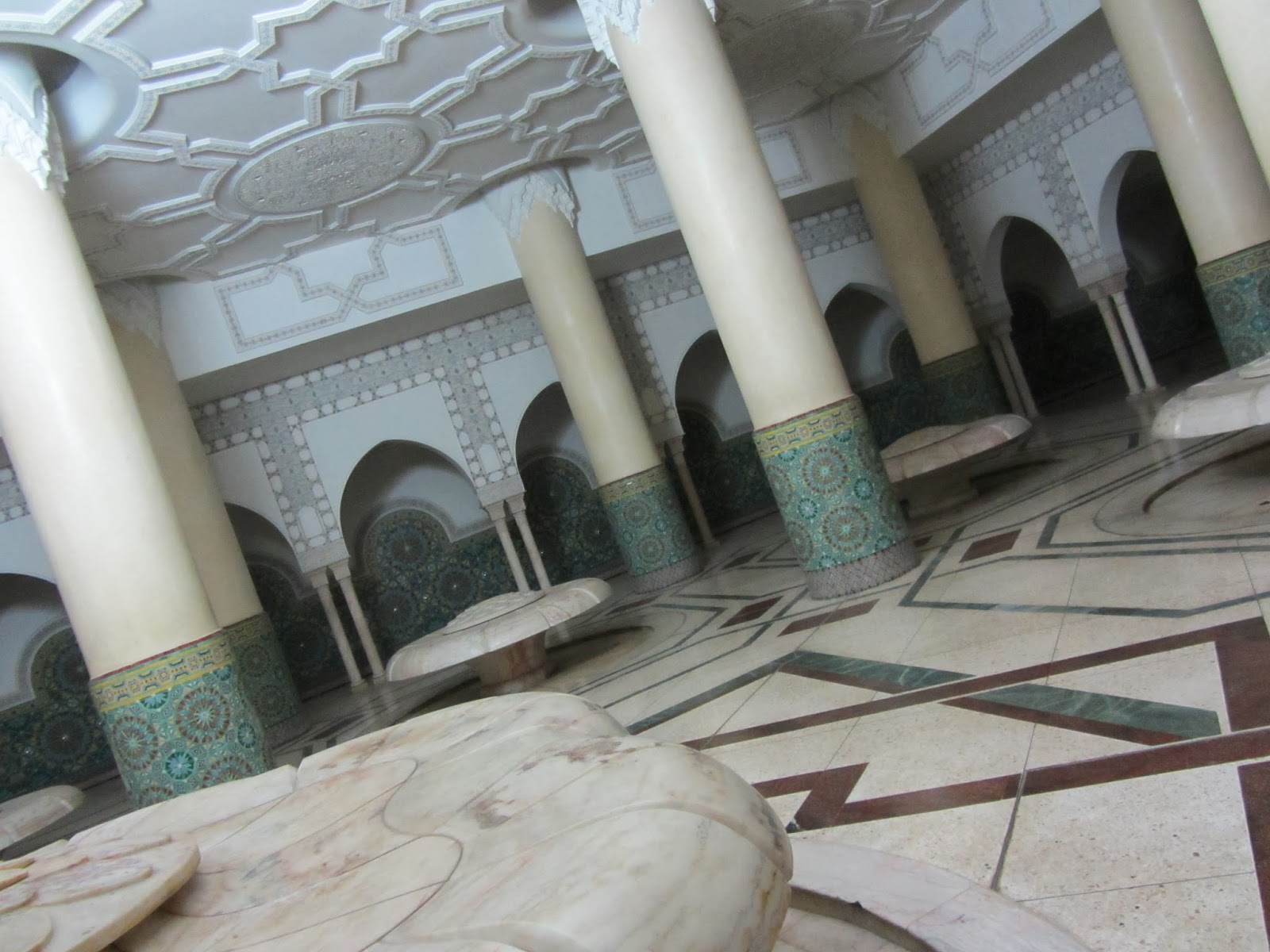
The second main space is the wash room situated below the central hall. It has rows of mushrooms where worshippers can prepare by washing their arms and faces.
Even in this functional space the decoration is grand from floor to ceiling.
The external space is just as grand and just as pretty. The grandeur or the mosque grabs you first and as you get closer the detail becomes more obvious and more impressive.
For example, beneath the large arch on the left you can see a green line on the ground. This is a fountain. Or rather a collection of small fountains in a geometric pattern. It the sort of fountain that if placed by itself in the centre of a town would attract much admiration and would have hordes of tourists taking pictures of themselves in front of it. Here it is so swamped by the building next to it that it could be overlooked completely.
The minaret is the focal point and easily lives up to its starring role with oodles of intricate decorative plaster and geometric ceramics. It is gorgeous and that is my excuse for taking about twenty very similar pictures of it!
Having feasted on the beauty of the mosque it was time to move on. We had made the relatively short trip from Rabat to Casablanca (just under 100km) by coach and we returned to the train for the leg to Marrakech (about 250km).
The route took us away from the coast for the first time and that meant a remarkable change to the landscape. We were also moving that much further south. We were not in the desert, that is on the other side of the mountains, but it looked much like one for most of the time.
Morocco's main industry is agriculture and this is fed by the many rivers flowing off the mountings (snow-melt provides water all summer) with olives and the like growing in the drier parts.
We stopped a few times, mostly at little stations like this. Unfortunately I had no idea of the timetable so was cautious of venturing too far away from the door to take photos. This was not a place I wanted to be stranded in.
The journey was hot and the train's air conditioning struggled to reduce the temperature in the compartment to anything bearable. Luckily there were some options and I spent quite a bit of time either in the corridor which had something of a breeze because of the train's movement and also some time by an open door (when moving!) where there was even more of a breeze.
The discomfort of the travel was more than compensated for by the views. The desert scene may have lacked much of specific interest but its contrast with what I was used to was great and that was enough interest of itself.
The ride was some four hours long and we arrived in Marrakech as the sun was setting, as we tended to on the holiday (that's good planning). There was just enough time for a good dinner in hotel and a walk through its extensive grounds before settling down for a good rest in anticipation of seeing the heart of the city the next day.
The main point of the day was to get us to Marrakech, which we did, and we had the considerable bonus of a couple of hours in Casablanca and an interesting, if warm, train ride.
I thought that it was staggering when I visited it in 2007 and I thought so again in 2013.
The mosque impresses in several ways.
The setting is magnificent. It sits next to the sea, and is partially built over it, and has a large square in front of. This absence of anything else near it emphasises its scale.
The headline figures is that it can accommodate 20,000 men inside on the ground floor and 5,000 women on the raised level. Another 80,000 can fit in the square outside.
For once I've deliberately included people in some of the pictures so show its size. It kept reminding me of the enormous buildings drawn by Philippe Druillet in his fantastic stories like Urm the Mad.
The building works just as well on the small scale too and meticulous attention was paid to the detail throughout. Everywhere is spectacularly pretty as well as spectacularly large.
The second main space is the wash room situated below the central hall. It has rows of mushrooms where worshippers can prepare by washing their arms and faces.
Even in this functional space the decoration is grand from floor to ceiling.
The external space is just as grand and just as pretty. The grandeur or the mosque grabs you first and as you get closer the detail becomes more obvious and more impressive.
For example, beneath the large arch on the left you can see a green line on the ground. This is a fountain. Or rather a collection of small fountains in a geometric pattern. It the sort of fountain that if placed by itself in the centre of a town would attract much admiration and would have hordes of tourists taking pictures of themselves in front of it. Here it is so swamped by the building next to it that it could be overlooked completely.
The minaret is the focal point and easily lives up to its starring role with oodles of intricate decorative plaster and geometric ceramics. It is gorgeous and that is my excuse for taking about twenty very similar pictures of it!
Having feasted on the beauty of the mosque it was time to move on. We had made the relatively short trip from Rabat to Casablanca (just under 100km) by coach and we returned to the train for the leg to Marrakech (about 250km).
The route took us away from the coast for the first time and that meant a remarkable change to the landscape. We were also moving that much further south. We were not in the desert, that is on the other side of the mountains, but it looked much like one for most of the time.
Morocco's main industry is agriculture and this is fed by the many rivers flowing off the mountings (snow-melt provides water all summer) with olives and the like growing in the drier parts.
We stopped a few times, mostly at little stations like this. Unfortunately I had no idea of the timetable so was cautious of venturing too far away from the door to take photos. This was not a place I wanted to be stranded in.
The journey was hot and the train's air conditioning struggled to reduce the temperature in the compartment to anything bearable. Luckily there were some options and I spent quite a bit of time either in the corridor which had something of a breeze because of the train's movement and also some time by an open door (when moving!) where there was even more of a breeze.
The discomfort of the travel was more than compensated for by the views. The desert scene may have lacked much of specific interest but its contrast with what I was used to was great and that was enough interest of itself.
The ride was some four hours long and we arrived in Marrakech as the sun was setting, as we tended to on the holiday (that's good planning). There was just enough time for a good dinner in hotel and a walk through its extensive grounds before settling down for a good rest in anticipation of seeing the heart of the city the next day.
The main point of the day was to get us to Marrakech, which we did, and we had the considerable bonus of a couple of hours in Casablanca and an interesting, if warm, train ride.
More stories like this:
casablanca,
grj2013,
morocco,
train,
travel
09 October 2013
DC Comics Digital Sneak Peeks: 9 October 2013
I am not convinced by the Willy Wonka figure in the foreground but the steam punk machine attacking him is wonderful and that's enough to get this cover included in my weekly selection.
Just to be contrary, having decried the central figure in the first cover I have then picked this cover because it has one. There is more to this picture than a confident Catwoman though, there are nice things like her long curving whip, the Batman shadow and the airships. I like the colouring too.
Rabat monuments, medina and casbah
As with Seville, we were only in Rabat for a day and that was a busy day with a guided tour in the morning and free time in the afternoon which included revising some of the places seen in the morning.
We started with a mausoleum close to the hotel, but we took a coach anyway. There were guards there that we could take photos of though we were warned that we could not generally take pictures of uniformed people or of royal places. This was confirmed a few days later when I tries to do so.
The early start worked well as there were many coaches there when we left and it became harder to take a picture of anything without a inappropriately colourful tourist in it.
As you would expect, the mausoleum was highly decorated though it is fair to say that a lot of places were, even in the medina (old town) that we visited later.
Next to the mausoleum were the remains of a mosque that was never completed.
I missed the story why, not that interested to be honest, but it may have been related to the many political changes that have seen Morocco's capital move a few times over the centuries.
The mostly completed minaret is the more impressive for being on its own apart from a few stubs of incomplete pillars.
From there we went to a royal palace, all the major cities have one for the king to live in when staying there. The only remarkable feature of the palace was that we were allowed to photograph it, which I did, but it is not a very grand building when seen from outside so I've not included it.
From there we were taken to the casbah (fortified area) where after a short stroll we were invited to pause for a drink, that meant mint tea. I chose to carry on exploring.
Like the old town, we came to that later, the streets were narrow and windy. Blue was the colour of choice, or regulation, and that gave a cosy uniformity to the area.
The walls around the casbah were suitably thick, tall and castellated. The casbah's other defence was the steep cliff up from the river that formed one boundary.
Then it was time for lunch and we were coached to the new town. I did not fancy much food but I did fancy some local money so I went off to find a bank and a cafe, in that order. That plan worked well and I had time for a little explore before rejoining the rest of the group. I had spotted a little park just off the main street so that is where I went.
It was lovely. Obviously sun is the main problem with being outside and so the ark had many trees to provide shade and lots of seats to take advantage of it. There were also lots of paths through the gardens giving lots of options for promenading through it. I had a group to rejoin so I took the safe option and went in and out of the park more-or-less the same way.
One nice surprise in the garden was the models of wild animals; I think that this was meant to be a leopard.
Our guide asked us if we wanted to go back to the hotel or go for a short walk and unsurprisingly we all opted for the walk.
This took us straight through the medina, which was exactly the sort of thing that I had gone to Morocco to see. I had been to medinas in Casablanca and Tunis and knew how exciting and different they could be.
These pictures tell only part of the story, they show the narrow path, the rough buildings and the people but they cannot show the bustle, movement and vitality.
This is not a place that you can walk slowly, or even moderately, without causing a jam and forcing people to squeeze past you. And then there are the carts and motorcycles to content with.
The main streets were lined with small shops selling everything from batteries to beds.
The narrow width of the streets and the presence of people in the front of the shops meant that it was difficult to take a discrete picture. Apparently it is alright to take photos of people if you ask for their permission first but that still felt too much like intrusion to me. Besides, I prefer to take photographs of things.
The walk through the media took us back to the casbah where our coach was one again waiting for us.
It was early afternoon, hot and siesta time so the coach took us back to our hotel where I used some of the rest time to head up to the roof bar, not for a drink but of the view. Rabat is at the mouth of river and our hotel was next to it.
I chose this picture both to show the general lay of the land and also to show the modern bridge and tram. I may have gone to Morocco to see mostly old things but I do not want to give the (unfair) impression that it is all decrepit and poor.
Looking the other way, towards the sea, showed a tired river struggling to fill the shallow valley it has created over millennia.
On the far bank new flats had colonised the beach while on the nearside the old town had what looks like a theatre of some sort that somebody had decided was the ideal place to dry their washing. In the quiet river in the middle a few small fishing boats patiently waited for their call to work.
Having taken a short rest I headed back in to the medina. There were several gates in the wall, mostly for pedestrians only, and I took one not too close to the small fire that was sending clouds of smoke over the wall.
My afternoon there had comforted me that the design was not that complicated and, if all else failed, I should be able to find my way to the main route through the centre and so I went for a fairly random stroll turning in to any street that looked more interesting than the one I was on. It worked and after an interesting exploration I exited through a gate that was close to the hotel.
As with the day I had in Seville two days earlier, I had packed a lot in to my one day in Rabat, had seen all the places the guide thought that I needed to see and was pleased with what I discovered in my free time.
We started with a mausoleum close to the hotel, but we took a coach anyway. There were guards there that we could take photos of though we were warned that we could not generally take pictures of uniformed people or of royal places. This was confirmed a few days later when I tries to do so.
The early start worked well as there were many coaches there when we left and it became harder to take a picture of anything without a inappropriately colourful tourist in it.
As you would expect, the mausoleum was highly decorated though it is fair to say that a lot of places were, even in the medina (old town) that we visited later.
Next to the mausoleum were the remains of a mosque that was never completed.
I missed the story why, not that interested to be honest, but it may have been related to the many political changes that have seen Morocco's capital move a few times over the centuries.
The mostly completed minaret is the more impressive for being on its own apart from a few stubs of incomplete pillars.
From there we went to a royal palace, all the major cities have one for the king to live in when staying there. The only remarkable feature of the palace was that we were allowed to photograph it, which I did, but it is not a very grand building when seen from outside so I've not included it.
From there we were taken to the casbah (fortified area) where after a short stroll we were invited to pause for a drink, that meant mint tea. I chose to carry on exploring.
Like the old town, we came to that later, the streets were narrow and windy. Blue was the colour of choice, or regulation, and that gave a cosy uniformity to the area.
The walls around the casbah were suitably thick, tall and castellated. The casbah's other defence was the steep cliff up from the river that formed one boundary.
Then it was time for lunch and we were coached to the new town. I did not fancy much food but I did fancy some local money so I went off to find a bank and a cafe, in that order. That plan worked well and I had time for a little explore before rejoining the rest of the group. I had spotted a little park just off the main street so that is where I went.
It was lovely. Obviously sun is the main problem with being outside and so the ark had many trees to provide shade and lots of seats to take advantage of it. There were also lots of paths through the gardens giving lots of options for promenading through it. I had a group to rejoin so I took the safe option and went in and out of the park more-or-less the same way.
One nice surprise in the garden was the models of wild animals; I think that this was meant to be a leopard.
Our guide asked us if we wanted to go back to the hotel or go for a short walk and unsurprisingly we all opted for the walk.
This took us straight through the medina, which was exactly the sort of thing that I had gone to Morocco to see. I had been to medinas in Casablanca and Tunis and knew how exciting and different they could be.
These pictures tell only part of the story, they show the narrow path, the rough buildings and the people but they cannot show the bustle, movement and vitality.
This is not a place that you can walk slowly, or even moderately, without causing a jam and forcing people to squeeze past you. And then there are the carts and motorcycles to content with.
The main streets were lined with small shops selling everything from batteries to beds.
The narrow width of the streets and the presence of people in the front of the shops meant that it was difficult to take a discrete picture. Apparently it is alright to take photos of people if you ask for their permission first but that still felt too much like intrusion to me. Besides, I prefer to take photographs of things.
The walk through the media took us back to the casbah where our coach was one again waiting for us.
It was early afternoon, hot and siesta time so the coach took us back to our hotel where I used some of the rest time to head up to the roof bar, not for a drink but of the view. Rabat is at the mouth of river and our hotel was next to it.
I chose this picture both to show the general lay of the land and also to show the modern bridge and tram. I may have gone to Morocco to see mostly old things but I do not want to give the (unfair) impression that it is all decrepit and poor.
Looking the other way, towards the sea, showed a tired river struggling to fill the shallow valley it has created over millennia.
On the far bank new flats had colonised the beach while on the nearside the old town had what looks like a theatre of some sort that somebody had decided was the ideal place to dry their washing. In the quiet river in the middle a few small fishing boats patiently waited for their call to work.
Having taken a short rest I headed back in to the medina. There were several gates in the wall, mostly for pedestrians only, and I took one not too close to the small fire that was sending clouds of smoke over the wall.
My afternoon there had comforted me that the design was not that complicated and, if all else failed, I should be able to find my way to the main route through the centre and so I went for a fairly random stroll turning in to any street that looked more interesting than the one I was on. It worked and after an interesting exploration I exited through a gate that was close to the hotel.
As with the day I had in Seville two days earlier, I had packed a lot in to my one day in Rabat, had seen all the places the guide thought that I needed to see and was pleased with what I discovered in my free time.
08 October 2013
From Seville to Rabat by coach, boat and train
After a day sight-seeing in Seville it was time to get back on the rails and head towards the heart of our holiday, Morocco.
This meant taking a ferry across the Mediterranean and that meant a coach ride to Terifa on the southern most tip of Spain. This still shows its heritage as a fortress town dependent on fishing and while there are some fishing boats left most of the craft are for pleasure or for the journey to Africa.
It takes just an hour to cross to Tangier and there were a few ferries moving in and out of the port. Ours was very busy and I suspect that most of them are.
The ferry was very much designed to get people, and vehicles, across the sea and not much effort had been made on the cruising aspect of boat journeys. There was only one small deck open to the outside and while this was full of passengers taking photos it also doubled as the smoking area.
The lack of a proper view did not matter much as we were soon out of sight of Europe and all we could see was the sea and the white turbulent mess that our boat was making of it.
Tangier was immediately different.
The heat was the same but the mixed building styles of Europe had been replaced by rectangular concrete blocks.
The area by the sea looked as though it had been improved recently with a clean wide promenade and a series of mid-rise blocks. It felt a little like Hove but with sunshine.
Along the beach were a series of bars, cafes and restaurants threatening late night discos and other such joys. Luckily this was lunchtime and all was quite. We went to one for a quick salad and a beer before heading to the station and our train to Rabat.
The train was delayed about half an hour and that gave me time to explore a little of the area around the station.
This was mostly more mid-rise blocks but this time they were due to become offices. There were a lot of new buildings going up so clearly something in the Moroccan economy was working. It was suggested later on the tour that this was the drug trade.
Our train was a little older and a little less comfortable that those we had become used to though that was to be expected and was part of the joy of the holiday.
We did not have reserved seating (that proved to be an issue at times) but were able to claim a number of the six-seater compartments in the first-class section.
It was quite hot by then, around 30c, and the air conditioning struggled to cope. It did just enough to make the journey bearable.
The glass could have been cleaner and that was a problem with trying to take photos through it. I managed a few, like the two below, which give some idea of the territory that we rolled through for a few hours.
The route followed the coast most of the way and at times we saw either the sea itself or evidence of its proximity, such as salt flats.
Most the time we rolled through dry undulating hills with regimented trees, mostly olives, and the occasional small settlement. We also saw quite a few cows, goats, sheep and donkeys either grazing or working.
There was also a vast amount of litter, largely plastic bags and bottles. The volume suggested that it had either been thrown out of trains or had accumulated next to the tracks for other reasons.
The route was largely single track and we had to wait a couple of times in passing places to allow other trains through. We were in no rush and the waits were an opportunity to open doors and get some much needed cooler air in.
We arrived in Rabat just as the sun set. Our evening meal was in the hotel, the Hotel Farah, and we ate immediately on arrival. The journey was interesting but all travel is tiring so after dinner we all retired to recover and prepare for the day of sight-seeing to come.
This meant taking a ferry across the Mediterranean and that meant a coach ride to Terifa on the southern most tip of Spain. This still shows its heritage as a fortress town dependent on fishing and while there are some fishing boats left most of the craft are for pleasure or for the journey to Africa.
It takes just an hour to cross to Tangier and there were a few ferries moving in and out of the port. Ours was very busy and I suspect that most of them are.
The ferry was very much designed to get people, and vehicles, across the sea and not much effort had been made on the cruising aspect of boat journeys. There was only one small deck open to the outside and while this was full of passengers taking photos it also doubled as the smoking area.
The lack of a proper view did not matter much as we were soon out of sight of Europe and all we could see was the sea and the white turbulent mess that our boat was making of it.
Tangier was immediately different.
The heat was the same but the mixed building styles of Europe had been replaced by rectangular concrete blocks.
The area by the sea looked as though it had been improved recently with a clean wide promenade and a series of mid-rise blocks. It felt a little like Hove but with sunshine.
Along the beach were a series of bars, cafes and restaurants threatening late night discos and other such joys. Luckily this was lunchtime and all was quite. We went to one for a quick salad and a beer before heading to the station and our train to Rabat.
The train was delayed about half an hour and that gave me time to explore a little of the area around the station.
This was mostly more mid-rise blocks but this time they were due to become offices. There were a lot of new buildings going up so clearly something in the Moroccan economy was working. It was suggested later on the tour that this was the drug trade.
Our train was a little older and a little less comfortable that those we had become used to though that was to be expected and was part of the joy of the holiday.
We did not have reserved seating (that proved to be an issue at times) but were able to claim a number of the six-seater compartments in the first-class section.
It was quite hot by then, around 30c, and the air conditioning struggled to cope. It did just enough to make the journey bearable.
The glass could have been cleaner and that was a problem with trying to take photos through it. I managed a few, like the two below, which give some idea of the territory that we rolled through for a few hours.
The route followed the coast most of the way and at times we saw either the sea itself or evidence of its proximity, such as salt flats.
Most the time we rolled through dry undulating hills with regimented trees, mostly olives, and the occasional small settlement. We also saw quite a few cows, goats, sheep and donkeys either grazing or working.
There was also a vast amount of litter, largely plastic bags and bottles. The volume suggested that it had either been thrown out of trains or had accumulated next to the tracks for other reasons.
The route was largely single track and we had to wait a couple of times in passing places to allow other trains through. We were in no rush and the waits were an opportunity to open doors and get some much needed cooler air in.
We arrived in Rabat just as the sun set. Our evening meal was in the hotel, the Hotel Farah, and we ate immediately on arrival. The journey was interesting but all travel is tiring so after dinner we all retired to recover and prepare for the day of sight-seeing to come.
Subscribe to:
Posts (Atom)