11 June 2010

LIKE 14 - Transliteracy

I went in to the LIKE meeting not knowing much at all about transliteracy but that did not matter as all it needed to be was a prompt for good conversations. And it was.

The formal definition we were given to play with was, "a unifying perspective on what it means to be literate in the 21st Century [including] the ability to read, write and interact across a range of platforms, tools and media from signing and orality through handwriting, print, TV, radio and film, to digital social networks". This definition comes from Professor Thomas and was given to us by Susie Andretta, our facilitator for the evening.

As usual, the conversations wandered wondrously and unpredictably around the topic with each participant nudging it a direction of interest to them or reacting to something that has been added to the mix.

My notes from the evening, also as usual, are a odd mix of things that struck me as we wandered through the evening. One of the reasons that I write these blogs is to allow me to reassess these notes for my own benefit and to give them some sort of structure. This is some of what I wrote, but not in the order in which I wrote it.

Transliteracy, i.e. being literate across many media, is a recently problem. Not that long ago people got all their information from one newspaper and the BBC.

When new media first arrived it was treated like old media; think about how your local library filed videos and tapes.

The literacy skills in the various media and both different and similar. For example, comprehension differs but authenticity is similar. I would like to see further research in to transliteracy explore these differences and similarities to help us all to understand which skills we can transfer and which new ones we need to learn.

While I understand the term transliteracy I am not sure whether it actually helps to use a new word that only a few academics understand. Perhaps something like multi-media literacy, or even just multiliteracy, would be more accessible.

I was pleasantly surprised to find myself quoted in a paper on transliteracy given at a conference of the International Federation of Library Associations and Institutions (IFLA).

With the arrival of the food and more drinks the conversations wandered even further off topic and my remaining notes are on KM chats on Twitter, Dulwich Picture Gallery and EHICs.

This was another very successful evening and I cannot overstress how useful I find LIKE meetings to my continual learning as a consultant, my intellectual stimulation as an, er, intellect, and my social interactions as a human being.

07 June 2010

Popping in to the Tate Modern

Working close to the Tate Modern is magic!

I loved the building when it was the disused Bankside Power Station and its sympathetic restoration has made it one of the jewels on the South Bank along with the Oxo Tower, National Theatre and South Bank Centre.

I have made the pilgrimage from London Bridge to Waterloo many times but it still excites me every time.

Even on a quick dash for a sarnie from the Rosie Tate Cafe (cheap, cheerful and recommended).

The building's impressive beauty comes from the indomitable dark brick, long sleek windows and the little touches of decoration that belie its strictly industrial heritage.

I want to live there.

On the longer lunch breaks I get to look inside too.

It's normally a quick visit to just one or two galleries. This quickness whets the appetite but does not completely satisfy so it's worth revisiting the same galleries a week or so later.

My usual destination is Level 3 and headlong in to modern paintings, such as the room filled with vast canvasses by Cy Twombly with loops and swirls of dripping red paint. Vision On meets Dexter.

I also like the monochrome (or mostly monochrome) paintings by the likes of Barnett Newman whose 1950 piece Eve is solid blood red (again!) with a sliver of burgundy down the right-hand side. Simple but gorgeous.

It can be easy to take London's treasures for granted at times, in a way that tourists don't, but when they are as close, accessible and rewarding as the Tate Modern then going there easily becomes a habit.

06 June 2010

Chces pivo?

I've been using the meetup website to try news things and meet new people so it's no surprise that I've used it to meet up with some Czech and Slovaks, or rather some people who like to talk in Czech and Slovak.

An added attraction was that the venue for their monthly drinks night is The Falcon next to Clapham Junction. Not only is this on the way home but, because of its convenient location, I've been there a few times before and liked the place.

The Falcon has, apparently, the longest continuous bar in England and it curves its way through a mix of areas that in olden days would have been public bars, lounge bars, a snug and a jug and bottle. There is space for every mood and everybody.

But what I like most about the place is the beer. It has the best selection is real ales that I can recall outside of a beer festival. Choosing one was very hard but in the end I went for the RCH Pitchfork and the Purity Pure Ubu. Both proved to be good choice but I do wish I had time to try some of the others too. Maybe next time.

And there is likely to be a next time as the meetup went well. There was one person that I knew there, which helped a little with the ice-breaking but the other half dozen or so people that I got to speak to were all new to me. As with the BCSA socials, there is no agenda, no plan and no rules; just a group of people with at least one common interest being in the same place at the same time. And it works.

As with most low-key socials, we spoke about nothing in particular and nothing of great import, though I do remember a discussion on family planning in West Africa.

All too soon the two hours that I allowed myself passed and it time to take the steps up to the station and the train home. But I think that I will be back there for more of the same next month.

05 June 2010

Billy Budd at Glyndebourne

Booking for the Glyndebourne Festival is a delicate matter of balancing friends' interests and availability and this year we are taking people to Macbeth, Don Giovanni and The Rake's Progress.

All very good but I wanted to see Billy Budd too so we decided to go on our own. This meant a slight deviation from the normal plans as, without company, there was no point in spending the whole afternoon there or in being too elaborate with the picnic. Instead the plan was to arrive there with just enough times for a Pimms before the start of the opera and, despite a bit of traffic trouble, the plan worked well.

Billy Budd was my third Benjamin Britten opera at Glyndebourne having seen The Turn of the Screw in 2007 and Albert Herring in 2008 so I had high expectations.

Billy Budd takes place entirely on board an English battleship HMS Indomitable during the French Revolutionary Wars in 1797.

The oppressive staging magnificently conveyed the darkness, crowding and brutality of life below decks and set the tone for the story perfectly.

Not surprisingly it's an all male cast and that works surprisingly well as it maintains the tension and drama.

There are several principle roles but it was the ensemble singing that I enjoyed the most. But all the singing was crystal clear, even from the cheap seats (£100 each!) at the back and the sur titles were largely redundant.

The plot is slight but moves along at a steady pace and there are some rich characters too so there is always something to grab your attention and the evening whizzed by in unseemly haste. It also ends in strangely positive mood despite Billy Budd's demise.

Billy Budd was a good example of all the things that Glyndebourne does consistently well with great staging, direction, singing and acting.

01 June 2010

Brompton Cemetery

I had only been to Brompton Cemetery once before, and that was as a short-cut from Earl's Court to Stamford Bridge around ten years ago, so it was long overdue a revisit. The excuse this time was the Arts Link Meetup Group who arranged a day of sketching, photography and general exploration.

Felling brave, I chose to cycle there and that worked pretty well with a large part of the journey being through Richmond Park and the few main roads that I had to use were quieter than usual thanks to it being a Bank Holiday weekend.

We met, around twenty of us, in a cafe where I refuelled with a late breakfast or early lunch of pitta bread with a pumpkin and chilli dip. It did the trick neatly.

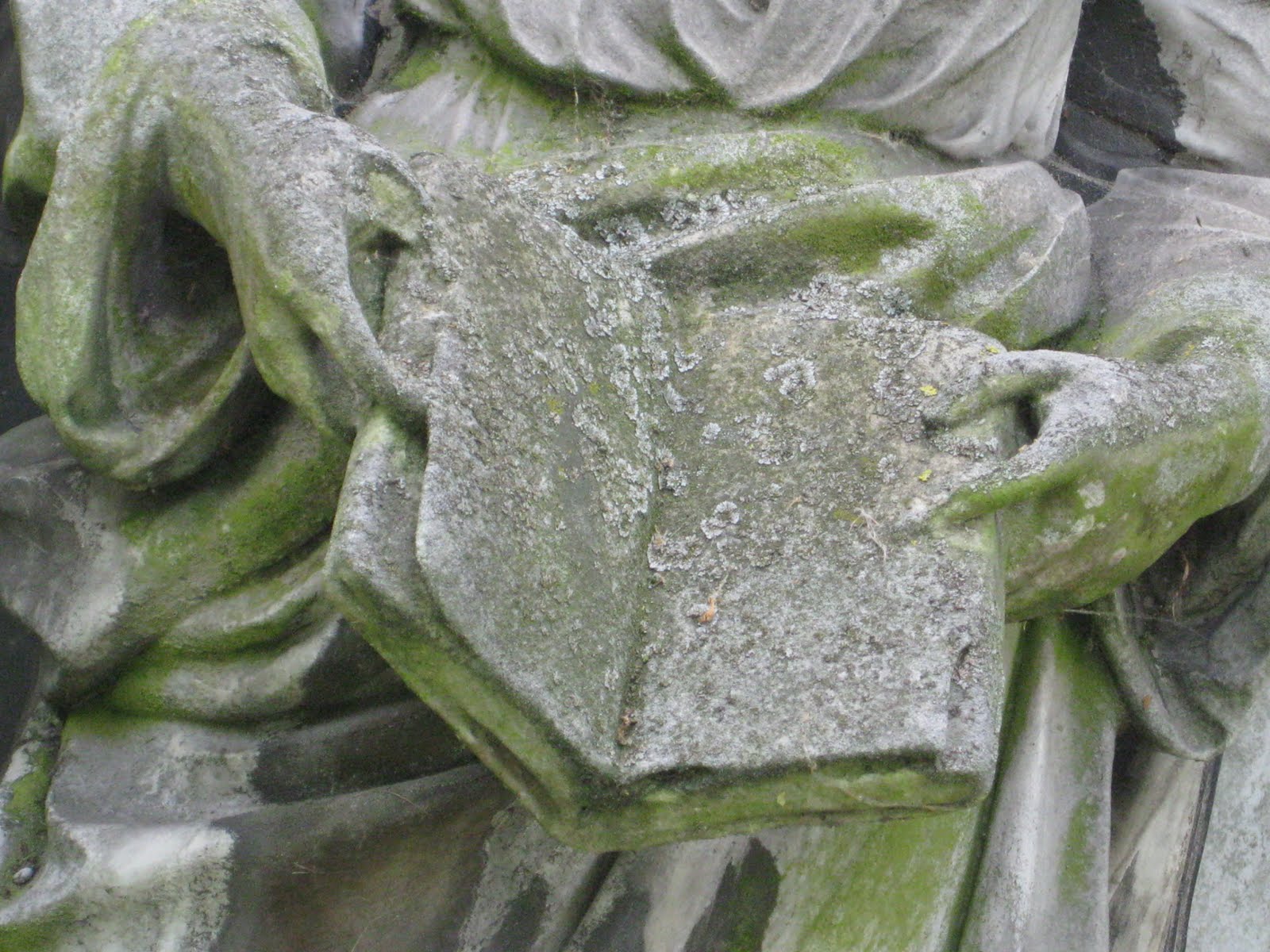
Apparently lots of famous people have been laid to rest in Brompton Cemetery but I'm not that interested in history or biographies. My reason for being there was the masonry.

A lot of this is the typical angels and it was impossible to get Dr Who out of my mind. I'm sure I blinked once or twice but I got away with it. This time.

The cemetery is tightly packed, reflecting the London around it, and has a nicely cluttered and unkempt feel to it. It helps that it is a Royal Park.

The long straight walk north to south through the centre of cemetery uncovers an eclectic mix of crosses, headstones, family mausoleums and statues ranging from a small bird to a preposterous lion. Walking slowly and carefully lets some of the subtle detail get noticed through the sea of grey stone swimming on a tide of long sharp grass and it's this detail that makes Brompton Cemetery so attractive.